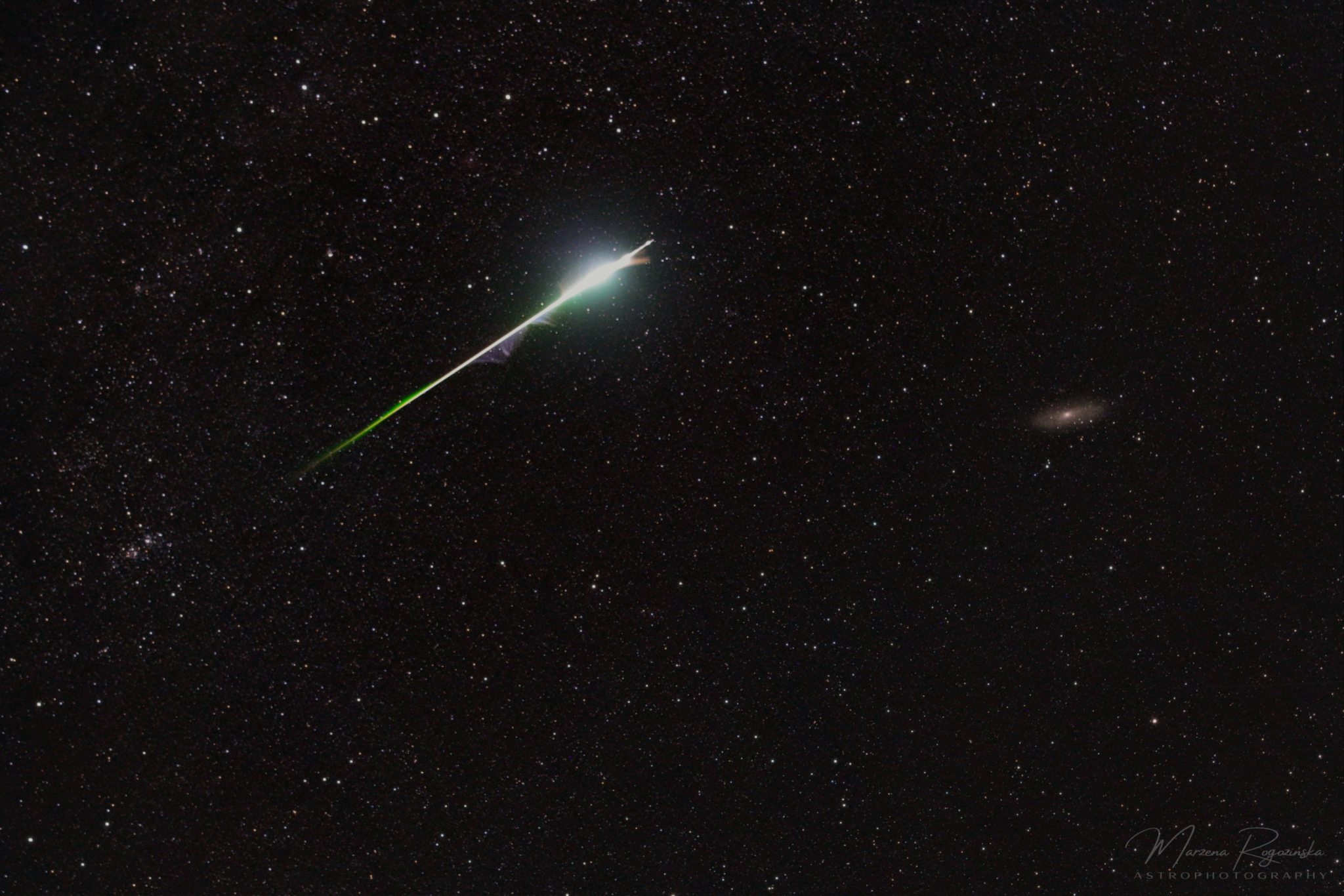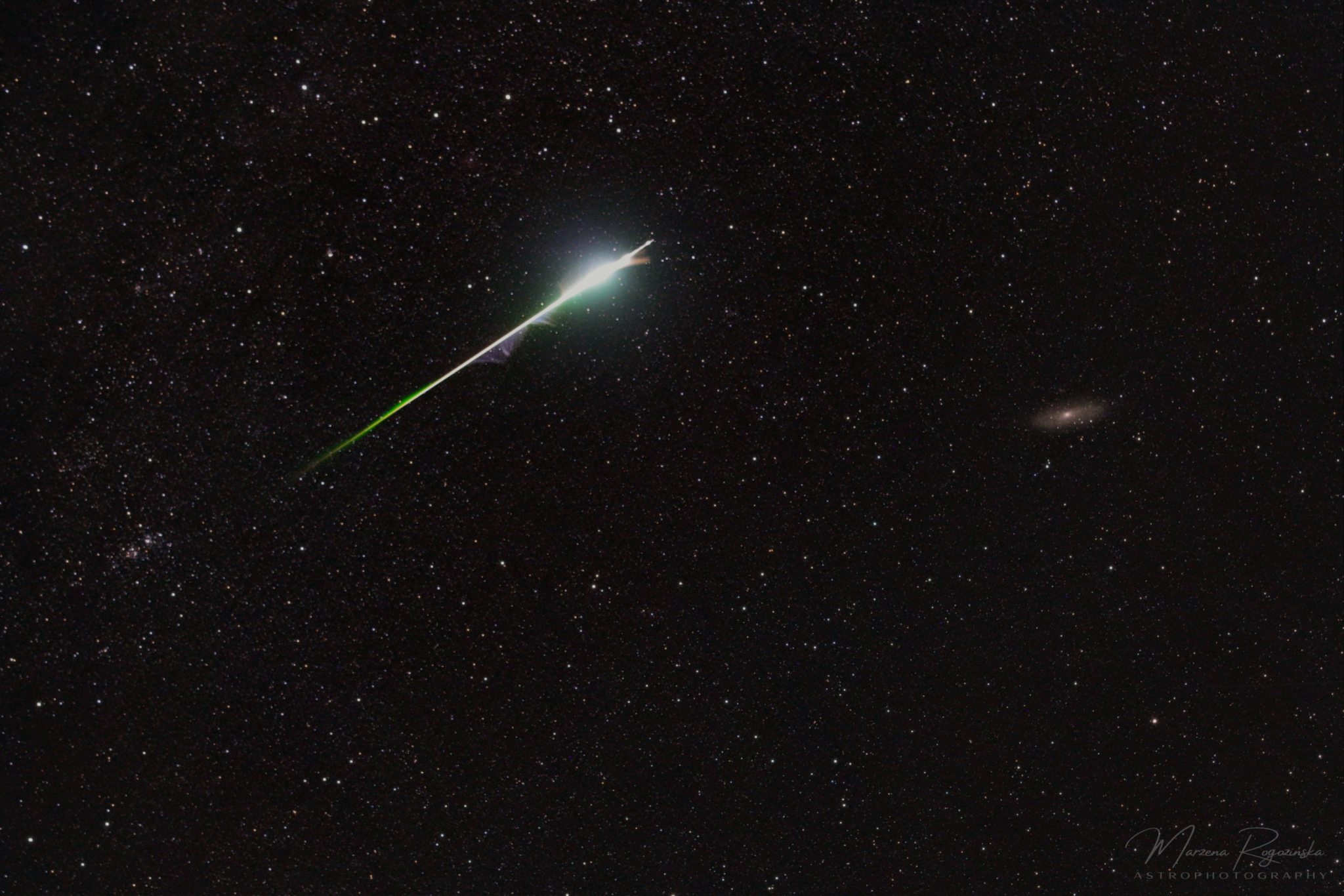
Stars in our own Milky Way Galaxy are scattered through this eye-catching field of view. From the early hours after midnight on August 13, the 30 second exposure of the night sky over Busko-Zdroj, Poland records the colorful and bright trail of a Perseid meteor. Seen near the peak of the annual Perseid meteor shower it flashes from lower left to upper right. The hurtling grain of cosmic sand, a piece of dust from periodic comet Swift-Tuttle, vaporized as it passed through planet Earth's atmosphere at almost 60 kilometers per second. Just above and right of center, well beyond the stars of the Milky Way, lies the island universe known as M31 or the Andromeda Galaxy. The Andromeda Galaxy is the most distant object easily visible to the naked-eye, about 2.5 million light-years away. The visible meteor trail begins only about 100 kilometers above Earth's surface, though. It points back to the meteor shower radiant in the constellation Perseus off the lower left edge of the frame. Follow this bright perseid meteor trail below and left to the stars of NGC 869and NGC 884, the double star cluster in Perseus. Notable APOD Image Submissions: Perseid Meteor Shower 2021
Las estrellas de nuestra propia Galaxia Vía Láctea se dispersan a través de este atractivo campo de visión. Desde las primeras horas después de la medianoche del 13 de agosto, la exposición de 30 segundos del cielo nocturno sobre Busko-Zdroj, Polonia, registra la colorida y brillante trayectoria de un meteoro de las Perseidas. Visto cerca del pico de la lluvia de meteoros anual de las Perseidas, este destello se extiende desde la esquina inferior izquierda hasta la superior derecha. La diminuta partícula de arena cósmica, un fragmento de polvo del cometa periódico Swift-Tuttle, se vaporizó al atravesar la atmósfera de la Tierra a casi 60 kilómetros por segundo. Justo encima y a la derecha del centro, más allá de las estrellas de la Vía Láctea, se encuentra el universo insular conocido como M31 o la Galaxia de Andrómeda. La Galaxia de Andrómeda es el objeto más distante que es fácilmente visible a simple vista, a unos 2,5 millones de años luz de distancia. Sin embargo, la trayectoria visible del meteoro comienza solo a unos 100 kilómetros sobre la superficie terrestre. Esta apunta hacia atrás hacia el radiante de la lluvia de meteoros en la constelación de Perseo, ubicado en el borde inferior izquierdo del marco. Siga esta brillante trayectoria de meteoro perseida hacia abajo y a la izquierda hasta las estrellas de NGC 869 y NGC 884, el doble cúmulo estelar en Perseo.