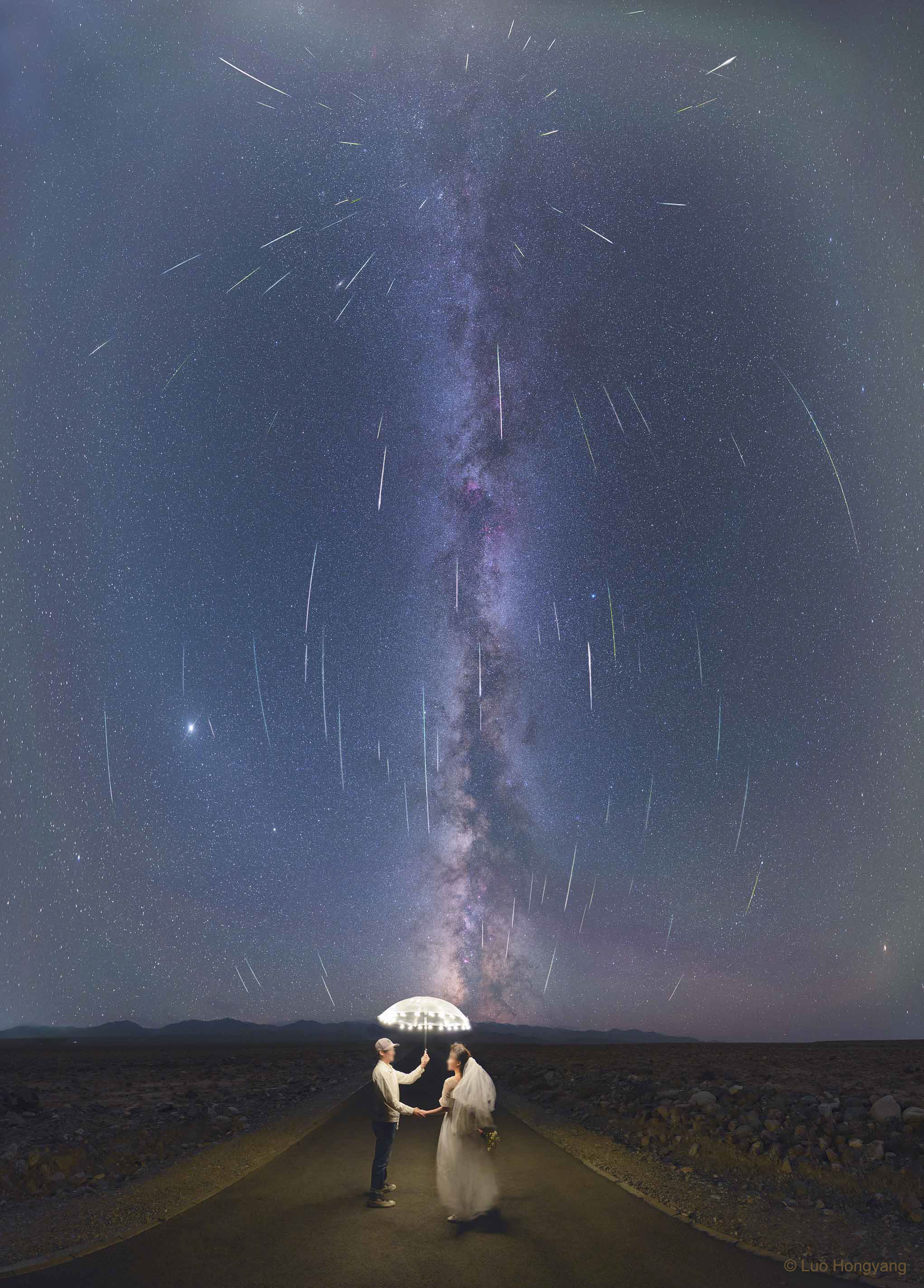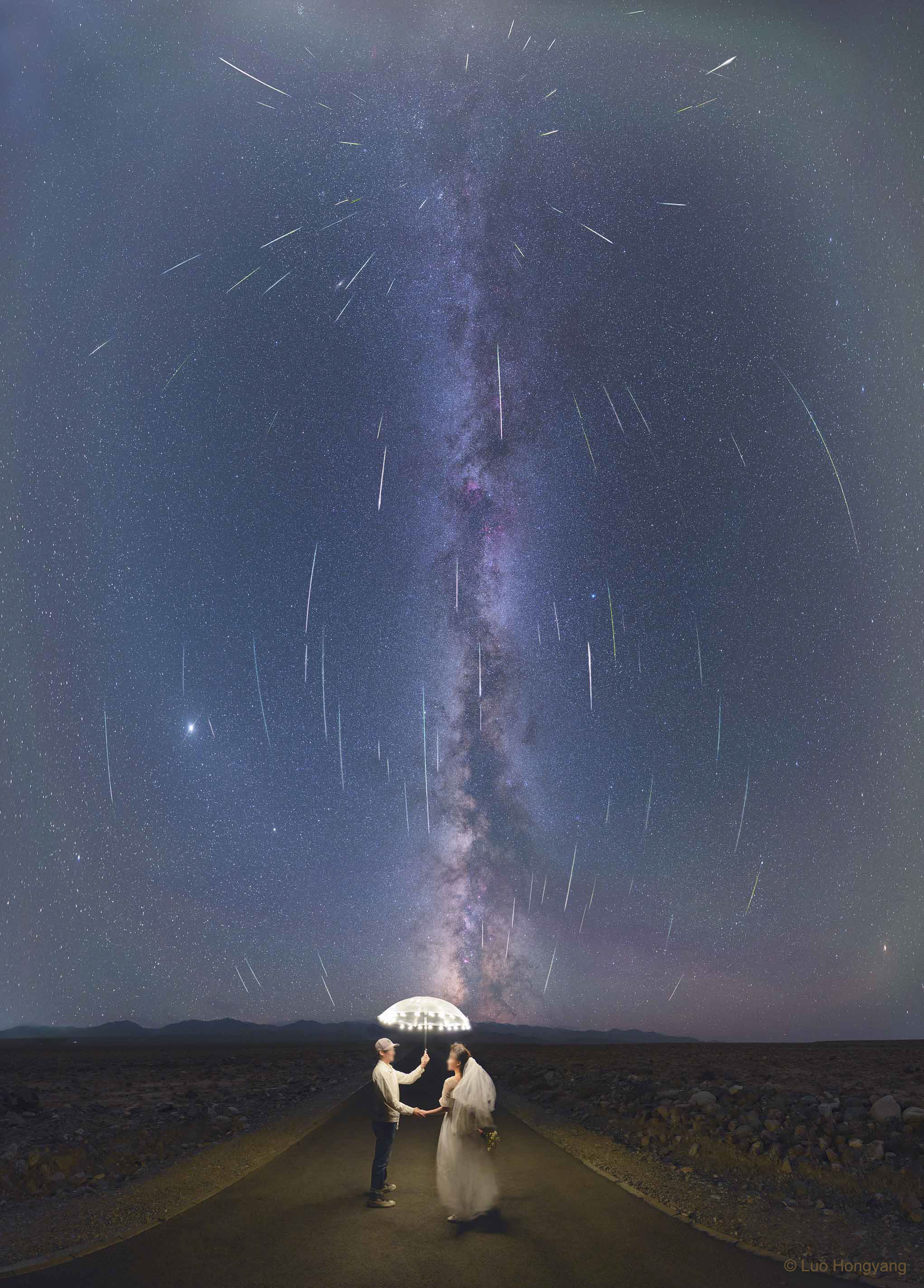
Comet dust rained down on planet Earth last week, streaking through dark skies in the annual Perseid meteor shower. The featured picture is a composite of many images taken from the same location over the peak night of the Perseids. The umbrella was not needed as a shield from meteors, since they almost entirely evaporate high in the Earth's atmosphere. Many of the component images featured individual Perseids, while one image featured the foreground near Jiuquan City, Gansu Province, China. The stellar background includes the central band of our Milky Way Galaxy, appearing nearly vertical, as well as the planets Jupiter and Saturn on the left. Although the comet dust particles are traveling parallel to each other, the resulting shower meteors clearly seem to radiate from a single point on the sky -- the radiant in the eponymous constellation Perseus. The image captured so long an angular field that the curvature of the sky is visible in the trajectory of the Perseids. Notable APOD Image Submissions: Perseid Meteor Shower 2021
El polvo de un cometa cayó sobre la Tierra la semana pasada, atravesando los cielos oscuros en la lluvia anual de meteoros de las Perseidas. La imagen destacada es una composición de muchas fotografías tomadas desde el mismo lugar durante la noche pico de las Perseidas. El paraguas no era necesario como protección contra los meteoros, ya que estos se evaporan casi por completo a gran altura en la atmósfera terrestre. Muchas de las imágenes componentes mostraban individuales Perseidas, mientras que una imagen mostraba el primer plano cerca de la ciudad de Jiuquan, en la provincia de Gansú, China. El fondo estelar incluye la banda central de nuestra Vía Láctea, que aparece casi vertical, así como los planetas Júpiter y Saturno a la izquierda. Aunque las partículas de polvo del cometa viajan en paralelo, las lluvias de meteoros resultantes claramente parecen radiar desde un solo punto en el cielo: el radiante en la constelación homónima de Perseo. La imagen capturó un campo angular tan amplio que se puede ver la curvatura del cielo en la trayectoria de las Perseidas.