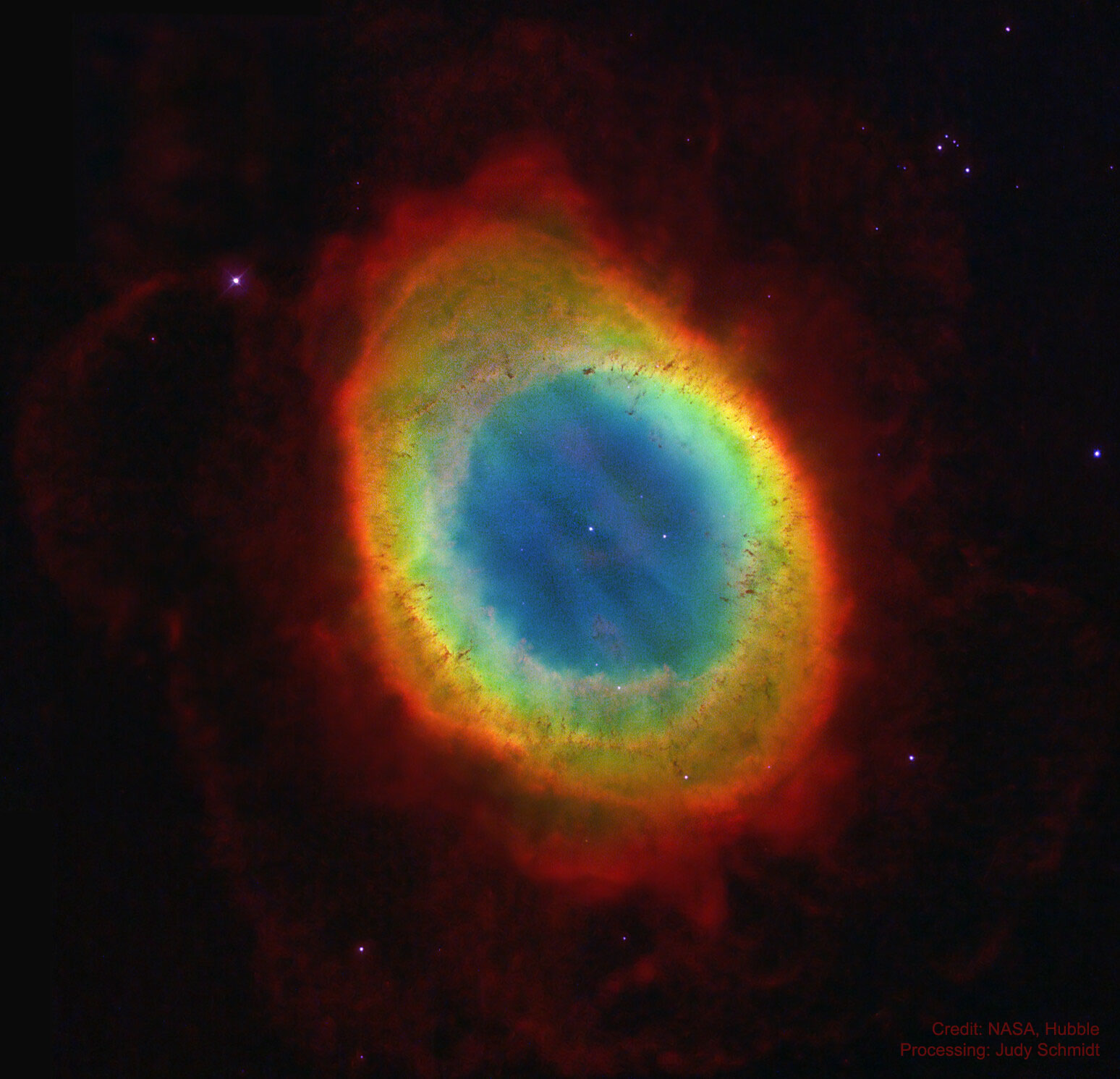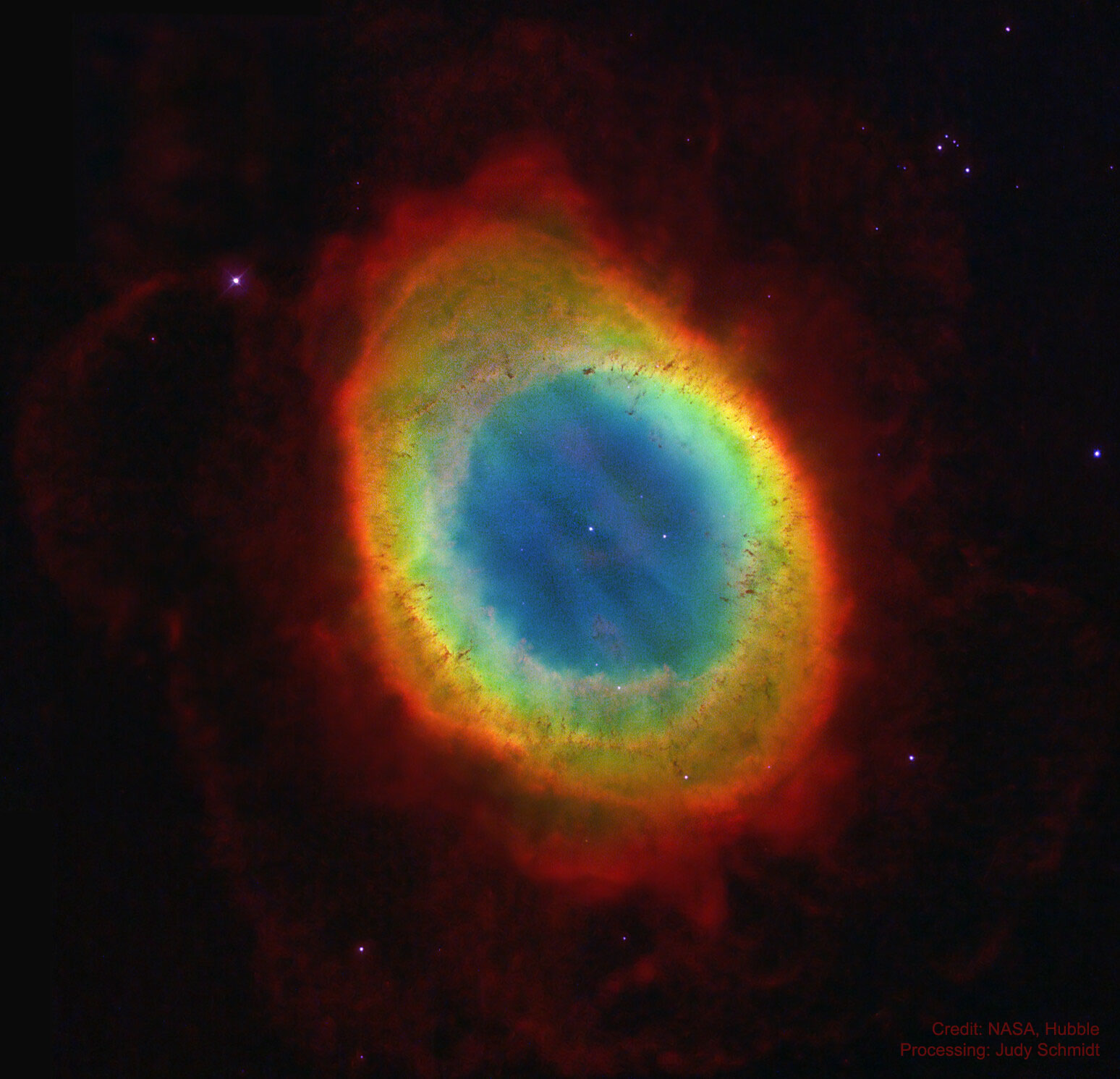
cept for the rings of Saturn, the Ring Nebula (M57) is probably the most famous celestial circle. Its classic appearance is understood to be due to our own perspective, though. The recent mapping of the expanding nebula's 3-D structure, based in part on this clear Hubble image,indicates that the nebula is a relatively dense, donut-like ring wrapped around the middle of a (American) football-shaped cloud of glowing gas. The view from planet Earth looks down the long axis of the football, face-on to the ring. Of course, in this well-studied example of a planetary nebula, the glowing material does not come from planets. Instead, the gaseous shroud represents outer layers expelled from the dying, once sun-like star, now a tiny pinprick of light seen at the nebula's center. Intense ultraviolet light from the hot central star ionizes atoms in the gas. The Ring Nebula is about one light-year across and 2,500 light-years away. Share the Sky: NASA Open API for APOD
Excepto por los anillos de Saturno, la Nebulosa Anular (M57) es probablemente el círculo celeste más famoso. Su apariencia clásica se entiende que se debe a nuestra propia perspectiva. El reciente mapeo de la estructura 3-D de la nebulosa en expansión, basado en parte en esta clara imagen de Hubble, indica que la nebulosa es un anillo denso, similar a un donut, envuelto alrededor del centro de una nube de gas luminoso con forma de balón de fútbol americano. La vista desde la Tierra mira a lo largo del eje largo del balón, de frente al anillo. Por supuesto, en este bien estudiado ejemplo de nebulosa planetaria, el material luminoso no proviene de planetas. En cambio, la envoltura gaseosa representa las capas externas expulsadas de una estrella moribunda, una vez similar al Sol, ahora un diminuto punto de luz visto en el centro de la nebulosa. La luz ultravioleta intensa de la estrella central ioniza los átomos en el gas. La Nebulosa Anular tiene aproximadamente un año luz de diámetro y se encuentra a 2500 años luz de distancia.