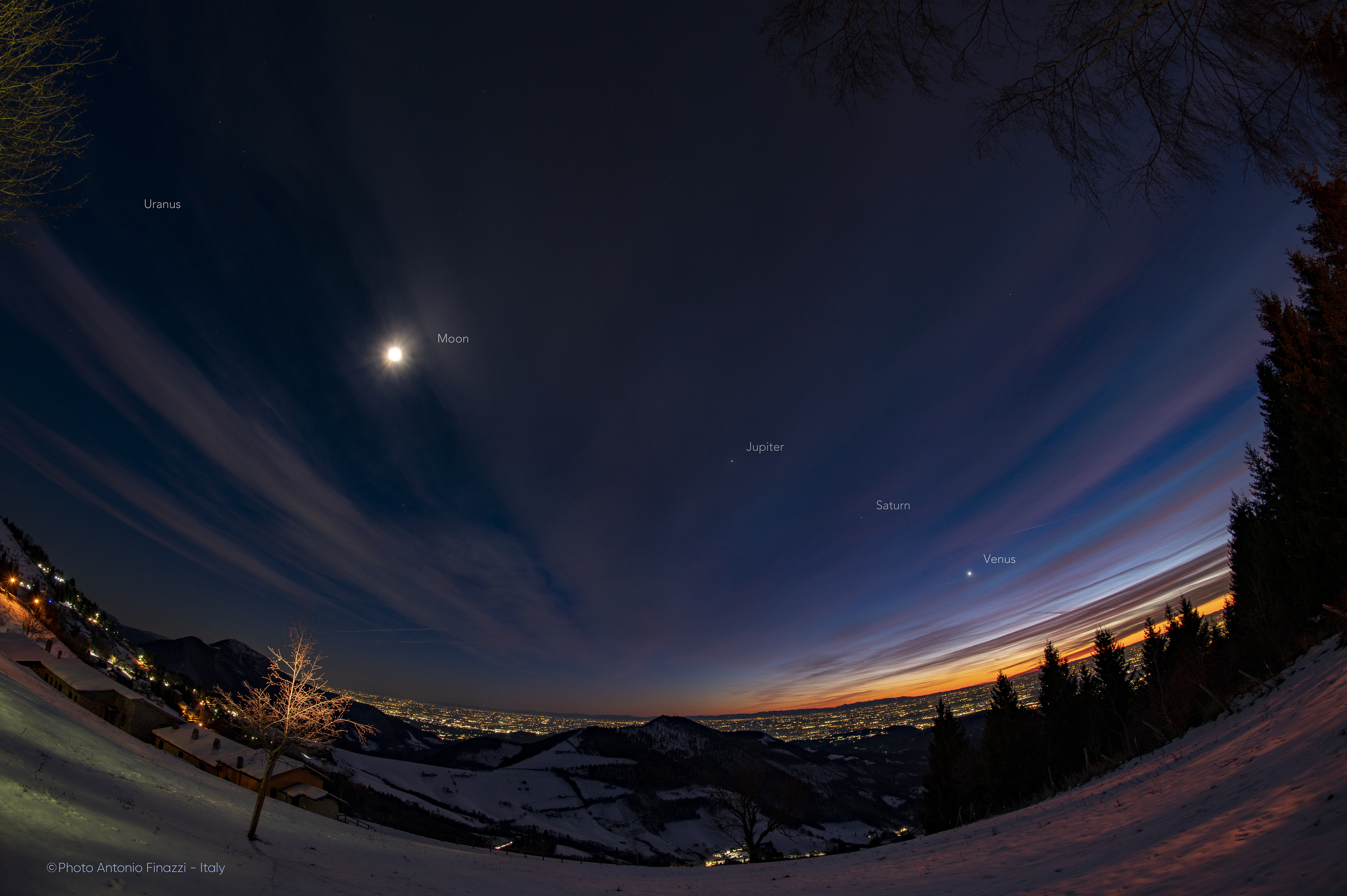
It is not a coincidence that planets line up. That's because all of the planets orbit the Sun in (nearly) a single sheet called the plane of the ecliptic. When viewed from inside that plane -- as Earth dwellers are likely to do -- the planets all appear confined to a single band. It is a coincidence, though, when three of the brightest planets all appear in nearly the same direction. Such a coincidence was captured earlier this month. Featured above (right to left), Venus, Saturn, and Jupiter were all imaged together in a line just after sunset, from the San Fermo Hills, Bergamo, Italy. Joining the alignment are Earth's Moon, and the position of the more distant Uranus. Bands of clouds streak across the sky toward the setting Sun. As Comet Leonard fades, this planetary alignment -- absent the Moon -- should persist for the rest of the month. Discovery + Outreach: Graduate student research position open for APOD
Crédito: NASA, APOD No es una coincidencia que los planetas se alineen. Eso se debe a que todos los planetas orbitan alrededor del Sol en (casi) una sola capa llamada plano de la eclíptica. Cuando se observa desde dentro de ese plano —como lo hacen los habitantes de la Tierra—, los planetas aparecen confinados a una sola banda. Es una coincidencia, sin embargo, cuando tres de los planetas más brillantes aparecen en casi la misma dirección. Esta coincidencia fue capturada a principios de este mes. En la imagen destacada (de derecha a izquierda), Venus, Saturno y Júpiter aparecen alineados en una fila inmediatamente después del atardecer, tomada desde las colinas de San Fermo, en Bergamo, Italia. Completando la alineación se encuentra la Luna de la Tierra y la posición del más distante Urano. Bandas de nubes cruzan el cielo hacia el Sol poniente. A medida que el cometa Leonard se atenúe, esta alineación planetaria —sin la Luna— debería persistir por el resto del mes.