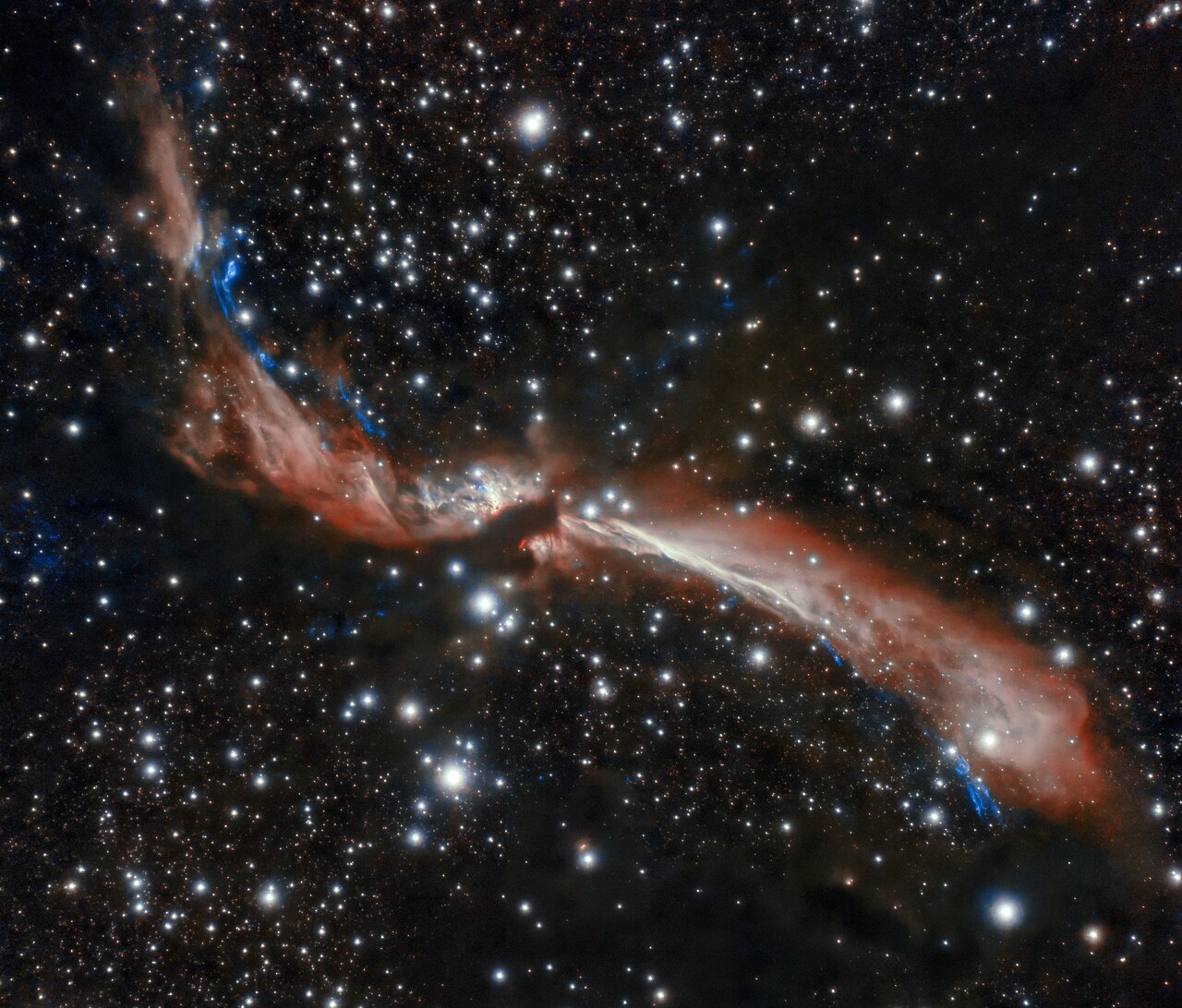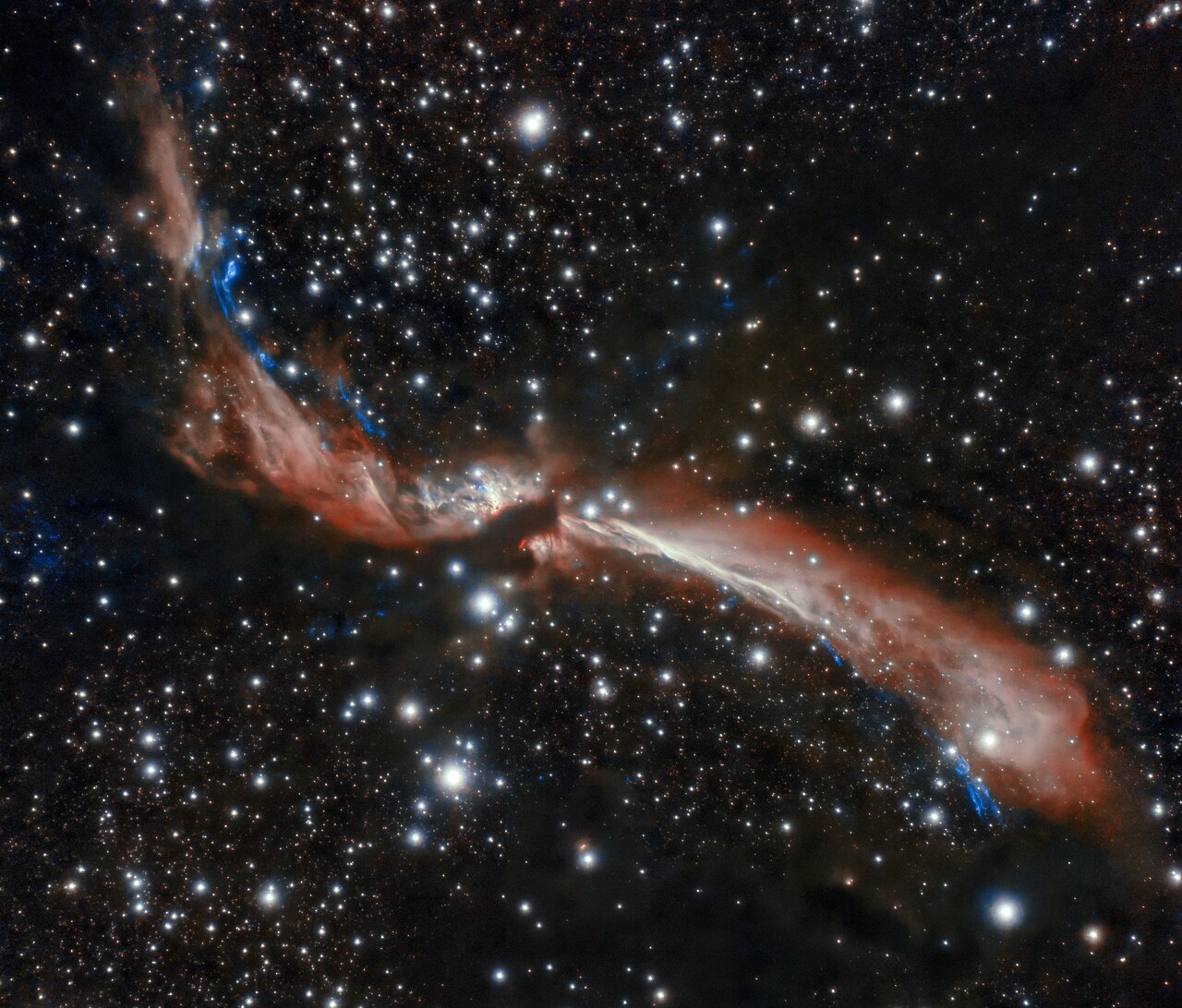
Laser guide stars and adaptive optics sharpened this stunning ground-based image of stellar jets from the Gemini South Observatory, Chilean Andes, planet Earth. These twin outflows of MHO 2147 are from a young star in formation. It lies toward the central Milky Way and the boundary of the constellations Sagittarius and Ophiuchus at an estimated distance of some 10,000 light-years. At center, the star itself is obscured by a dense region of cold dust. But the infrared image still traces the sinuous jets across a frame that would span about 5 light-years at the system's estimated distance. Driven outward by the young rotating star, the apparent wandering direction of the jets is likely due to precession. Part of a multiple star system, the young star's rotational axis would slowly precess or wobble like a top under the gravitation influence of its nearby companions.
Crédito: Observatorio Gemini Sur, Sistemas de Apoyo Científico de Gemini Estrellas guía láser y óptica adaptativa acentuaron esta impresionante imagen terrestre de chorros estelares obtenida por el Observatorio Gemini Sur en los Andes chilenos, en la Tierra. Estos dos chorros de MHO 2147 provienen de una estrella joven en formación. Se encuentra hacia el centro de la Vía Láctea y en la frontera entre las constelaciones de Sagitario y Ofiuco, a una distancia estimada de unos 10 000 años luz. En el centro, la estrella en sí está oculta por una región densa de polvo frío. Sin embargo, la imagen en infrarrojo aún traza los chorros sinuosos a través de un marco que abarcaría aproximadamente 5 años luz a la distancia estimada del sistema. Impulsados hacia afuera por la estrella joven en rotación, la aparente dirección errante de los chorros probablemente se deba a la precesión. Parte de un sistema de múltiples estrellas, el eje de rotación de la estrella joven se precesaría o balancearía lentamente como un trompo bajo la influencia gravitacional de sus compañeros cercanos.