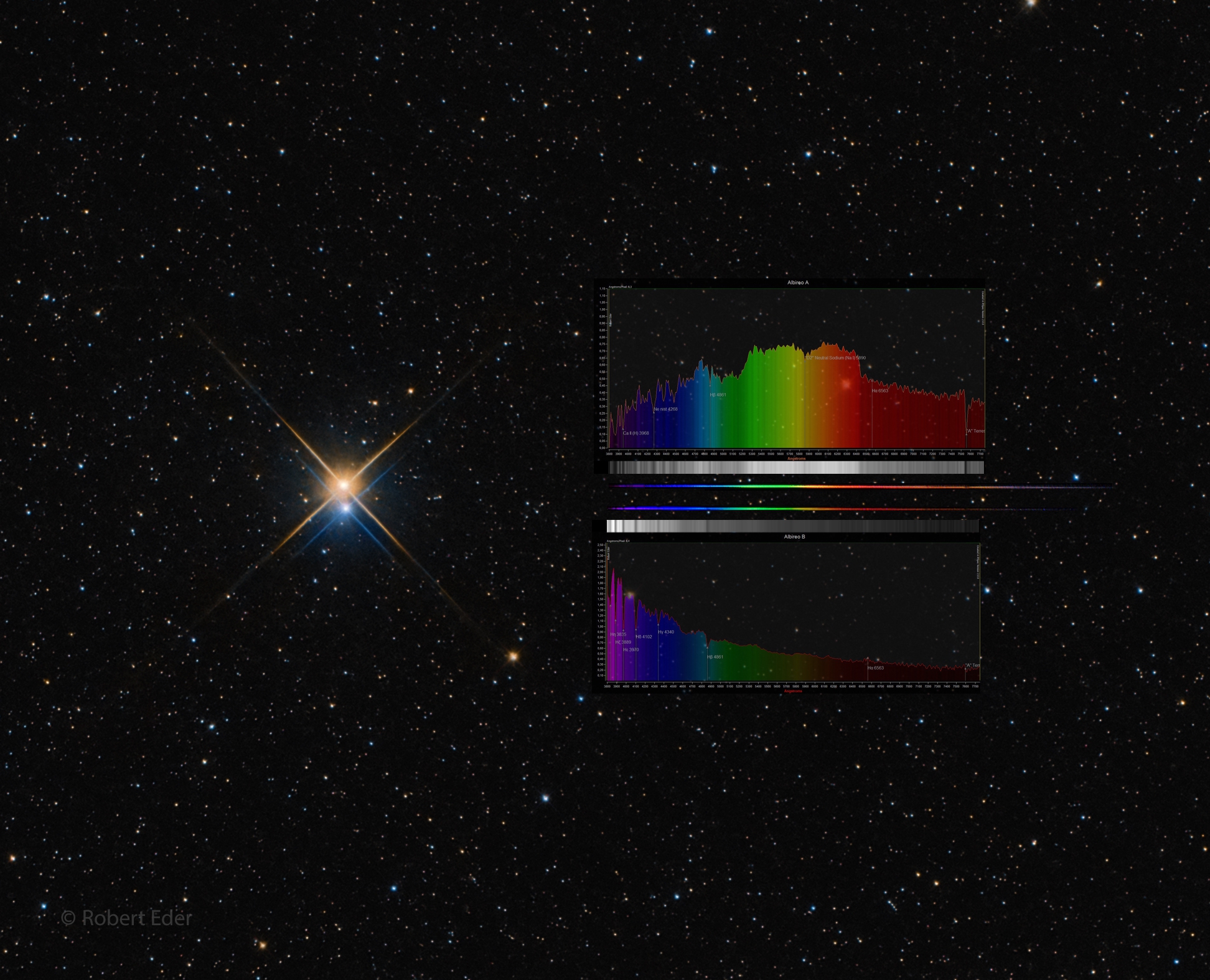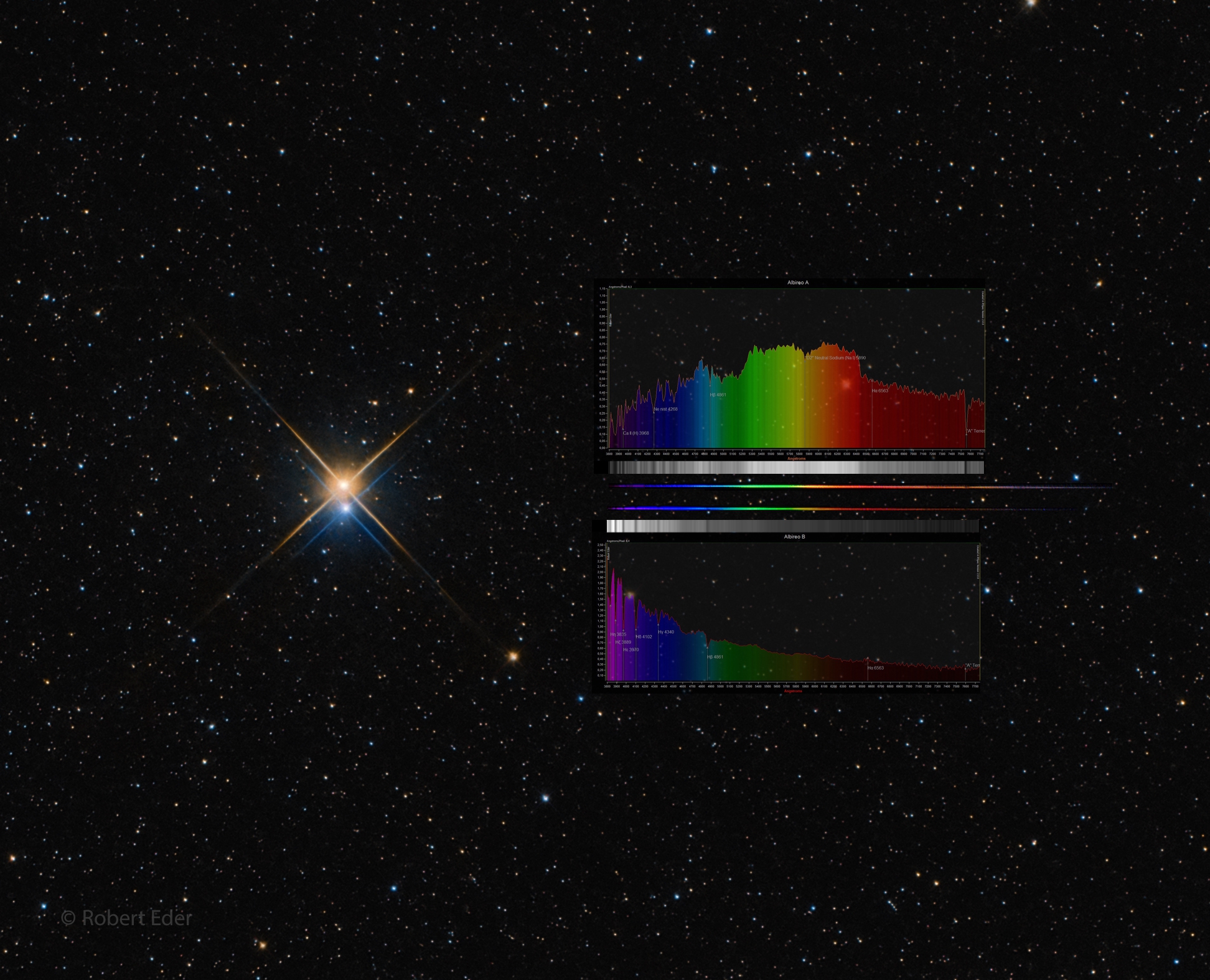
Beta Cygni is a single bright star to the naked eye. About 420 light-years away it marks the foot of the Northern Cross, famous asterism in the constellation Cygnus. But a view through the eyepiece of a small telescope will transform it into a beautiful double star, a treasure of the night sky in blue and gold. Beta Cygni is also known as Albireo, designated Albireo AB to indicate its two bright component stars. Their visually striking color difference is illustrated in this telescopic snapshot, along with their associated visible spectrum of starlight shown in insets to the right. Albireo A, top inset, shows the spectrum of a K-type giant star, cooler than the Sun and emitting most of its energy at yellow and red wavelengths. Below, Albireo B has the spectrum of a main sequence star much hotter than the Sun, emitting more energy in blue and violet. Albireo A is known to be a binary star, two stars together orbiting a common center of mass, though the two stars are too close together to be seen separately with a small telescope. Well-separated Albireo A and B most likely represent an optical double star and not a physical binary system because the two components have clearly different measured motions through space.
Crédito: NASA, CGRO SSC Beta Cygni es una única estrella brillante para el ojo desnudo. A unos 420 años luz de distancia, marca el pie de la Cruz del Norte, un famoso asterismo en la constelación de Cisne. Pero una vista a través del ocular de un pequeño telescopio la transforma en una hermosa estrella doble, un tesoro del cielo nocturno en azul y dorado. Beta Cygni también se conoce como Albireo, designada como Albireo AB para indicar sus dos componentes estelares brillantes. Su notable diferencia de color se ilustra en esta imagen capturada con telescopio, junto con su espectro visible de luz estelar mostrado en recuadros a la derecha. Albireo A, en el recuadro superior, muestra el espectro de una gigante de tipo K, más fría que el Sol y que emite la mayor parte de su energía en longitudes de onda amarillas y rojas. Debajo, Albireo B tiene el espectro de una estrella de la secuencia principal mucho más caliente que el Sol, que emite más energía en azul y violeta. Se sabe que Albireo A es una estrella binaria, dos estrellas que orbitan juntas un centro común de masa, aunque las dos estrellas están demasiado cerca como para ser vistas por separado con un pequeño telescopio. Albireo A y B, bien separadas, probablemente representan una estrella doble óptica y no un sistema binario físico, ya que sus componentes tienen claramente diferentes movimientos medidos a través del espacio.