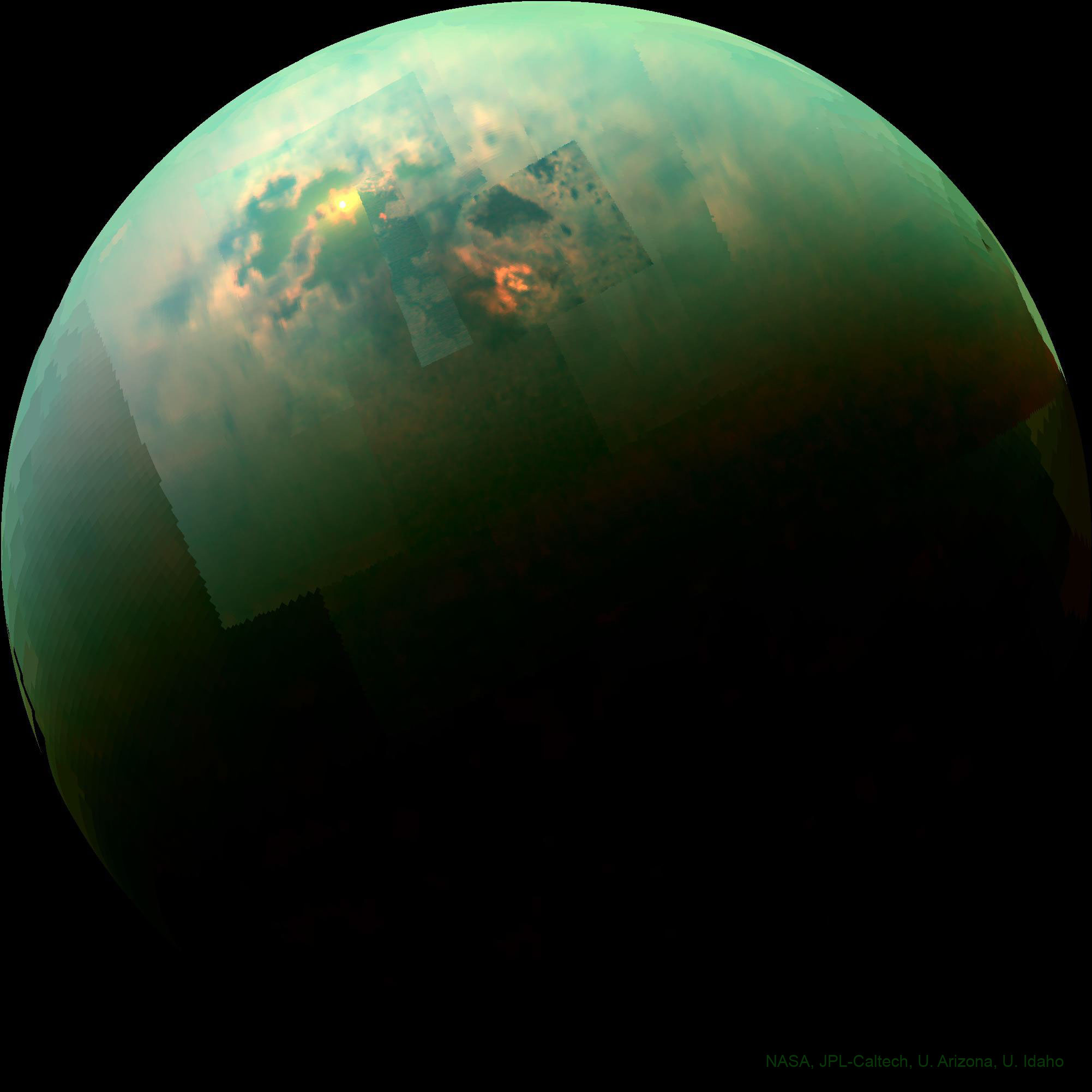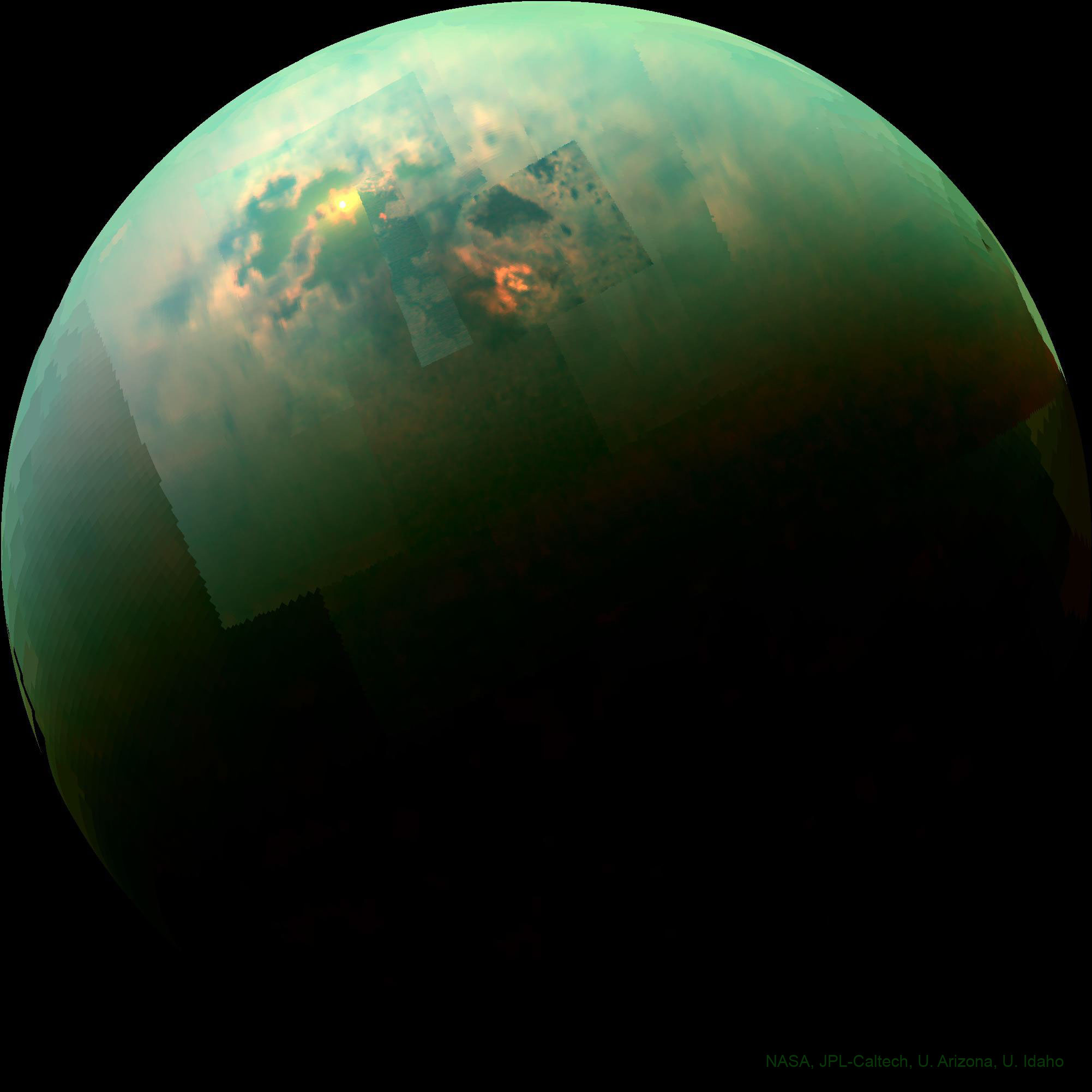
Why would the surface of Titan light up with a blinding flash? The reason: a sunglint from liquid seas. Saturn's moon Titan has numerous smooth lakes of methane that, when the angle is right, reflect sunlight as if they were mirrors. Pictured here in false-color, the robotic Cassini spacecraft that orbited Saturn from 2004 to 2017 imaged the cloud-covered Titan in 2014 in different bands of cloud-piercing infrared light. This specular reflection was so bright it saturated one of Cassini's infrared cameras. Although the sunglint was annoying -- it was also useful. The reflecting regions confirm that northern Titan houses a wide and complex array of seas with a geometry that indicates periods of significant evaporation. During its numerous passes of our Solar System's most mysterious moon, Cassini has revealed Titan to be a world with active weather -- including times when it rains a liquefied version of natural gas.
¿Por qué la superficie de Titán se ilumina con un destello cegador? La razón: un reflejo solar procedente de mares líquidos. La luna de Saturno Titán tiene numerosos lagos de metano que, cuando el ángulo es el adecuado, reflejan la luz solar como si fueran espejos. En la imagen, en color falso, la nave robótica Cassini, que orbitó Saturno desde 2004 hasta 2017, capturó una imagen de Titán, cubierto de nubes, en 2014 en diferentes bandas de luz infrarroja capaces de atravesar las nubes. Este reflejo especular fue tan brillante que saturó una de las cámaras infrarrojas de Cassini. Aunque el reflejo solar resultó molesto, también fue útil. Las regiones reflejantes confirman que el norte de Titán alberga una amplia y compleja variedad de mares cuya geometría indica períodos de evaporación significativa. Durante sus numerosos sobrevuelos de la luna más misteriosa de nuestro Sistema Solar, Cassini reveló que Titán es un mundo con un clima activo, incluyendo momentos en los que llueve una versión licuada del gas natural.