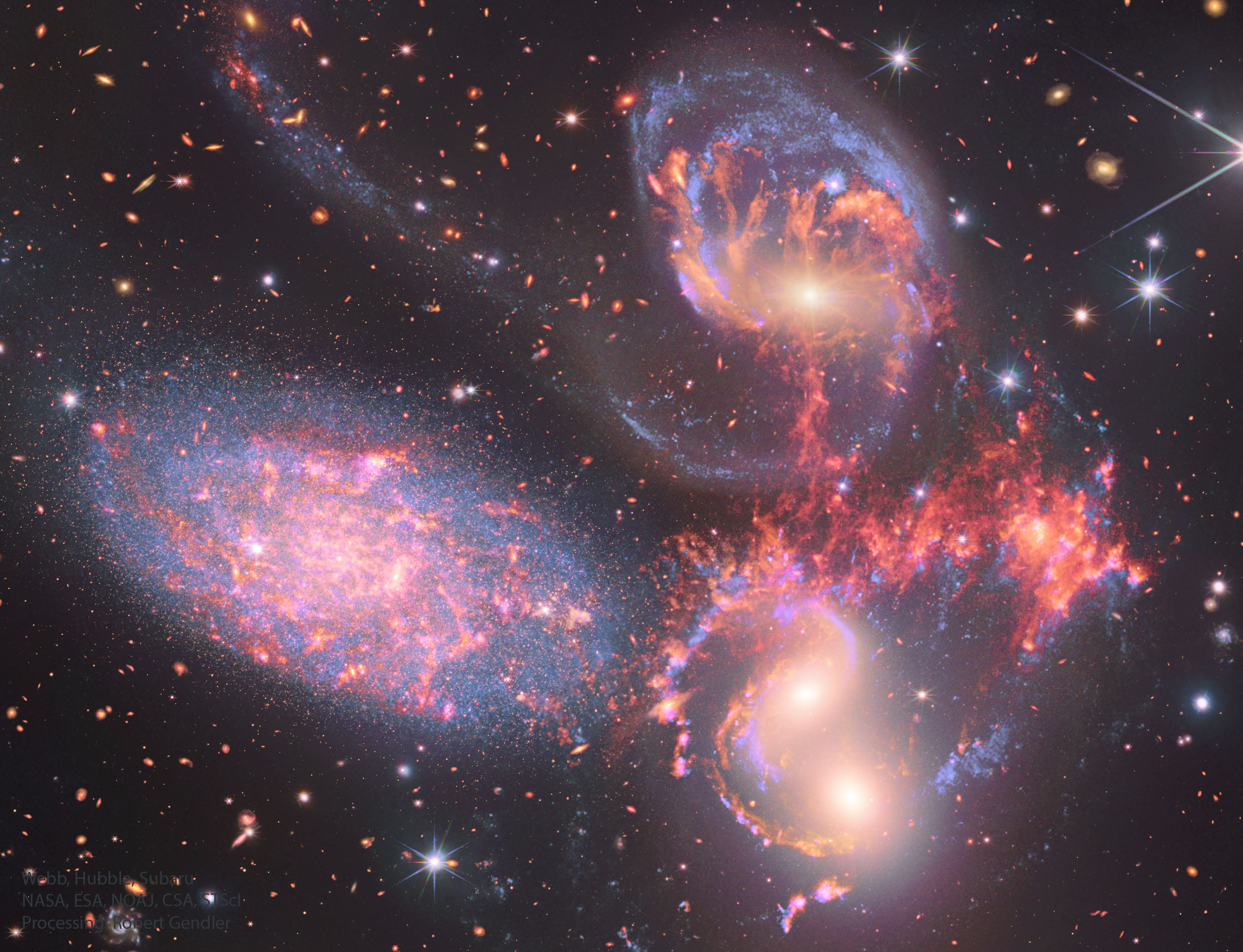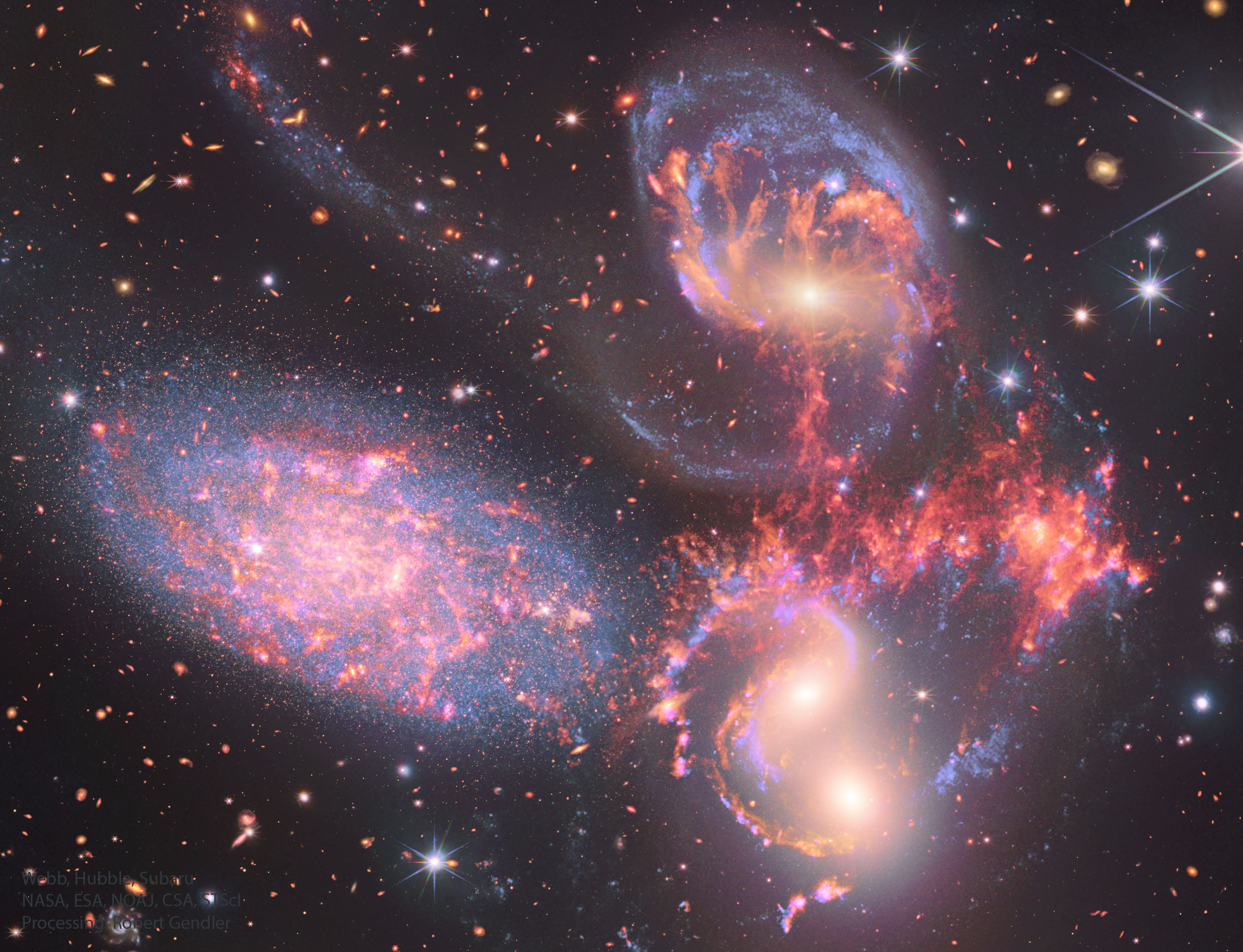
OK, but why can't you combine images from Webb and Hubble? You can, and today's featured image shows one impressive result. Although the recently launched James Webb Space Telescope (Webb) has a larger mirror than Hubble, it specializes in infrared light and can't see blue -- only up to about orange. Conversely, the Hubble Space Telescope (Hubble) has a smaller mirror than Webb and can't see as far into the infrared as Webb, but can image not only blue light but even ultraviolet. Therefore, Webb and Hubble data can be combined to create images across a wider variety of colors. The featured image of four galaxies from Stephan's Quintet shows Webb images as red and also includes images taken by Japan's ground-based Subaru telescope in Hawaii. Because image data for Webb, Hubble, and Subaru are made freely available, anyone around the world can process it themselves, and even create intriguing and scientifically useful multi-observatory montages. Stephan's Quintet from just: Webb, Hubble
Bueno, pero ¿por qué no se pueden combinar imágenes de Webb y Hubble? Se pueden, y la imagen destacada de hoy muestra un resultado impresionante. Aunque el recientemente lanzado Telescopio Espacial James Webb (Webb) tiene un espejo más grande que Hubble, se especializa en luz infrarroja y no puede ver el azul — solo hasta el naranja aproximadamente. Por el contrario, el Telescopio Espacial Hubble (Hubble) tiene un espejo más pequeño que Webb y no puede ver tan lejos en el infrarrojo como Webb, pero puede capturar no solo luz azul sino incluso ultravioleta. Por lo tanto, los datos de Webb y Hubble pueden combinarse para crear imágenes que abarquen una mayor variedad de colores. La imagen destacada de cuatro galaxias del Cuarteto de Stephan muestra las imágenes de Webb en rojo y también incluye imágenes tomadas por el telescopio terrestre Subaru de Japón en Hawai. Debido a que los datos de imagen de Webb, Hubble y Subaru están disponibles gratuitamente, cualquiera del mundo puede procesarlos por sí mismo, e incluso crear montajes entretelescopios intrigantes y científicamente útiles.