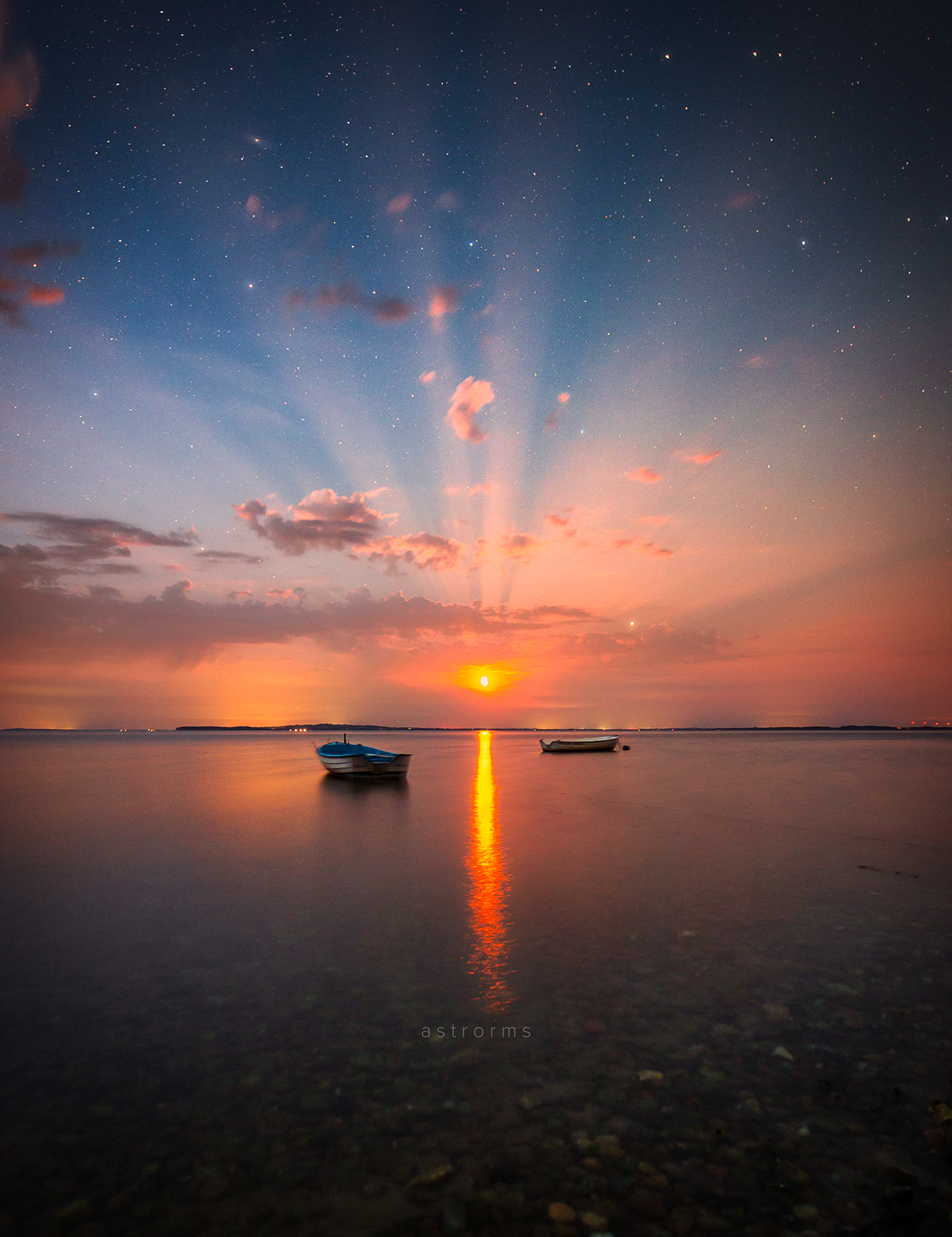
This moon made quite an entrance. Typically, a moonrise is quiet and serene. Taking a few minutes to fully peek above the horizon, Earth's largest orbital companion can remain relatively obscure until it rises high in the nighttime sky. About a week ago, however, and despite being only half lit by the Sun, this rising moon put on a show -- at least from this location. The reason was that, as seen from Limfjord in Nykøbing Mors, Denmark, the moon rose below scattered clouds near the horizon. The result, captured here in a single exposure, was that moonlight poured through gaps in the clouds to created what are called crepuscular rays. These rays can fan out dramatically across the sky when starting near the horizon, and can even appear to converge on the other side of the sky. Well behind our Moon, stars from our Milky Way galaxy dot the background, and our galaxy's largest orbital companion -- the Andromeda galaxy -- can be found on the upper left. Almost Hyperspace: Random APOD Generator
Esta Luna hizo una entrada bastante llamativa. Típicamente, una puesta de Luna es tranquila y serena. Tarda unos minutos en asomarse completamente sobre el horizonte, y nuestro mayor satélite natural puede permanecer relativamente oculto hasta que se eleva alto en el cielo nocturno. Sin embargo, hace aproximadamente una semana, y a pesar de estar iluminada solo a la mitad por el Sol, esta Luna ascendente ofreció un espectáculo — al menos desde esta ubicación. La razón fue que, vista desde el Limfjord en Nykøbing Mors, Dinamarca, la Luna se elevó por debajo de nubes dispersas cerca del horizonte. El resultado, capturado aquí en una única exposición, fue que la luz lunar se filtró a través de los huecos en las nubes, creando lo que se conoce como rayos crepusculares. Estos rayos pueden extenderse dramáticamente a través del cielo cuando parten cerca del horizonte, e incluso pueden parecer converger en el otro extremo del cielo. Más allá de nuestra Luna, estrellas de nuestra galaxia, la Vía Láctea, decoran el fondo, y el mayor satélite orbital de nuestra galaxia — la galaxia de Andrómeda — se encuentra en la parte superior izquierda.