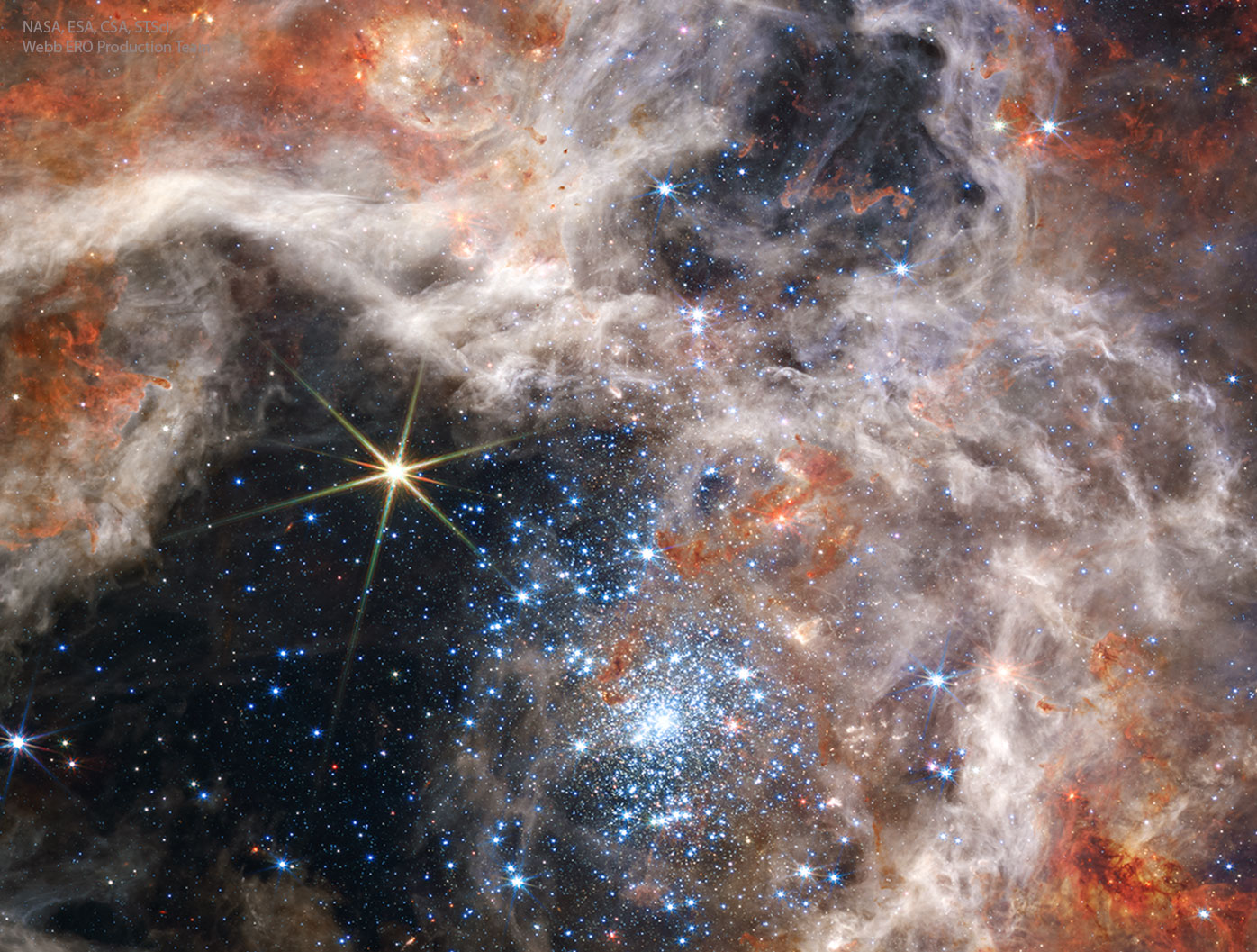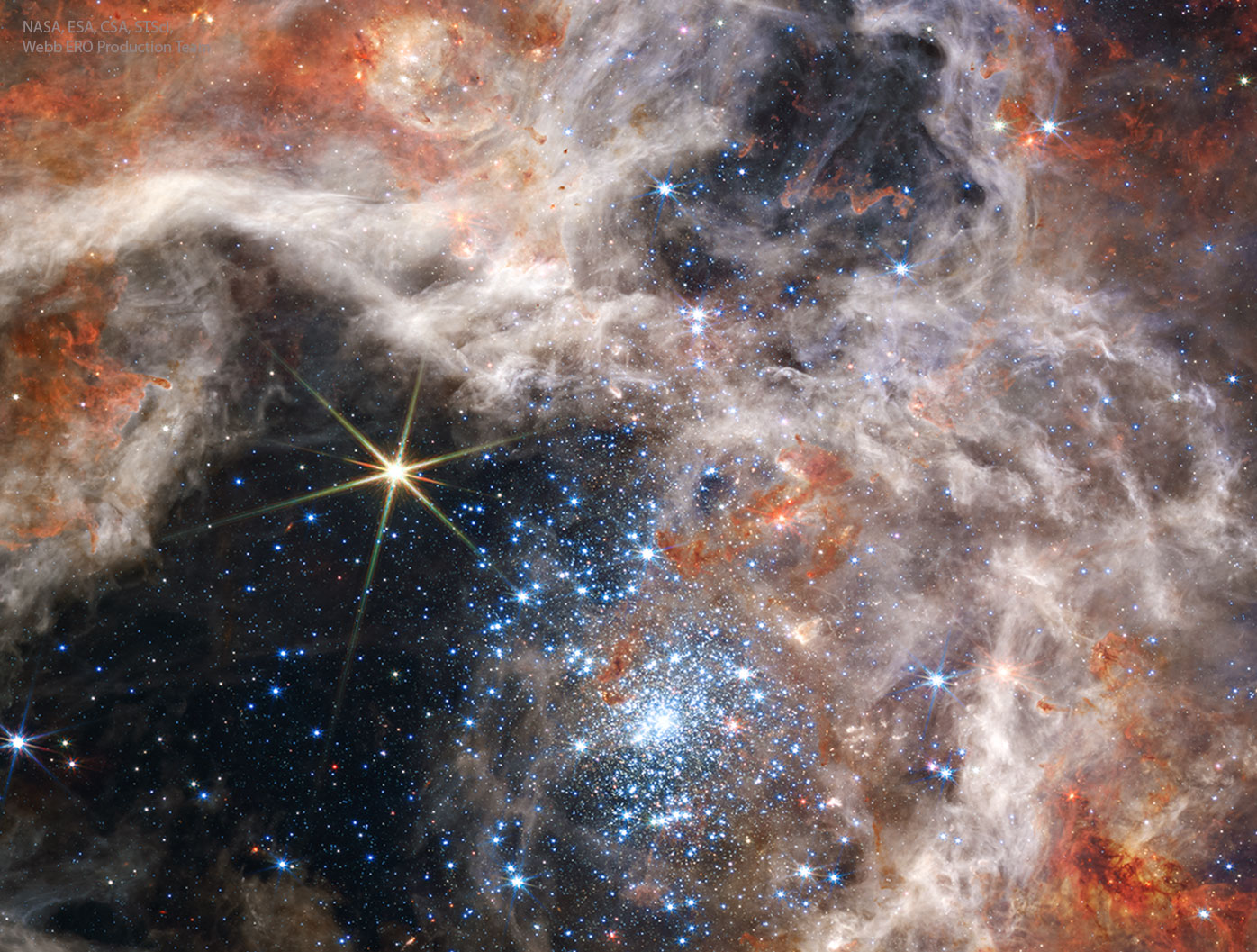
Near the center of a nearby star-forming region lies a massive cluster containing some of the largest and hottest stars known. Collectively known as star cluster NGC 2070, these stars are part of the vast Tarantula Nebula and were captured in two kinds of infrared light by the new Webb Space Telescope. The main image shows the group of stars at NGC 2070's center -- known as R136 -- in near-infrared, light just a bit too red for humans to see. In contrast, the rollover image captures the cluster center in mid-infrared light, light closer to radio waves. Since R136's brightest stars emit more of their light in the near infrared, they are much more prominent on that image. This LMC cluster's massive stars emit particle winds and energetic light that are evaporating the gas cloud from which they formed. The Webb images, released yesterday, shows details of R136 and its surroundings that have never been seen before, details that are helping humanity to a better understanding of how all stars are born, evolve and die.
Cerca del centro de una región cercana de formación estelar se encuentra un cúmulo masivo que contiene algunas de las estrellas más grandes y calientes conocidas. Colectivamente conocido como el cúmulo estelar NGC 2070, estas estrellas forman parte de la vasta Nebulosa Tarántula y fueron capturadas en dos tipos de luz infrarroja por el nuevo Telescopio Espacial Webb. La imagen principal muestra al grupo de estrellas en el centro de NGC 2070, conocido como R136, en luz infrarroja cercana, una luz ligeramente más roja de lo que los humanos pueden ver. En contraste, la imagen al pasar el cursor captura el centro del cúmulo en luz infrarroja media, una luz más cercana a las ondas de radio. Dado que las estrellas más brillantes de R136 emiten más de su luz en el infrarrojo cercano, son mucho más prominentes en esa imagen. Las estrellas masivas de este cúmulo en la Nube de Magallanes emiten vientos de partículas y luz energética que están evaporando la nube de gas de la cual se formaron. Las imágenes de Webb, publicadas ayer, muestran detalles de R136 y su entorno que nunca antes se habían visto, detalles que están ayudando a la humanidad a comprender mejor cómo nacen, evolucionan y mueren todas las estrellas.