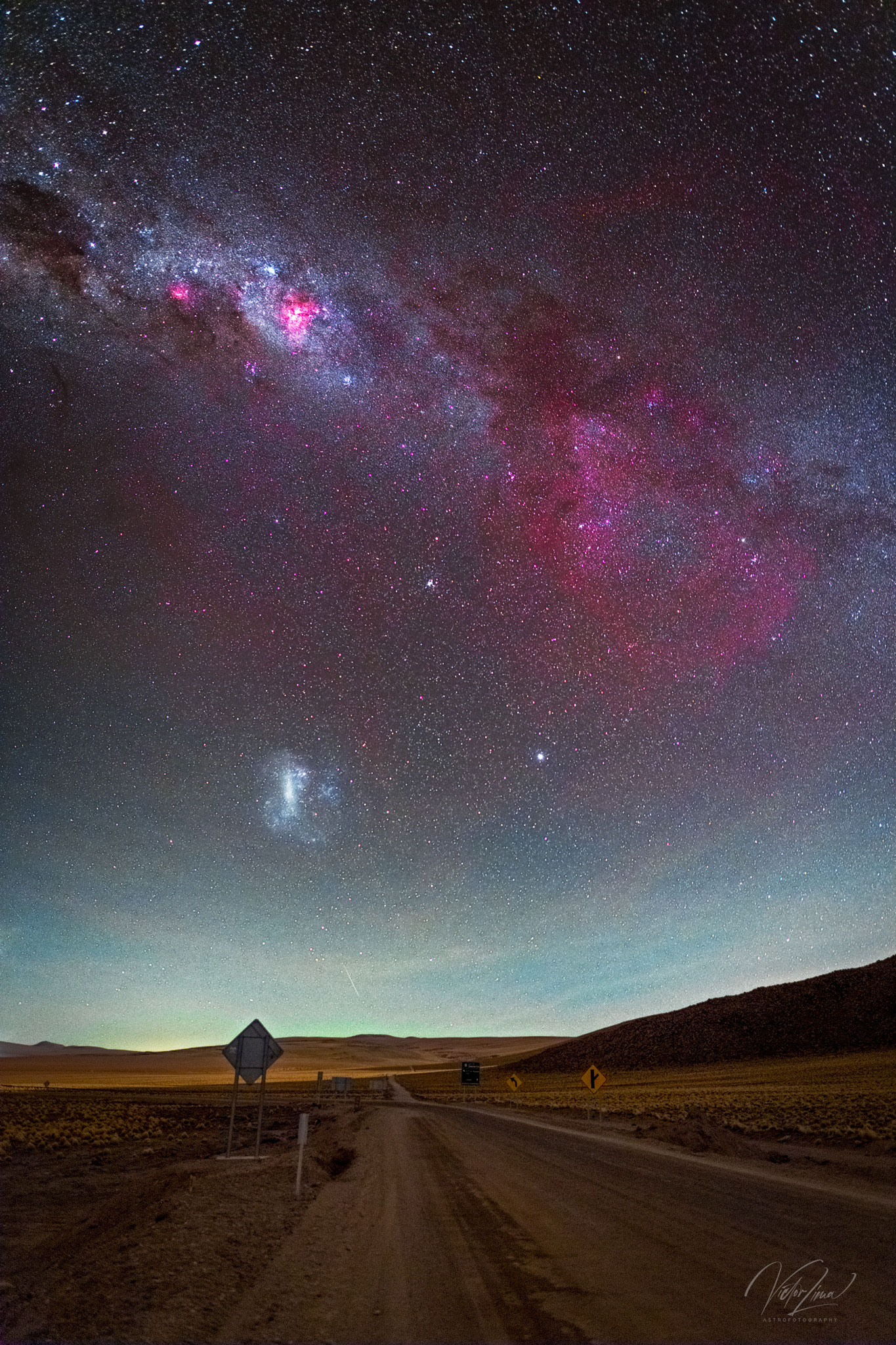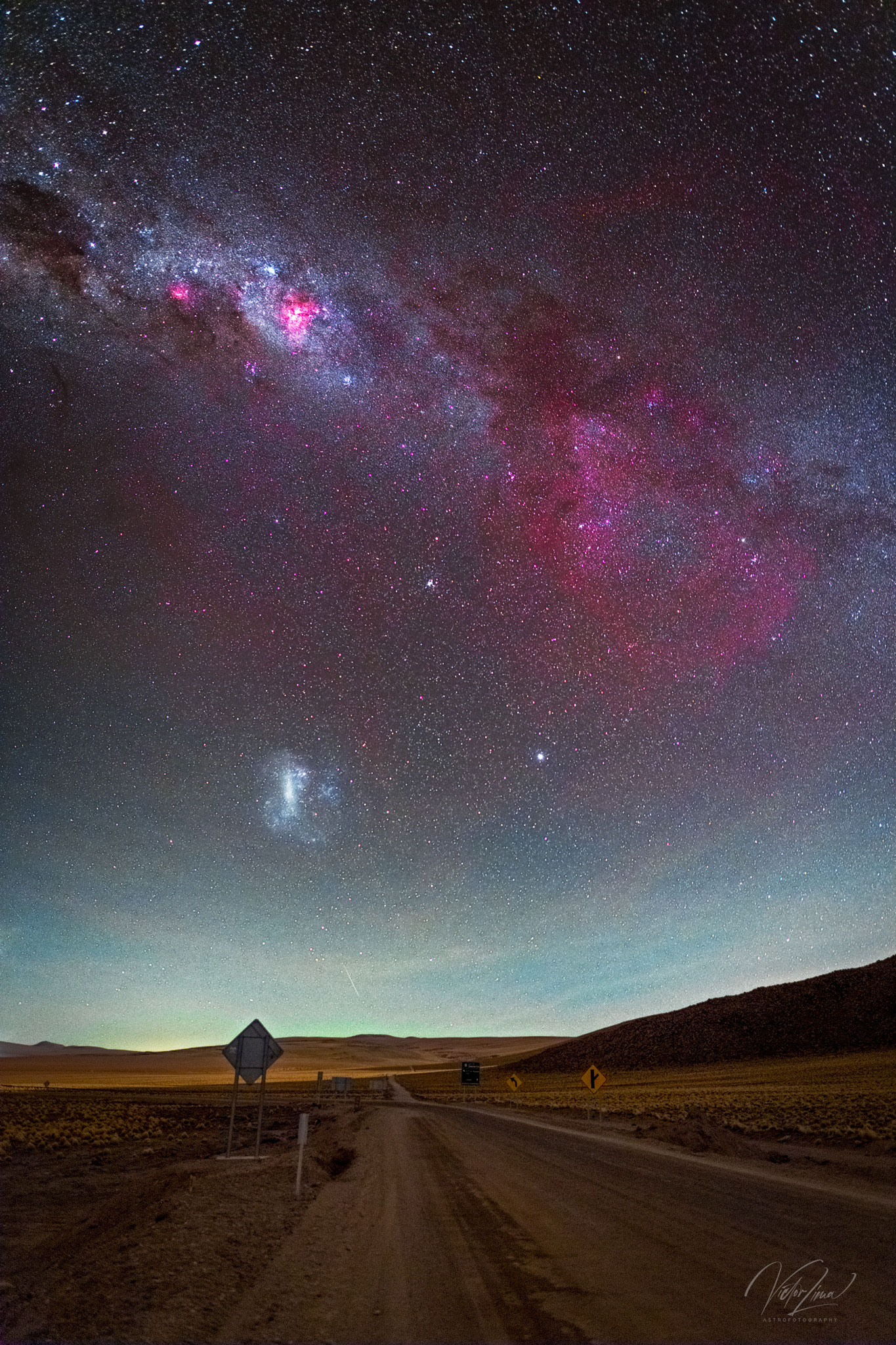
Because the Gum Nebula is the closest supernova remnant, it is actually hard to see. Spanning 40 degrees across the sky, the nebula appears so large and faint that it is easily lost in the din of a bright and complex background. The Gum Nebula is highlighted nicely in red emission toward the right of the featured wide-angle, single-image photograph taken in late May. Also visible in the frame are the Atacama Desert in Chile in the foreground, the Carina Nebula in the plane of our Milky Way galaxy running diagonally down from the upper left, and the neighboring Large Magellanic Cloud (LMC) galaxy. The Gum Nebula is so close that we are much nearer the front edge than the back edge, each measuring 450 and 1500 light years respectively. The complicated nebula lies in the direction of the constellations of Puppis and Vela. Oddly, much remains unknown about the Gum Nebula, including the timing and even number of supernova explosions that formed it.
Crédito: NASA, ESO, y fotógrafo autor La Nebulosa Gum es el remanente de supernova más cercano, por lo que en realidad es difícil de ver. Con un tamaño de 40 grados a través del cielo, la nebulosa aparece tan grande y tenue que fácilmente se pierde entre el ruido de un fondo brillante y complejo. La Nebulosa Gum se destaca claramente en la emisión roja hacia la derecha de la fotografía de amplio ángulo y de una sola imagen que se muestra aquí, tomada a finales de mayo. También visibles en el marco están el desierto de Atacama en Chile en primer plano, la Nebulosa Carina en el plano de nuestra galaxia Vía Láctea que corre diagonalmente desde la esquina superior izquierda, y la galaxia vecina Gran Nube de Magallanes (LMC). La Nebulosa Gum está tan cerca que estamos mucho más próximos al borde frontal que al borde posterior, que miden 450 y 1500 años luz respectivamente. La compleja nebulosa se encuentra en la dirección de las constelaciones de Puppis y Vela. Curiosamente, aún queda mucho por descubrir sobre la Nebulosa Gum, incluyendo la cronología e incluso el número de explosiones de supernova que la formaron.