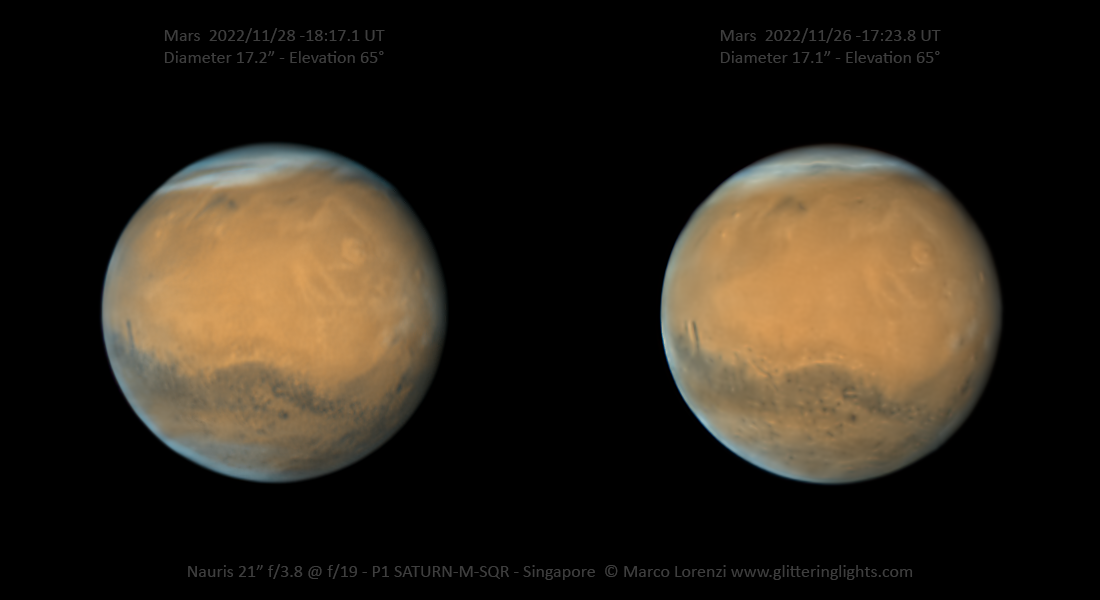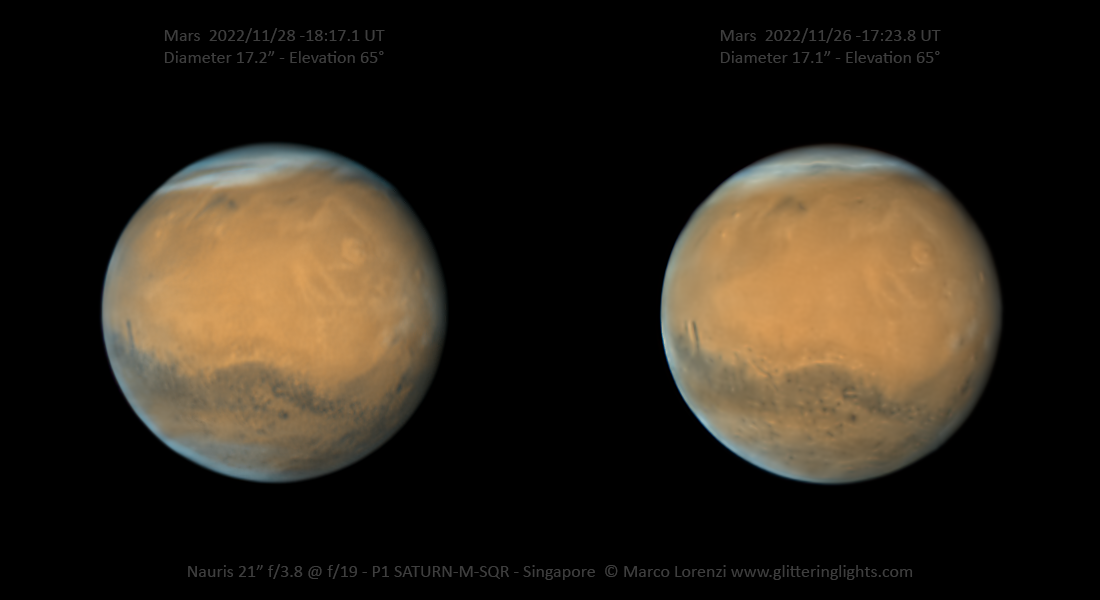
Mars looks sharp in these two rooftop telescope views captured in late November from Singapore, planet Earth. At the time, Mars was about 82 million kilometers from Singapore and approaching its opposition, opposite the Sun in planet Earth's sky on December 8. Olympus Mons, largest of the volcanoes in the Tharsis Montes region (and largest known volcano in the Solar System), is near Mars' western limb. In both images it's the whitish donut-shape at the upper right. The dark area visible near center is the Terra Sirenum region while the long dark peninsula closest to the planet's eastern limb is Sinus Gomer. Near its tip is Gale crater, the Curiosity rover's landing site in 2012. Above Sinus Gomer, white spots are other volcanoes in the Elysium region. At the top of the planet is the north polar cap covered with ice and clouds. Taken about two days apart, these images of the same martian hemisphere form a stereo pair. Look at the center of the frame and cross your eyes until the separate images come together to see the Red Planet in 3D.
Marte aparece nítido en estas dos imágenes captadas desde un telescopio en un tejado en noviembre desde Singapur, en la Tierra. En ese momento, Marte se encontraba a unos 82 millones de kilómetros de Singapur y se acercaba a su oposición, cuando se encuentra opuesto al Sol en el cielo terrestre, el 8 de diciembre. Olympus Mons, el mayor de los volcanes de la región Tharsis Montes (y el mayor volcán conocido del Sistema Solar), se encuentra cerca del borde occidental de Marte. En ambas imágenes es la forma blanquecina en forma de donut en la parte superior derecha. El área oscura visible cerca del centro es la región Terra Sirenum, mientras que la península oscura y larga más cercana al borde oriental del planeta es el Sinus Gomer. Cerca de su extremo se encuentra el cráter Gale, el lugar de aterrizaje del rover Curiosity en 2012. Por encima del Sinus Gomer, los puntos blancos son otros volcanes en la región de Elysium. En la parte superior del planeta se encuentra el casquete polar norte, cubierto de hielo y nubes. Tomadas con dos días de diferencia, estas imágenes del mismo hemisferio marciano forman un par estereoscópico. Mire el centro del marco y cruce los ojos hasta que las imágenes separadas se unan para ver el planeta rojo en 3D.