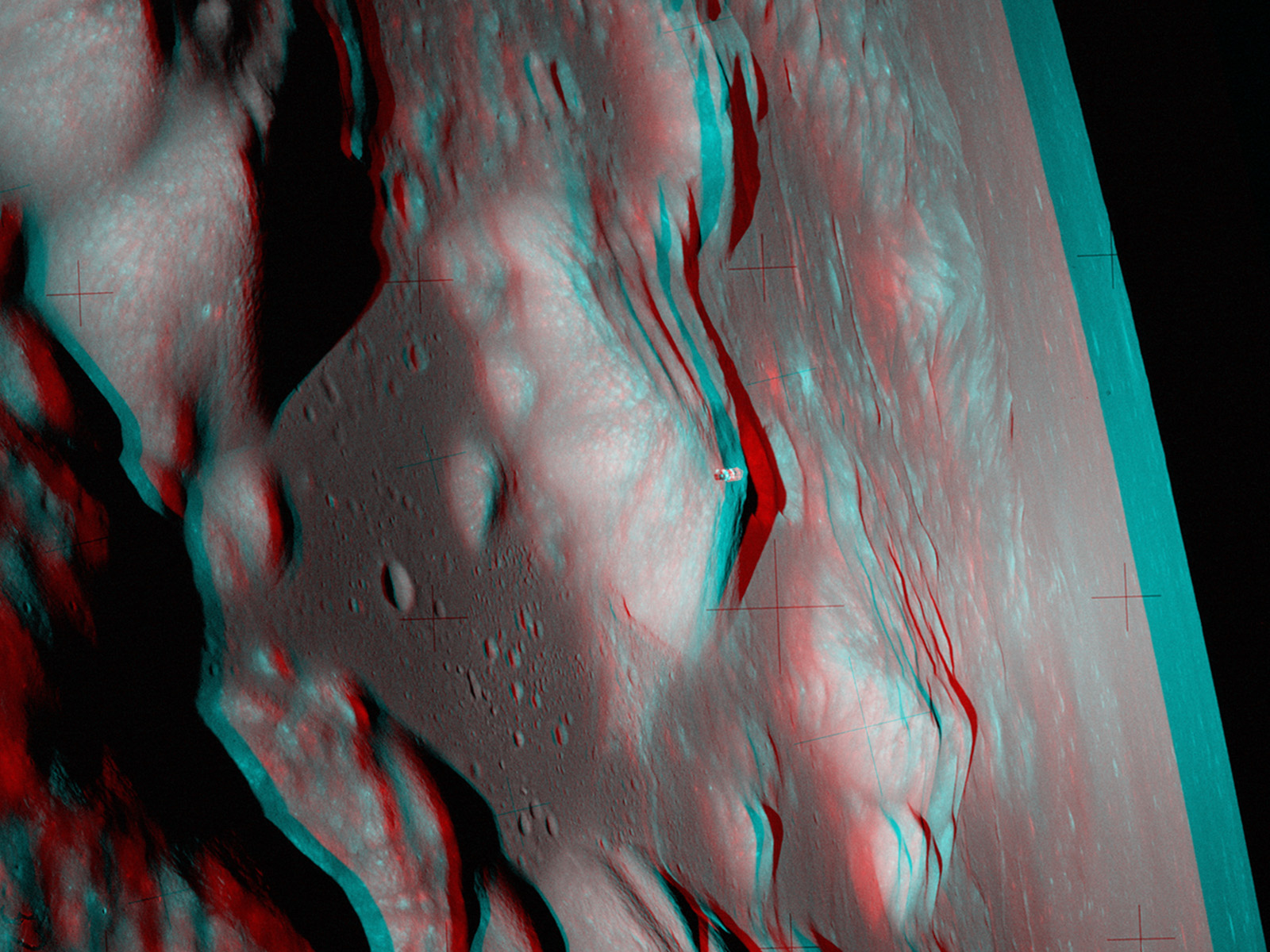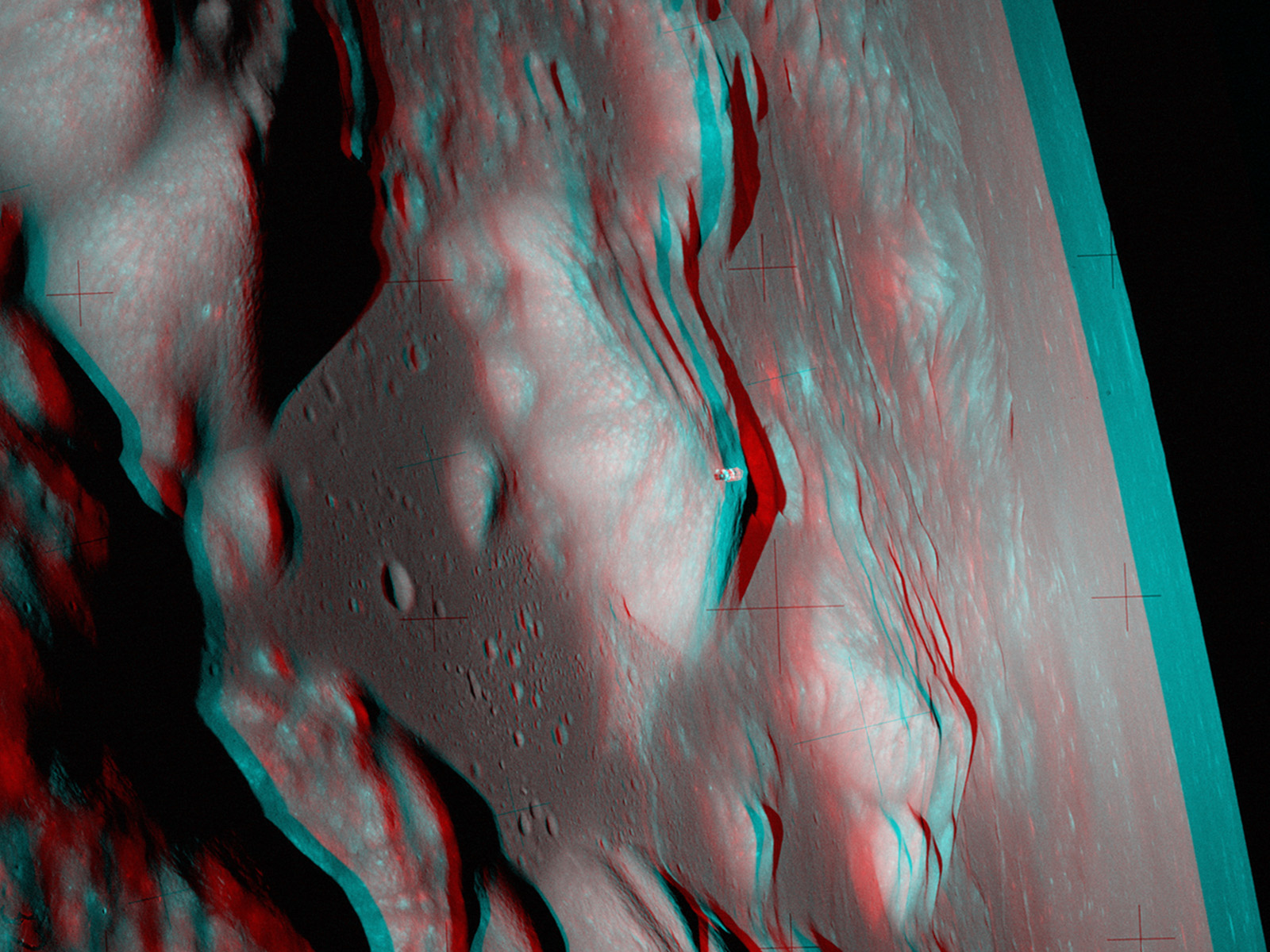
Get out your red/blue glasses and check out this stereo view of another world. Fifty years ago the scene was recorded by Apollo 17 mission commander Eugene Cernan on December 11, 1972, one orbit before descending to land on the Moon. The stereo anaglyph was assembled from two photographs (AS17-147-22465, AS17-147-22466) captured from his vantage point on board the Lunar Module Challenger as he and Dr. Harrison Schmitt flew over Apollo 17's landing site in the Taurus-Littrow Valley. The broad, sunlit face of the mountain dubbed South Massif rises near the center of the frame, above the dark floor of Taurus-Littrow to its left. Piloted by Ron Evans, the Command Module America is visible in orbit in the foreground against the South Massif's peak. Beyond the mountains, toward the lunar limb, lies the Moon's Mare Serenitatis.
Crédito: NASA, Apollo 17 Sacar tus gafas rojo/azul y examina esta vista estereoscópica de otro mundo. Hace cincuenta años, la escena fue registrada por el comandante de la misión Apollo 17, Eugene Cernan, el 11 de diciembre de 1972, una órbita antes de descender para aterrizar en la Luna. El anaglifo estereoscópico fue ensamblado a partir de dos fotografías (AS17-147-22465, AS17-147-22466) capturadas desde su punto de observación a bordo del Módulo Lunar Challenger, mientras él y el Dr. Harrison Schmitt sobrevolaban el lugar de aterrizaje de Apollo 17 en el Valle de Taurus-Littrow. La amplia cara iluminada del monte denominado South Massif se eleva cerca del centro del marco, sobre el suelo oscuro de Taurus-Littrow a su izquierda. El Módulo Comando América, pilotado por Ron Evans, es visible en órbita en primer plano, frente a la cima del South Massif. Más allá de las montañas, hacia el borde lunar, se extiende el Mar de la Serenidad de la Luna.