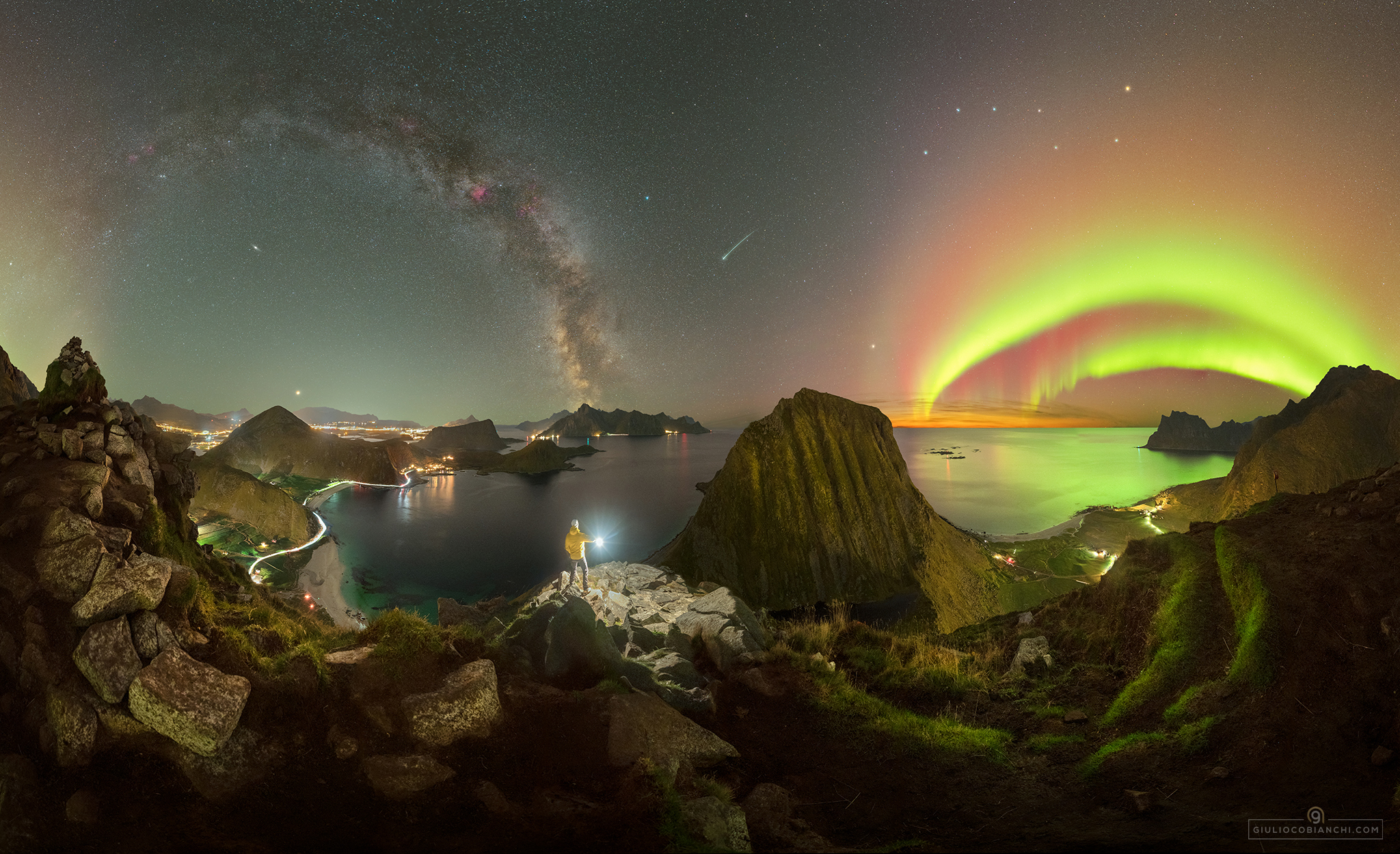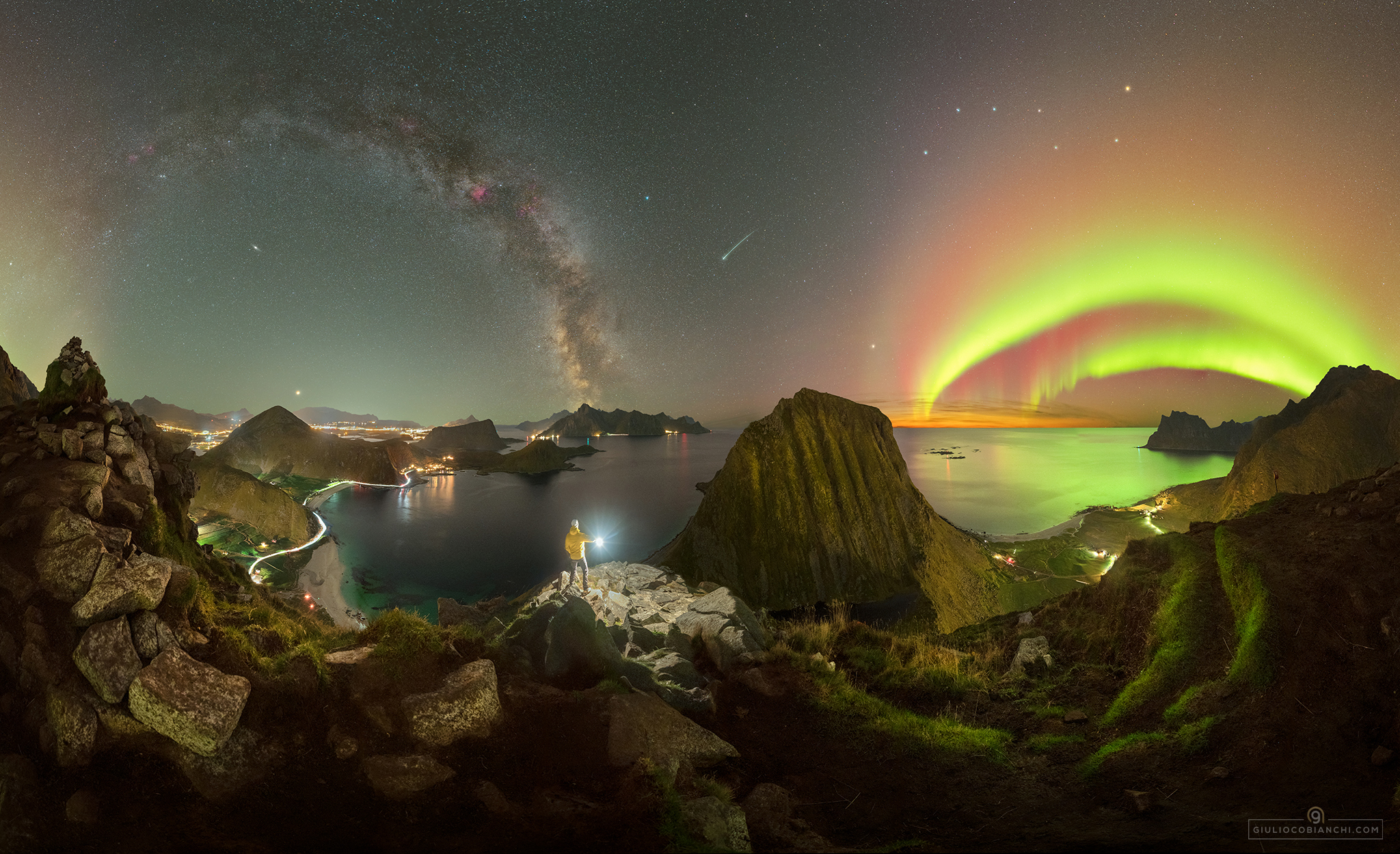
Can the night sky be both art and science? If so, perhaps the featured image is an example. The digital panorama was composed of 10 landscape and 10 sky images all taken on the same night, from the same location, and with the same camera. Iconic features in the image have been artfully brightened, and the ground nearby was artfully illuminated. Visible in the foreground is the creative photographer anchoring an amazing view from the rugged Lofoten Islands of Norway, two months ago, by holding a lamp. Far in the distance are three prominent arches: our Milky Way Galaxy on the left, while a scientifically-unusual double-arced aurora is documented on the right. A meteor is highlighted between them. Other notable skylights include, left to right, the Andromeda Galaxy, the planet Jupiter, the star Vega, and the stars that compose the Big Dipper asterism.
¿Puede el cielo nocturno ser a la vez arte y ciencia? Si es así, quizás la imagen destacada sea un ejemplo. El panorama digital fue compuesto con 10 imágenes de paisaje y 10 del cielo, todas tomadas la misma noche, desde el mismo lugar y con la misma cámara. Características icónicas en la imagen han sido artísticamente aclaradas, y el suelo cercano ha sido iluminado de manera artística. En primer plano se ve al fotógrafo creativo sosteniendo una lámpara para fijar una vista asombrosa desde las rúgidas islas Lofoten de Noruega, hace dos meses. Muy lejos, en el horizonte, se encuentran tres arcos prominentes: nuestra galaxia Vía Láctea a la izquierda, mientras que a la derecha se documenta un aurora doble arqueada científicamente inusual. Entre ellos se destaca un meteoro. Otros elementos notables en el cielo incluyen, de izquierda a derecha, la galaxia Andrómeda, el planeta Júpiter, la estrella Vega y las estrellas que componen el asterismo de la Osa Mayor.