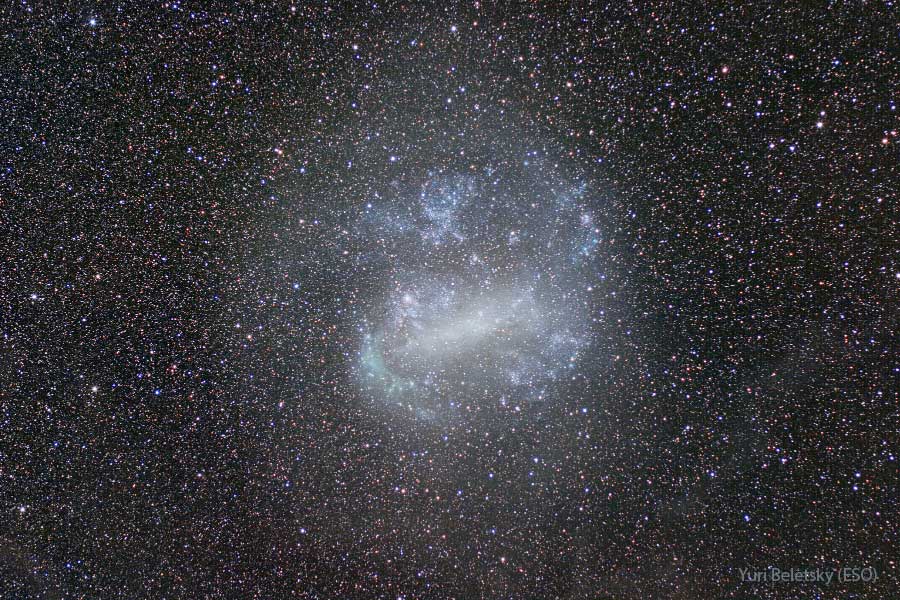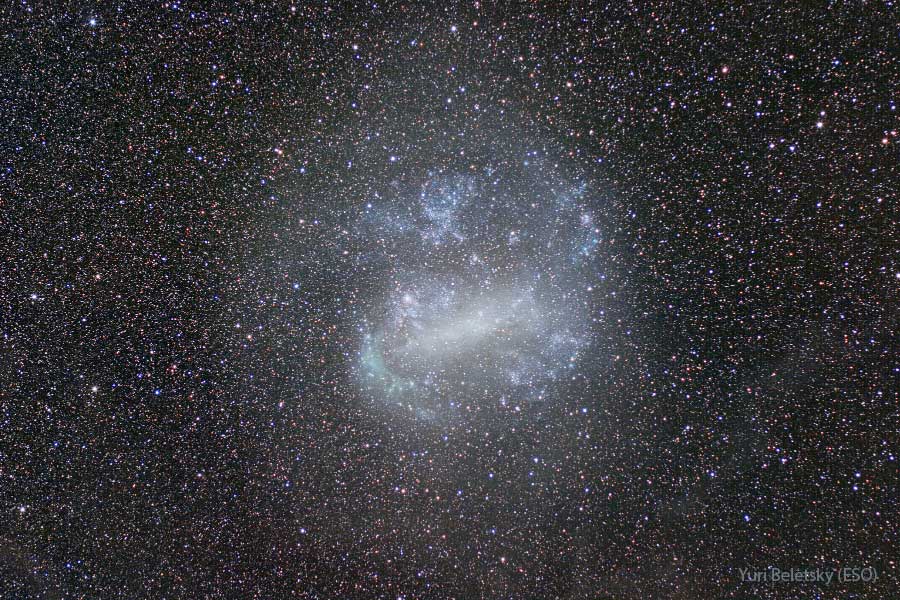
Is this a spiral galaxy? No. Actually, it is the Large Magellanic Cloud (LMC), the largest satellite galaxy of our own Milky Way Galaxy. The LMC is classified as a dwarf irregular galaxy because of its normally chaotic appearance. In this deep and wide exposure, however, the full extent of the LMC becomes visible. Surprisingly, during longer exposures, the LMC begins to resemble a barred spiral galaxy. The Large Magellanic Cloud lies only about 180,000 light-years distant towards the constellation of the Dolphinfish (Dorado). Spanning about 15,000 light-years, the LMC was the site of SN1987A, the brightest and closest supernova in modern times. Together with the Small Magellanic Cloud (SMC), the LMC can be seen in Earth's southern hemisphere with the unaided eye. Your Sky Surprise: What picture did APOD feature on your birthday? (post 1995)
¿Es esta una galaxia en espiral? No. De hecho, se trata de la Gran Nube de Magallanes (LMC, por sus siglas en inglés), la galaxia satélite más grande de nuestra propia Galaxia Vía Láctea. La LMC se clasifica como una galaxia enana irregular debido a su apariencia normalmente caótica. Sin embargo, en esta exposición profunda y amplia, se hace visible la extensión completa de la LMC. Sorprendentemente, durante exposiciones más largas, la LMC comienza a parecerse a una galaxia en espiral con barra. La Gran Nube de Magallanes se encuentra a solo unos 180 000 años luz de distancia, en dirección a la constelación del Pez Vela (Dorado). Con una extensión de unos 15 000 años luz, la LMC fue el lugar de SN1987A, la supernova más brillante y cercana de la era moderna. Junto con la Pequeña Nube de Magallanes (SMC), la LMC es visible a simple vista en el hemisferio sur de la Tierra. Tu sorpresa del cielo: ¿Qué imagen presentó APOD en tu fecha de nacimiento? (desde 1995)