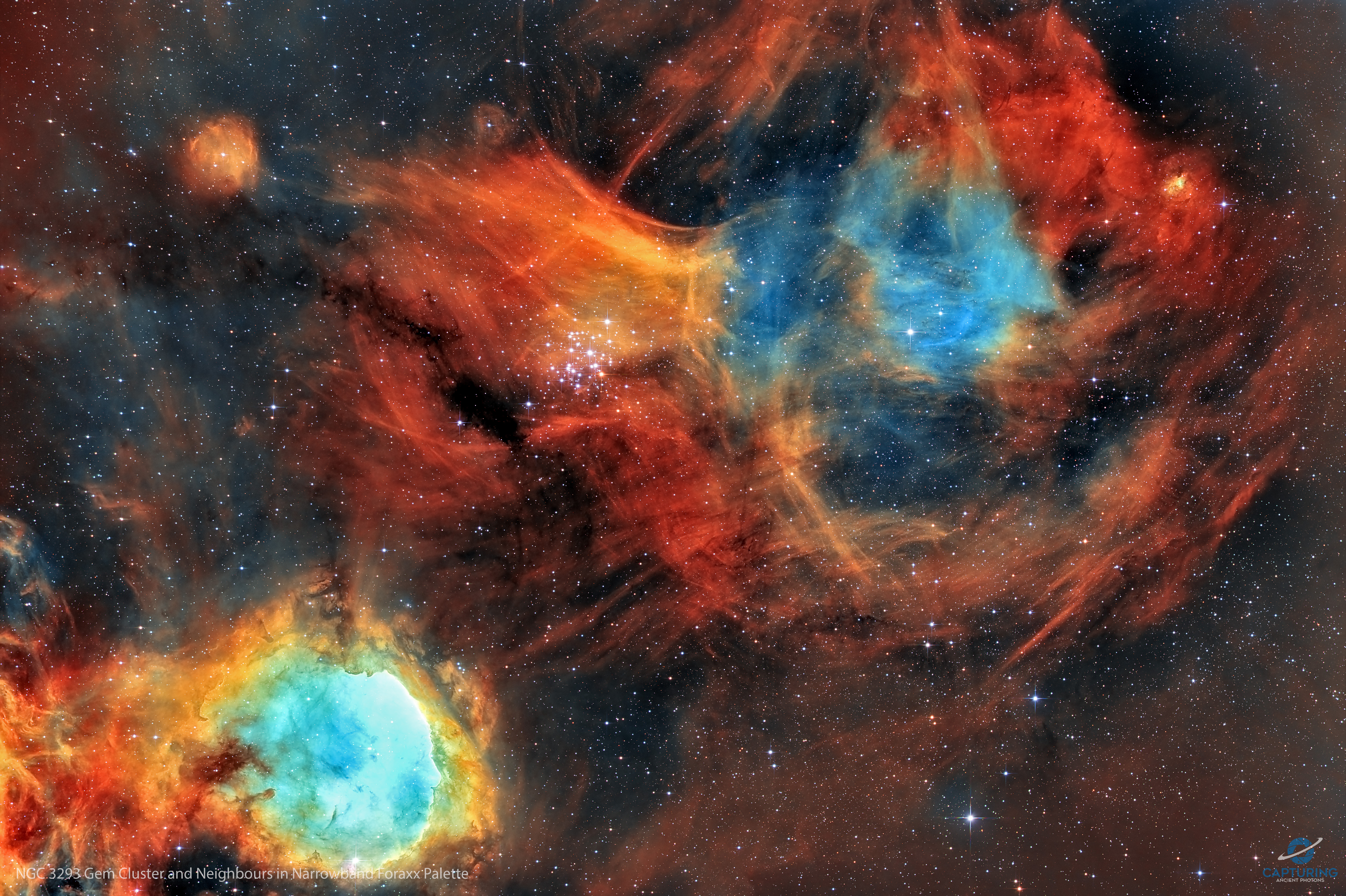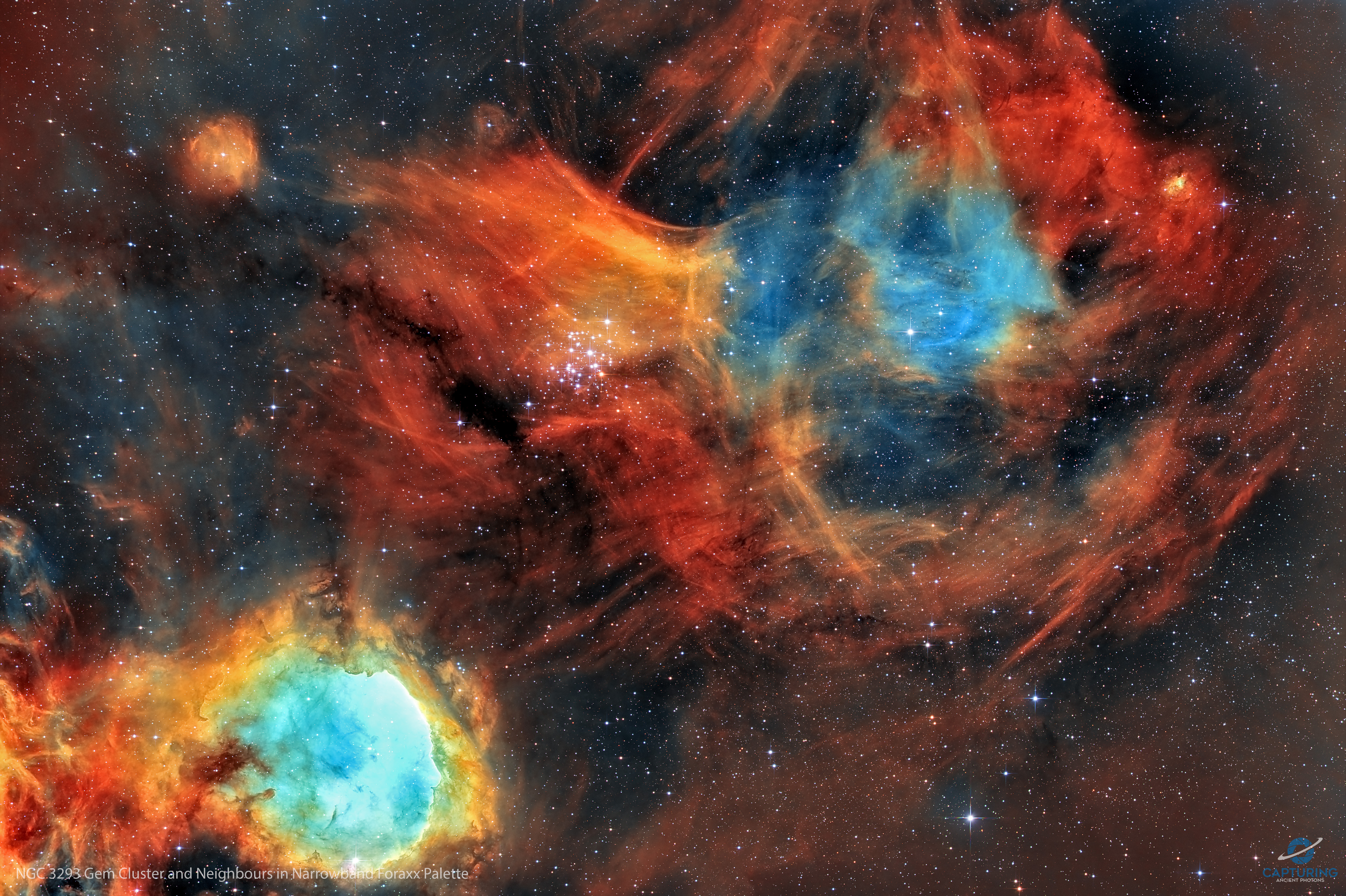
The Great Carina Nebula is home to strange stars and iconic nebulas. Named for its home constellation, the huge star-forming region is larger and brighter than the Great Orion Nebula but less well known because it is so far south -- and because so much of humanity lives so far north. The featured image shows in great detail the northernmost part of the Carina Nebula. On the bottom left is the Gabriela Mistral Nebula consisting of an emission nebula of glowing gas (IC 2599) surrounding the small open cluster of stars (NGC 3324). Above the image center is the larger star cluster NGC 3293, while to its right is the emission nebula Loden 153. The most famous occupant of the Carina Nebula, however, is not shown. Off the image to the lower right is the bright, erratic, and doomed star known as Eta Carinae -- a star once one of the brightest stars in the sky and now predicted to explode in a supernova sometime in the next few million years.
La Gran Nebulosa de Carina alberga estrellas extrañas e iconicas nebulosas. Nombrada en honor a su constelación de origen, esta vasta región de formación estelar es más grande y brillante que la Gran Nebulosa de Orión, pero es menos conocida debido a su ubicación tan al sur — y porque gran parte de la humanidad vive tan al norte. La imagen destacada muestra con gran detalle la parte más septentrional de la Nebulosa de Carina. En la esquina inferior izquierda se encuentra la Nebulosa Gabriela Mistral, compuesta por una nebulosa de emisión de gas brillante (IC 2599) que rodea al pequeño cúmulo abierto de estrellas (NGC 3324). Encima del centro de la imagen se encuentra el cúmulo estelar más grande NGC 3293, mientras que a su derecha se encuentra la nebulosa de emisión Loden 153. Sin embargo, el ocupante más famoso de la Nebulosa de Carina no se muestra en la imagen. Fuera de la imagen, en la parte inferior derecha, se encuentra la brillante, errática y condenada estrella conocida como Eta Carinae — una estrella que en una época fue una de las más brillantes del cielo y que ahora se predice que explotará en una supernova en algún momento de los próximos millones de años.