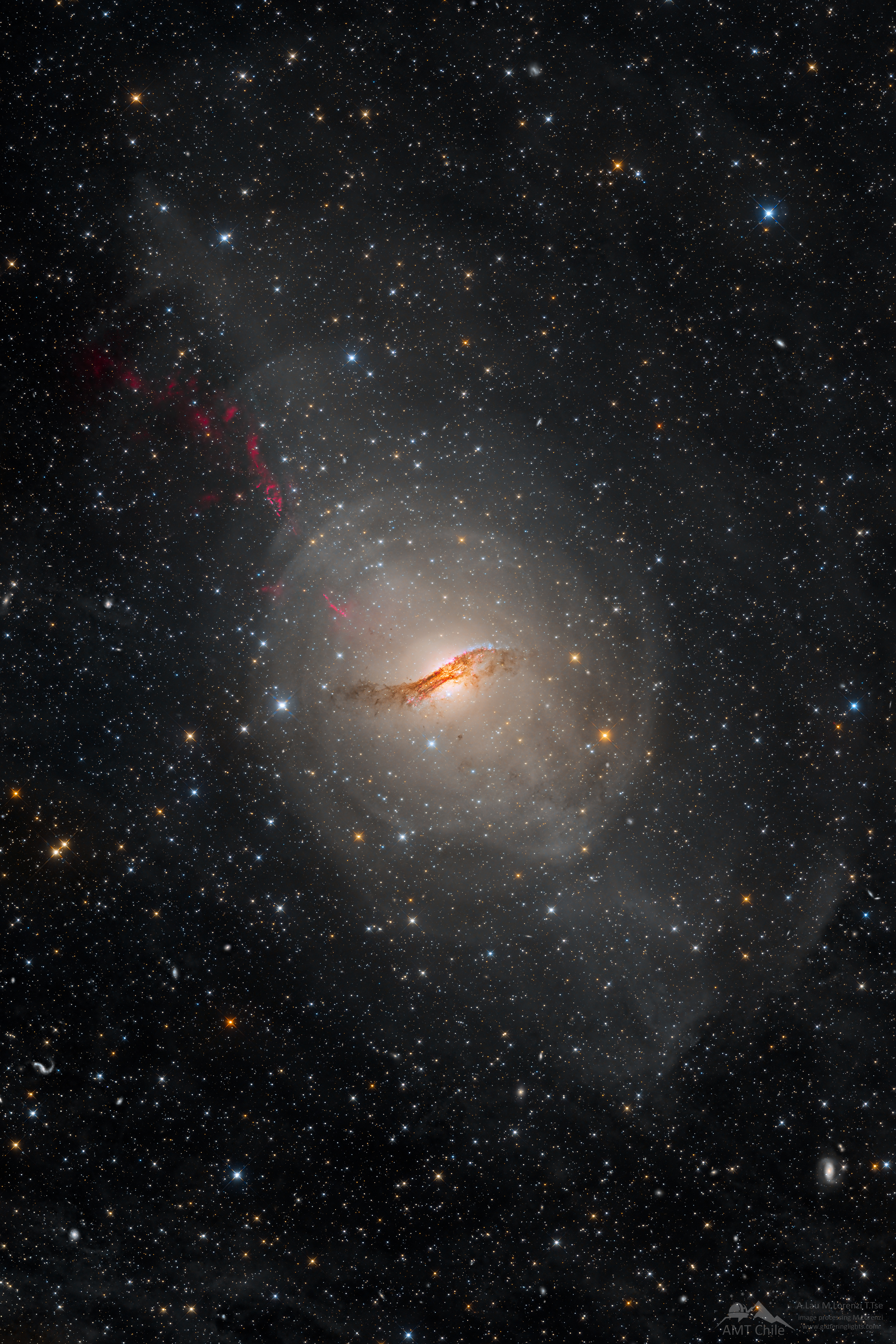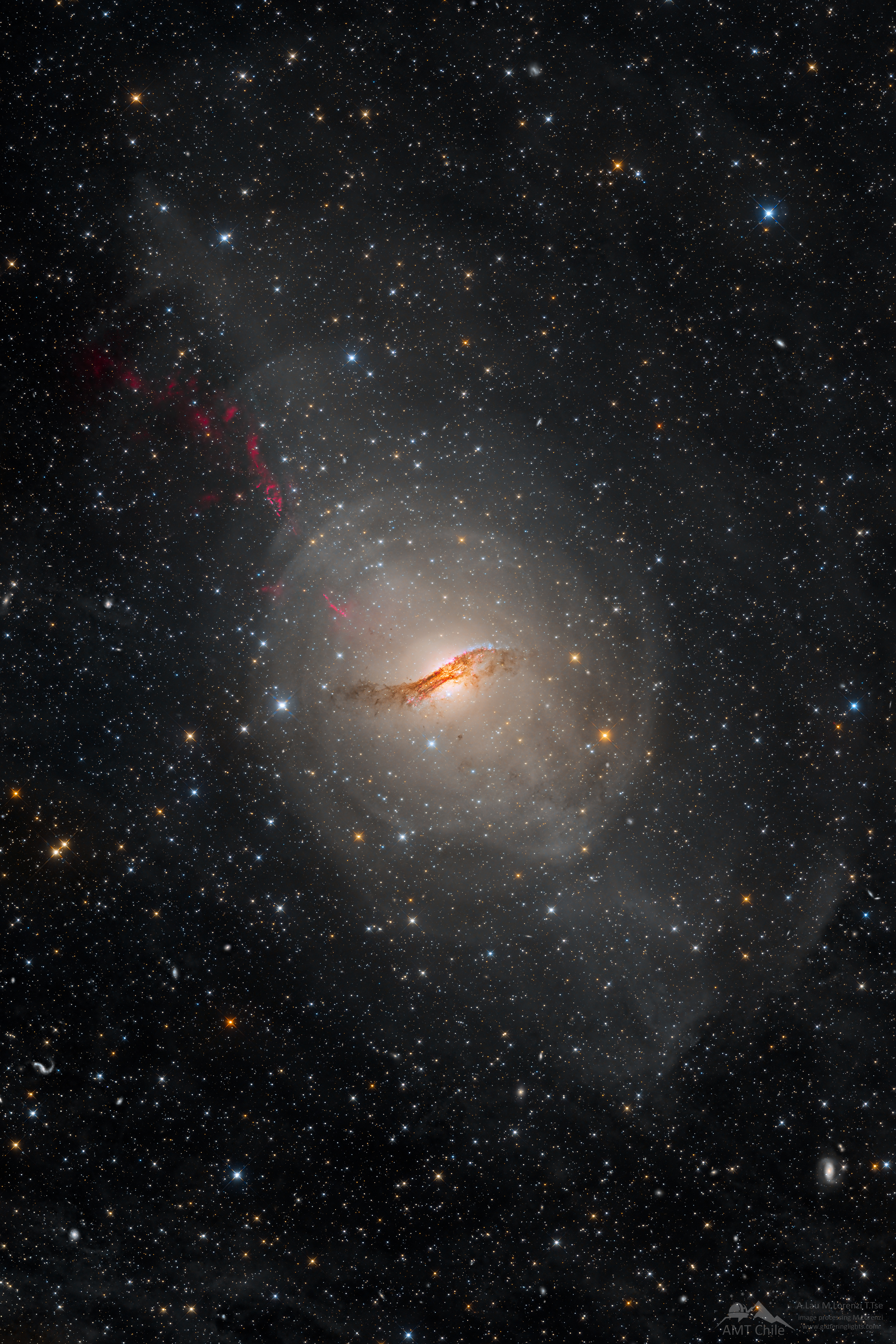
Galaxies are fascinating. In galaxies, gravity alone holds together massive collections of stars, dust, interstellar gas, stellar remnants and dark matter. Pictured is NGC 5128, better known as Centaurus A. Cen A is the fifth brightest galaxy on the sky and is located at a distance of about 12 million light years from Earth. The warped shape of Cen A is the result of a merger between an elliptical and a spiral galaxy. Its active galactic nucleus harbors a supermassive black hole that is about 55 million times more massive than our Sun. This central black hole ejects a fast jet visible in both radio and X-ray light. Filaments of the jet are visible in red in the upper left. New observations by the Event Horizon Telescope have revealed a brightening of the jet only towards its edges -- but for reasons that are currently unknown and an active topic of research. At NASA it's: Black Hole Week
Las galaxias son fascinantes. En las galaxias, la gravedad sola mantiene unidas masivas colecciones de estrellas, polvo, gas interestelar, restos estelares y materia oscura. La imagen muestra NGC 5128, más conocida como Centaurus A. Cen A es la quinta galaxia más brillante en el cielo y se encuentra a una distancia de aproximadamente 12 millones de años luz de la Tierra. La forma distorsionada de Cen A es el resultado de una fusión entre una galaxia elíptica y una galáctica espiral. Su núcleo galáctico activo alberga un agujero negro supermasivo que es aproximadamente 55 millones de veces más masivo que nuestro Sol. Este agujero negro central expulsa un chorro rápido visible tanto en ondas de radio como en luz de rayos X. Filamentos del chorro son visibles en rojo en la parte superior izquierda. Nuevas observaciones del Telescopio del Horizonte de Sucesos han revelado un aumento de brillo del chorro solo hacia sus bordes, pero por razones que actualmente son desconocidas y un tema activo de investigación.