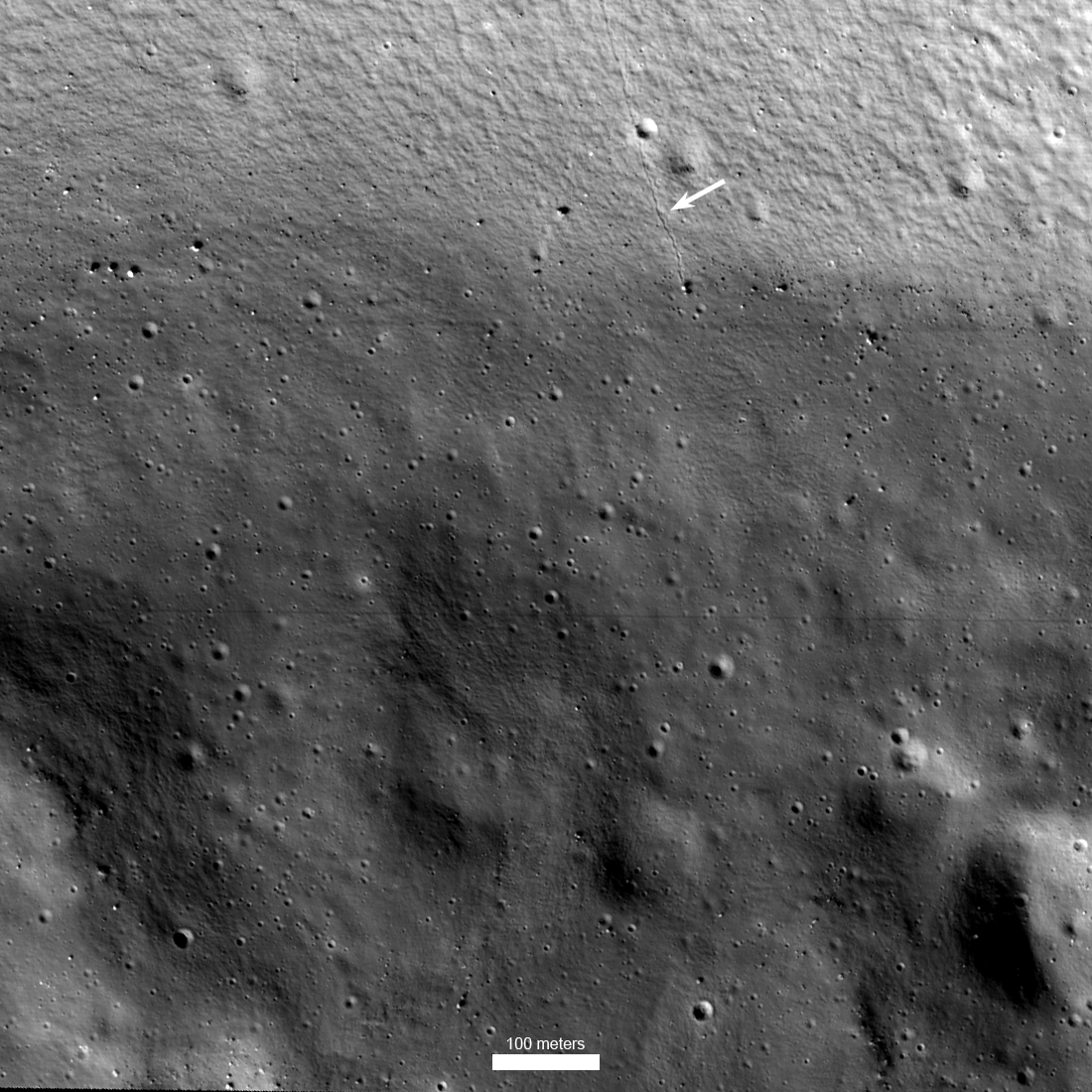
Shackleton crater lies at the lunar south pole. Peaks along the rim of the 21 kilometer diameter crater are in sunlight, but Shackleton's floor is in dark permanent shadow. Still, this image of the shadowed rim wall and floor of Shackleton crater was captured from NASA's ShadowCam, an instrument on board the Korea Pathfinder Lunar Orbiter (KPLO) launched in August 2022. About 200 times more sensitive than, for example, the Lunar Reconnaissance Orbiter's Narrow Angle Camera, ShadowCam was designed to image the permanently shadowed regions of the lunar surface. Avoiding direct sunlight, those regions are expected to be reservoirs of water-ice and other volatiles deposited by ancient cometary impacts and useful to future Moon missions. Of course, the permanently shadowed regions are still illuminated by reflections of sunlight from nearby lunar terrain. In this stunningly detailed ShadowCam image, an arrow marks the track made by a single boulder rolling down Shackleton crater's wall. The image scale is indicated at the bottom of the frame.
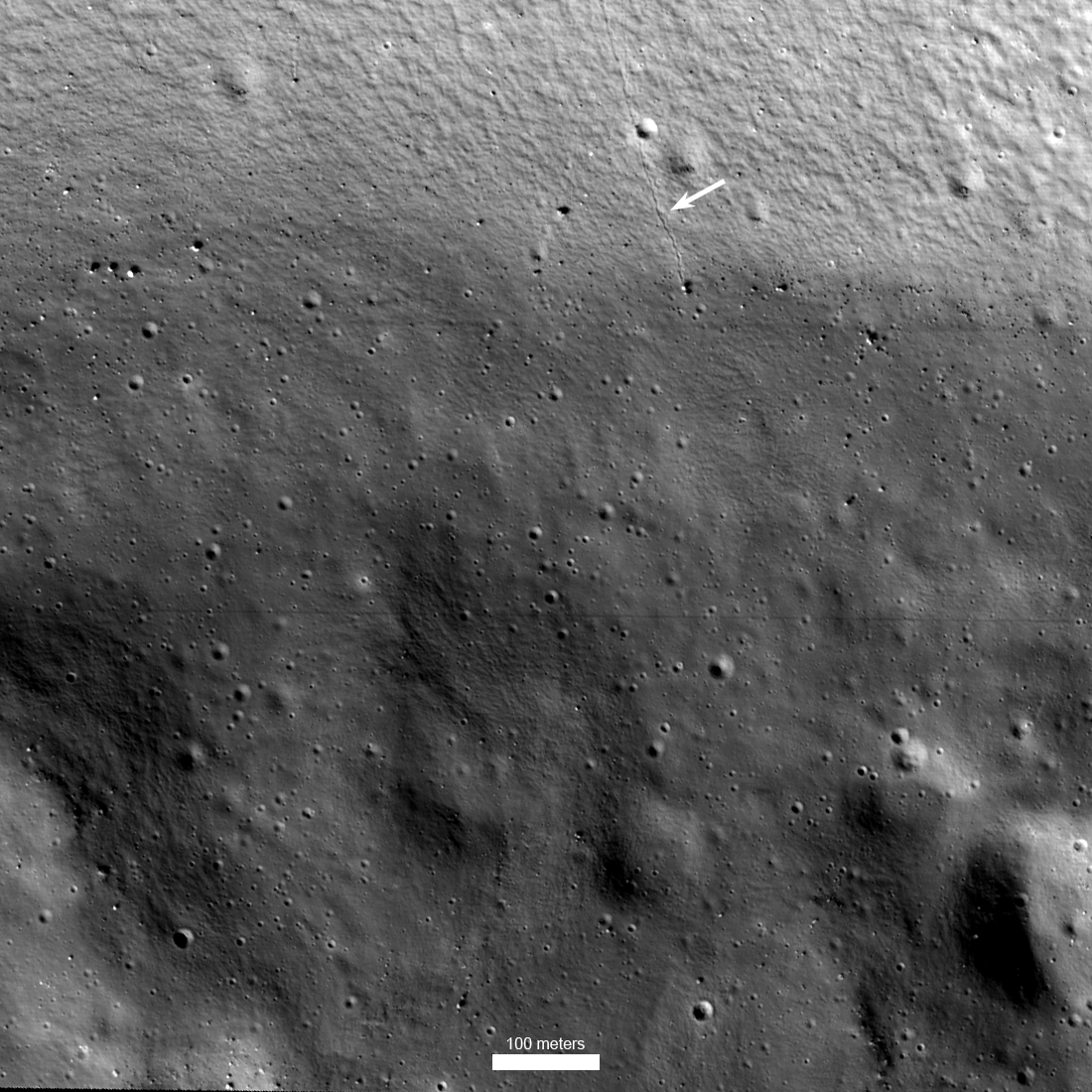
Crédito: NASA, KPLO, ShadowCam El cráter Shackleton se encuentra en el polo sur lunar. Las crestas a lo largo del borde del cráter de 21 kilómetros de diámetro están iluminadas por el sol, pero el fondo de Shackleton se encuentra en una sombra permanente oscura. Sin embargo, esta imagen de la pared y el fondo en sombra del cráter Shackleton fue capturada desde ShadowCam de la NASA, un instrumento a bordo del Korea Pathfinder Lunar Orbiter (KPLO), lanzado en agosto de 2022. ShadowCam es aproximadamente 200 veces más sensible, por ejemplo, que la cámara de ángulo estrecho del Lunar Reconnaissance Orbiter. ShadowCam fue diseñado específicamente para capturar imágenes de las regiones permanentemente en sombra de la superficie lunar. Al evitar la luz solar directa, se espera que estas regiones sean depósitos de hielo de agua y otros volátiles depositados por impactos antiguos de cometas, útiles para futuras misiones a la Luna. Por supuesto, las regiones permanentemente en sombra aún están iluminadas por reflejos de la luz solar proveniente del terreno lunar cercano. En esta imagen sorprendentemente detallada de ShadowCam, una flecha marca la pista dejada por un solo bloque que rodó por la pared del cráter Shackleton. La escala de la imagen se indica en la parte inferior del marco.