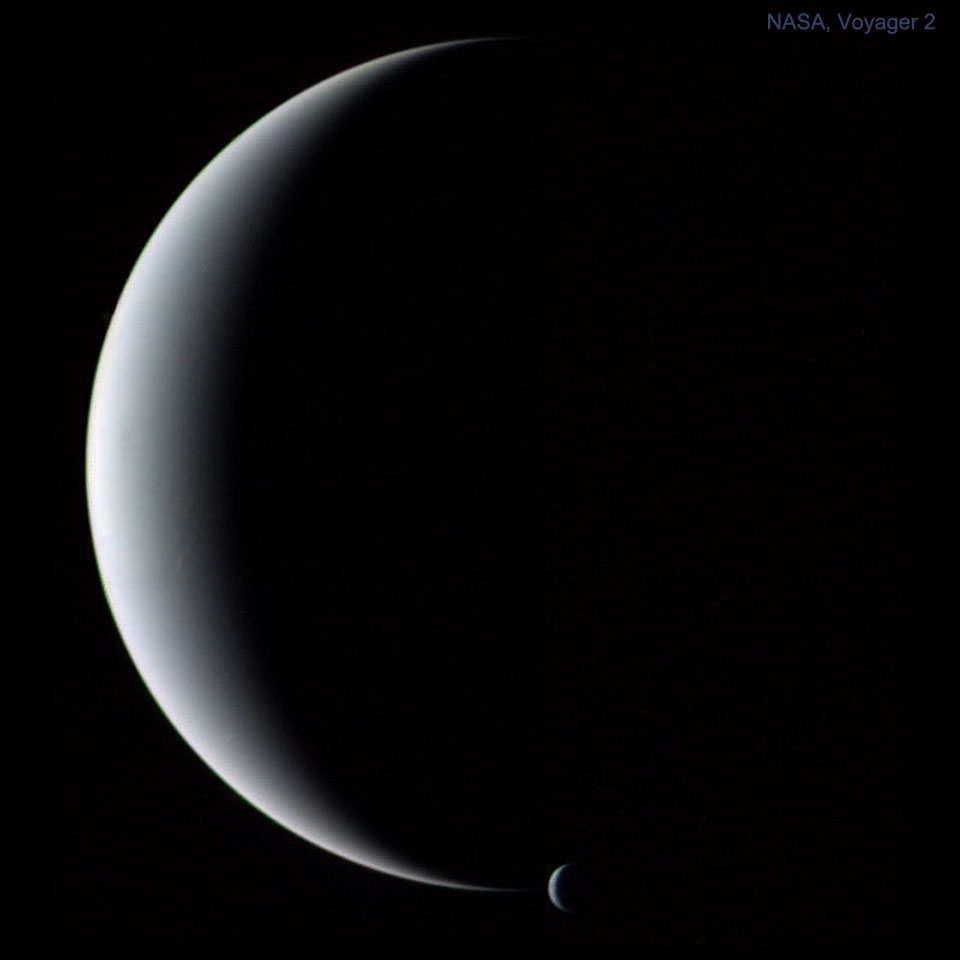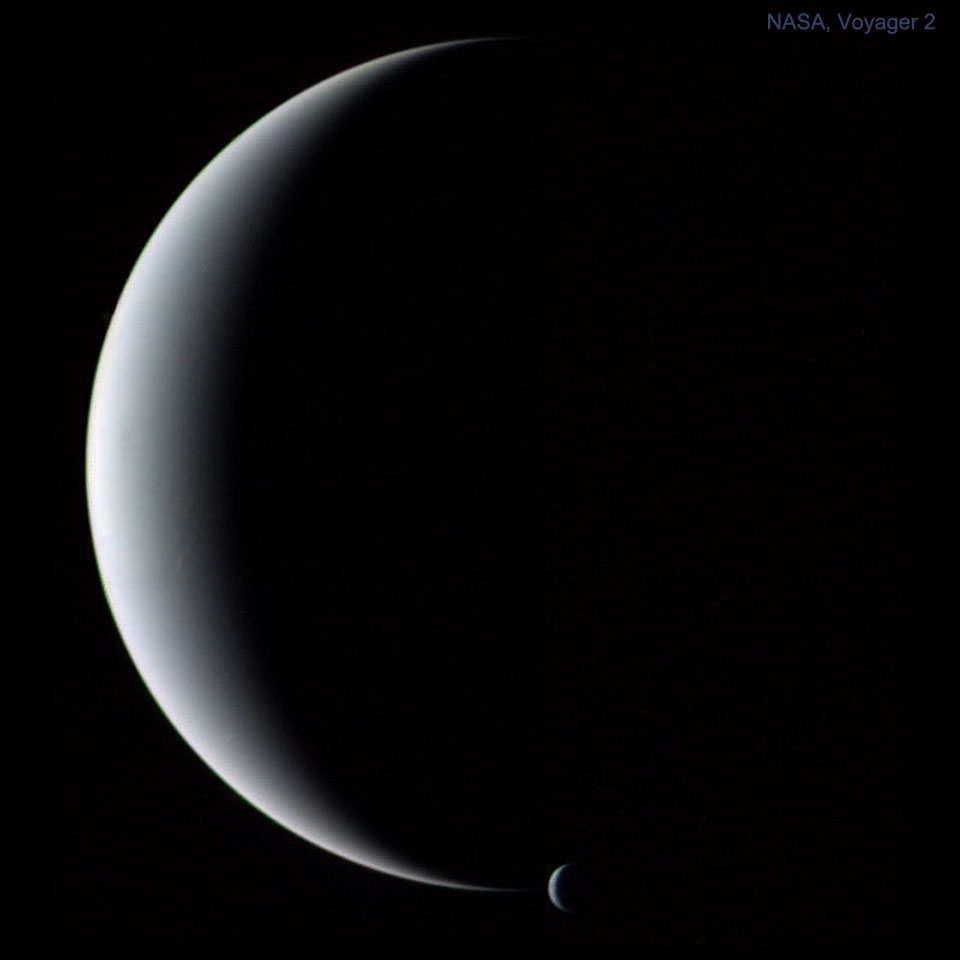
Gliding through the outer Solar System, in 1989 the Voyager 2 spacecraft looked toward the Sun to find this view of most distant planet Neptune and its moon Triton together in a crescent phase. The elegant image of ice-giant planet and largest moon was taken from behind just after Voyager's closest approach. It could not have been taken from Earth because the most distant planet never shows a crescent phase to sunward eyes. Heading for the heliopause and beyond, the spacecraft's parting vantage point also robs Neptune of its familiar blue hue.
Mientras se desplazaba por el sistema solar exterior, en 1989 la nave espacial Voyager 2 miró hacia el Sol para captar esta imagen de Neptuno, el planeta más distante, y su luna Tritón, ambos en fase creciente. La elegante imagen del planeta gigante de hielo y su luna más grande fue tomada desde atrás, poco después del acercamiento más cercano de Voyager. No podría haber sido tomada desde la Tierra, ya que el planeta más distante nunca muestra una fase creciente a los ojos que miran hacia el Sol. Dirigiéndose hacia la heliopausa y más allá, la posición final de la nave espacial también le arrebata a Neptuno su característico tono azul.