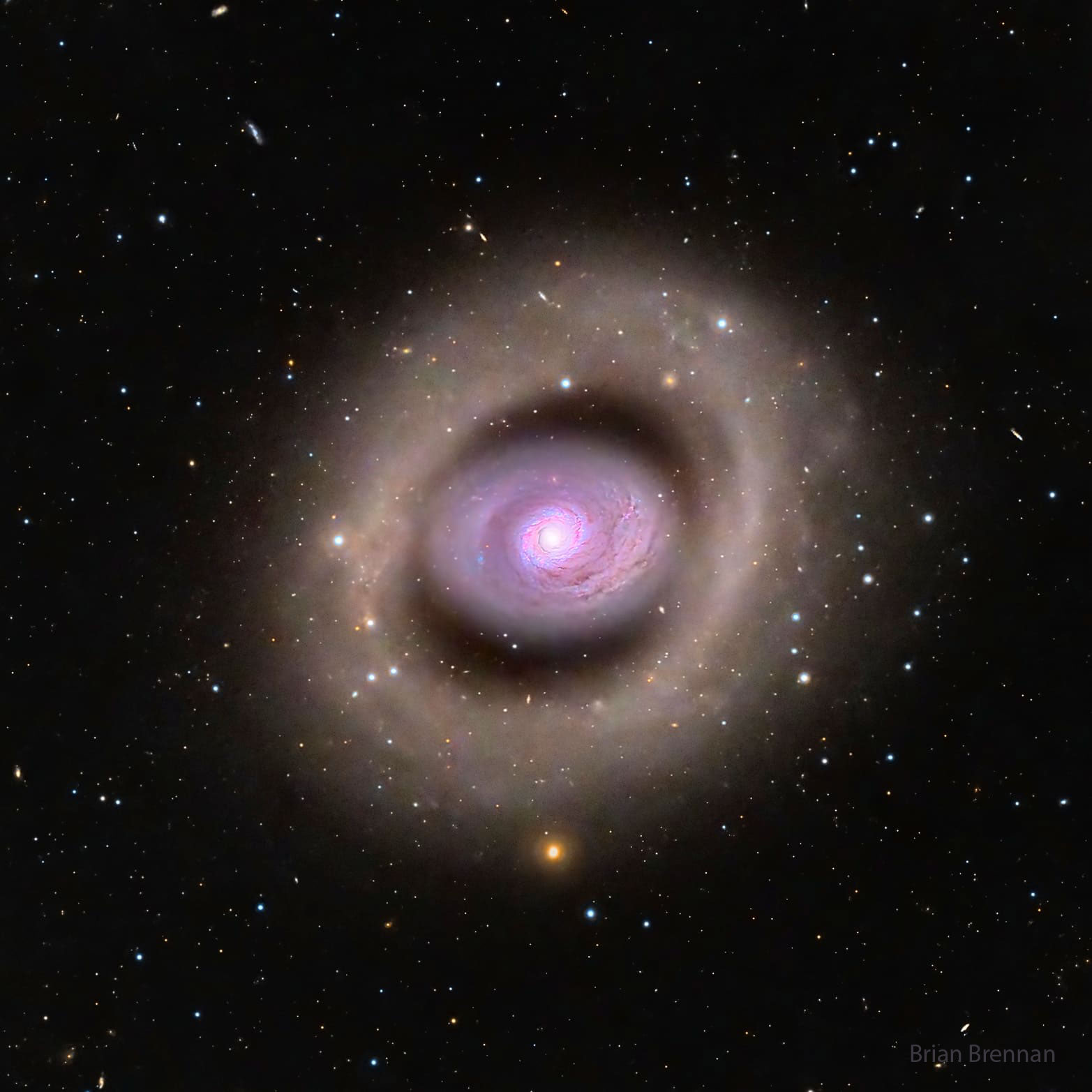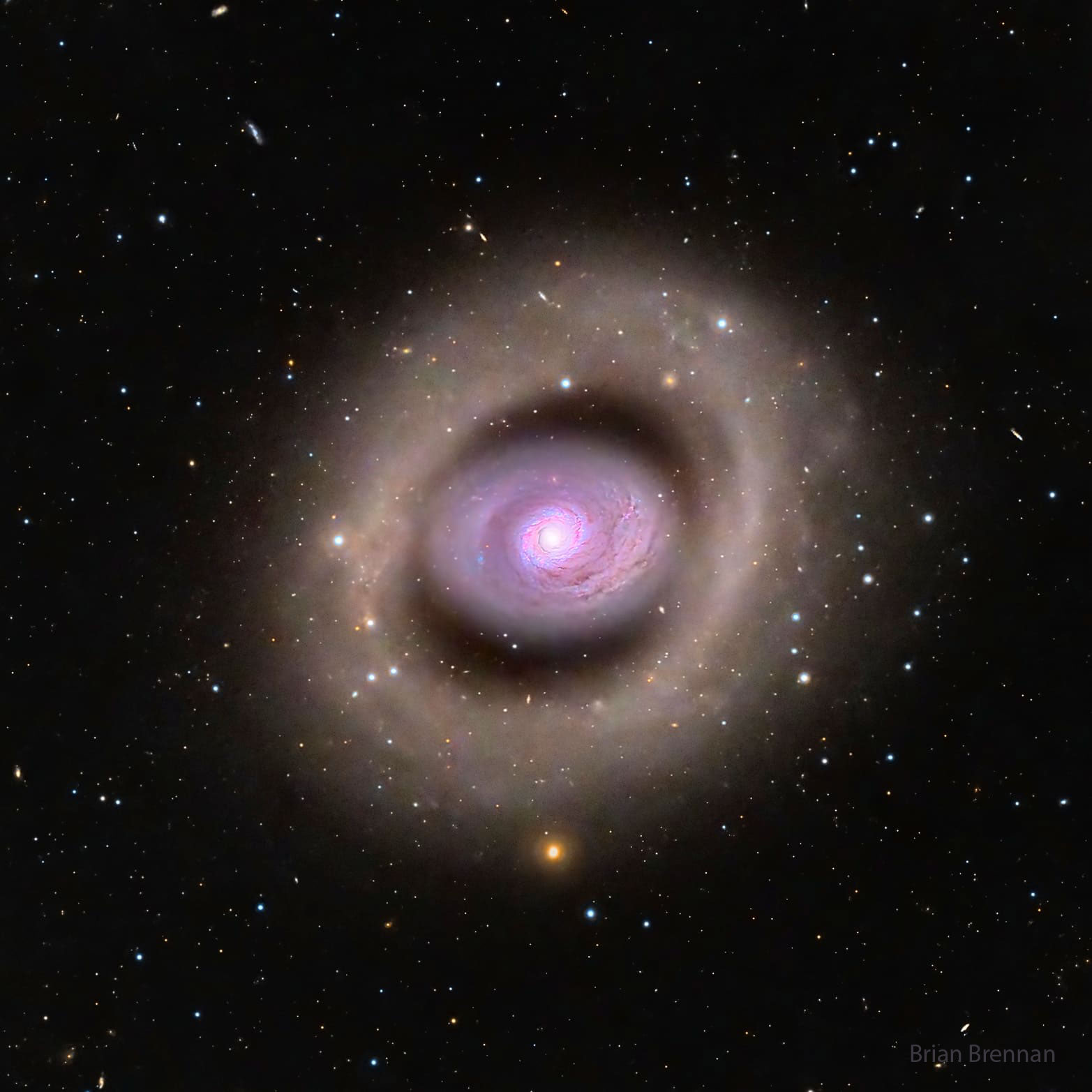
Most galaxies don't have any rings of stars and gas -- why does M94 have two? First, spiral galaxy M94 has an inner ring of newly formed stars surrounding its nucleus, giving it not only an unusual appearance but also a strong interior glow. A leading origin hypothesis holds that an elongated knot of stars known as a bar rotates in M94 and has generated a burst of star formation in this inner ring. Observations have also revealed another ring, an outer ring, one that is more faint, different in color, not closed, and relatively complex. What caused this outer ring is currently unknown. M94, pictured here, spans about 45,000 light years in total, lies about 15 million light years away, and can be seen with a small telescope toward the constellation of the Hunting Dogs (Canes Venatici). More Availability: APOD now accessible via Flipboard.
Crédito: NASA, CGRO SSC La mayoría de las galaxias no tienen anillos de estrellas y gas -- ¿por qué M94 tiene dos? Primero, la galaxia espiral M94 tiene un anillo interior de estrellas recién formadas que rodea su núcleo, lo que le da no solo una apariencia inusual, sino también un brillo interior intenso. Una hipótesis principal sobre su origen sostiene que un nudo alargado de estrellas conocido como barra gira en M94 y ha generado un brote de formación estelar en este anillo interior. Las observaciones también han revelado otro anillo, un anillo exterior, que es más tenue, de color diferente, no cerrado y relativamente complejo. ¿Qué causó este anillo exterior es actualmente desconocido. M94, mostrada aquí, tiene un diámetro total de aproximadamente 45,000 años luz, se encuentra a unos 15 millones de años luz de distancia y puede verse con un telescopio pequeño hacia la constelación de los Perros de Caza (Canes Venatici).