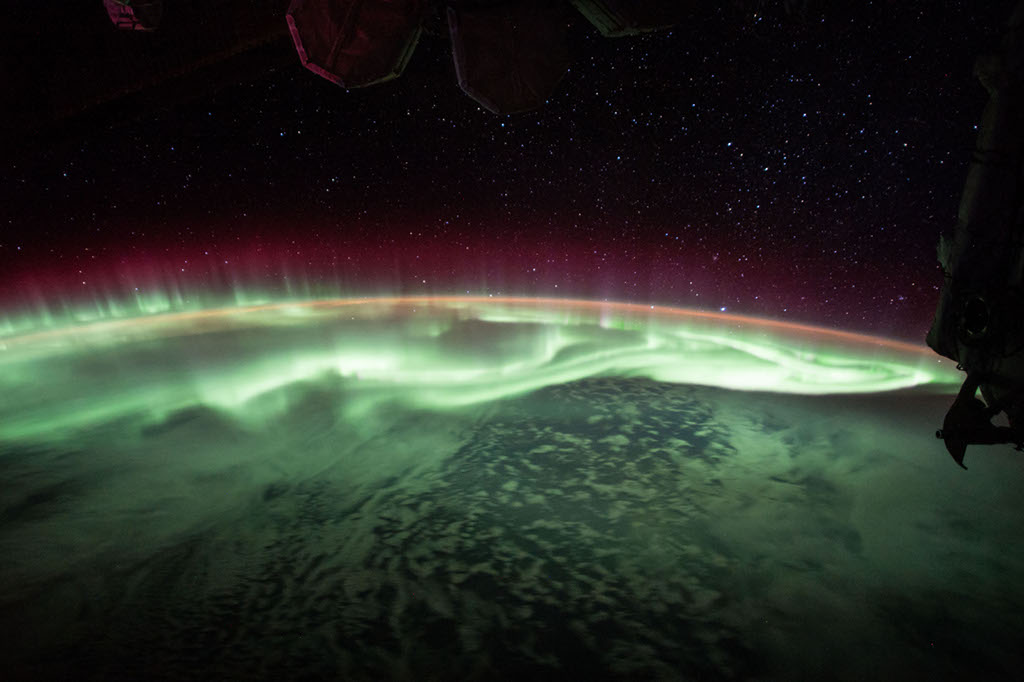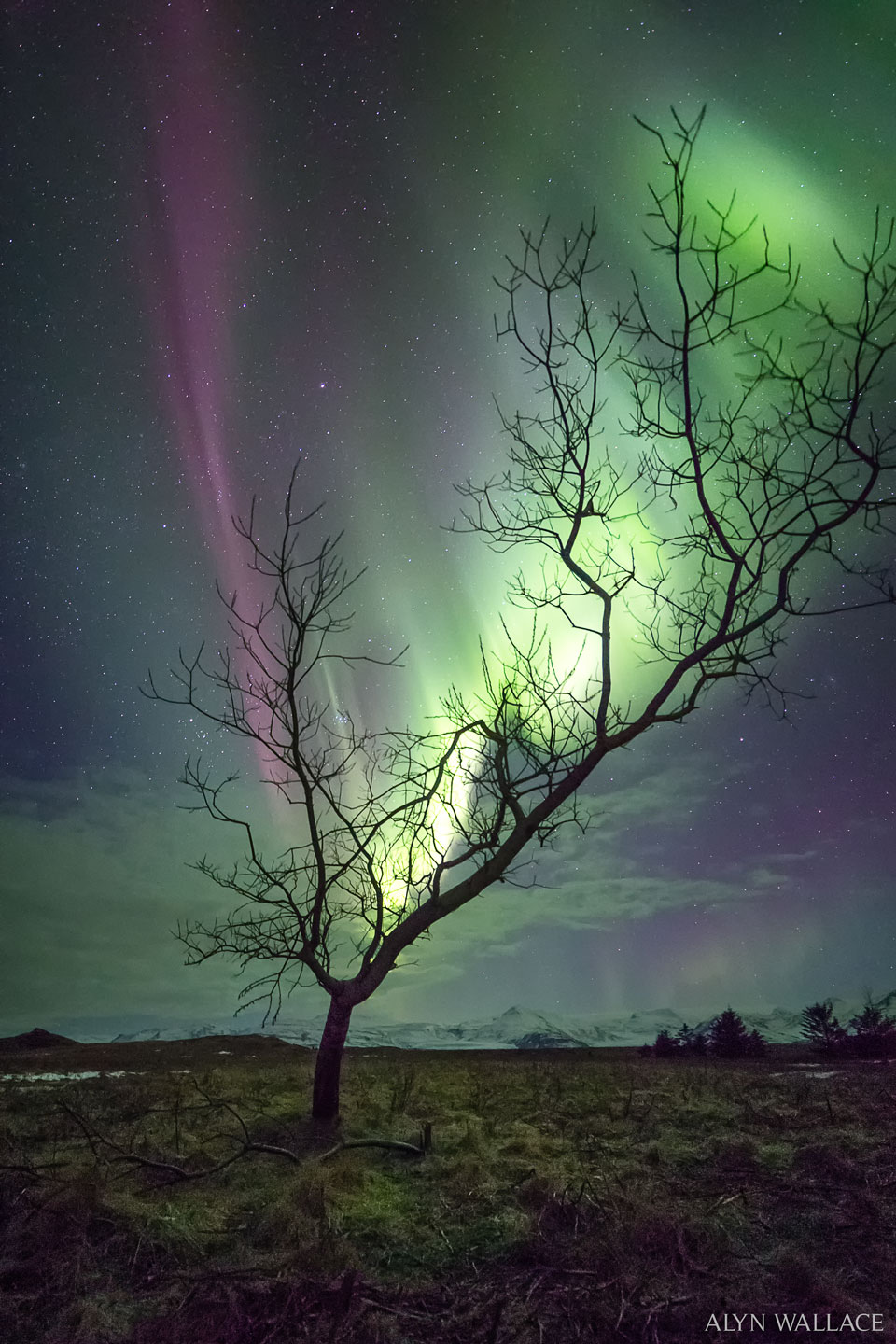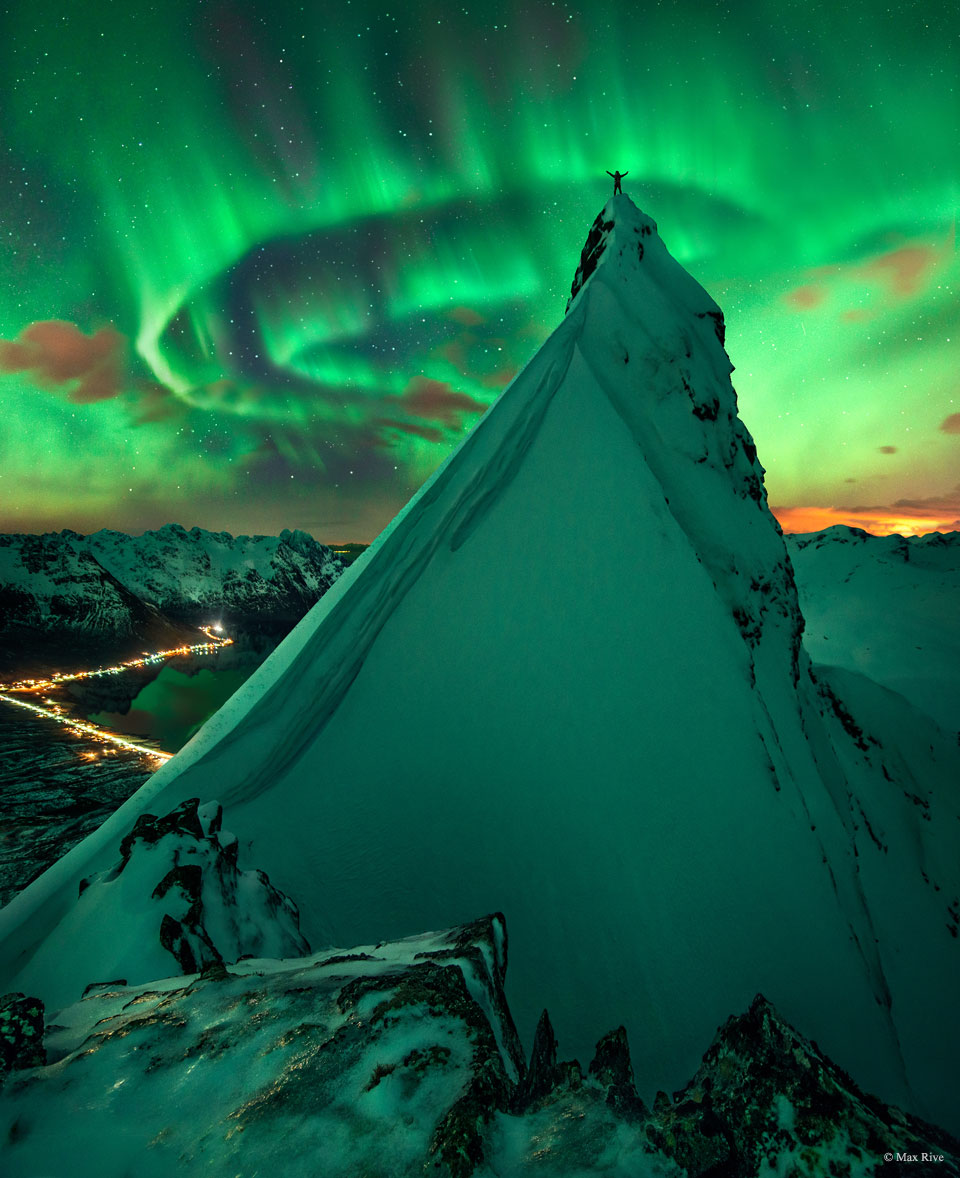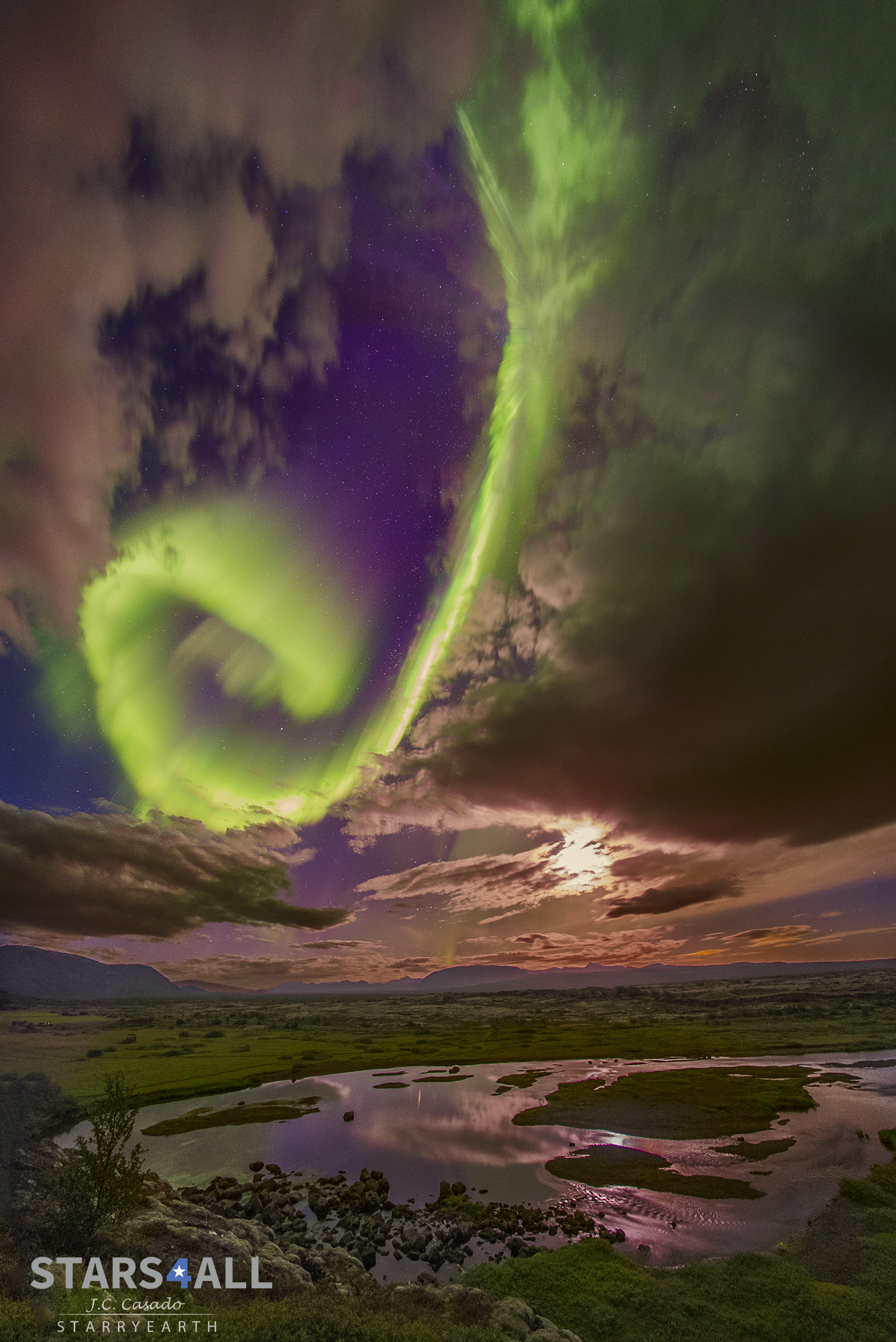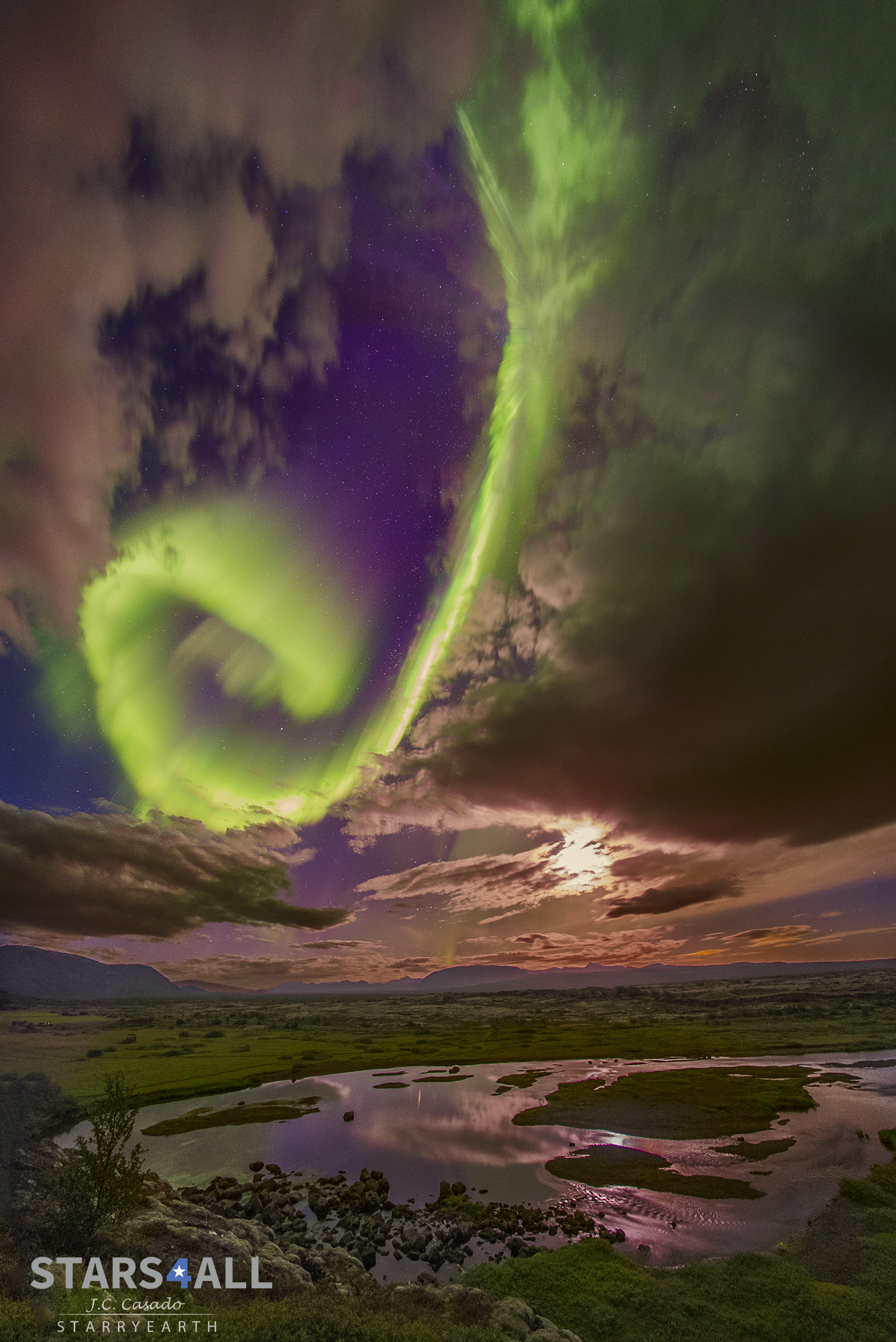
Admire the beauty but fear the beast. The beauty is the aurora overhead, here taking the form of a great green spiral, seen between picturesque clouds with the bright Moon to the side and stars in the background. The beast is the wave of charged particles that creates the aurora but might, one day, impair civilization. In 1859, following notable auroras seen all across the globe, a pulse of charged particles from a coronal mass ejection (CME) associated with a solar flare impacted Earth's magnetosphere so forcefully that it created the Carrington Event. This assault from the Sun compressed the Earth's magnetic field so violently that it created high currents and sparks along telegraph wires, shocking many telegraph operators. Were a Carrington-class event to impact the Earth today, speculation holds that damage might occur to global power grids and electronics on a scale never yet experienced. The featured aurora was imaged in 2016 over Thingvallavatn Lake in Iceland, a lake that partly fills a fault that divides Earth's large Eurasian and North American tectonic plates. Almost Hyperspace: Random APOD Generator
Admira la belleza pero teme a la bestia. La belleza es la aurora sobre nosotros, aquí toma la forma de una gran espiral verde, visible entre nubes pintorescas con la Luna brillante al costado y estrellas en el fondo. La bestia es la ola de partículas cargadas que crea la aurora pero que, algún día, podría afectar a la civilización. En 1859, tras notables auroras vistas en todo el mundo, un pulso de partículas cargadas de una eyección de masa coronal (CME) asociada a una mancha solar impactó la magnetosfera terrestre con tanta fuerza que creó el Evento de Carrington. Este ataque del Sol comprimió el campo magnético terrestre con tanta violencia que generó altas corrientes y chispas a lo largo de los cables de telégrafo, sorprendiendo a muchos operadores de telégrafo. Si un evento de clase Carrington impactara la Tierra hoy, se especula que podría causar daños a las redes eléctricas globales y a la electrónica en una escala nunca antes experimentada. La aurora mostrada fue capturada en 2016 sobre el lago Thingvallavatn en Islandia, un lago que parcialmente llena una falla que divide las grandes placas tectónicas euroasiática y norteamericana de la Tierra.