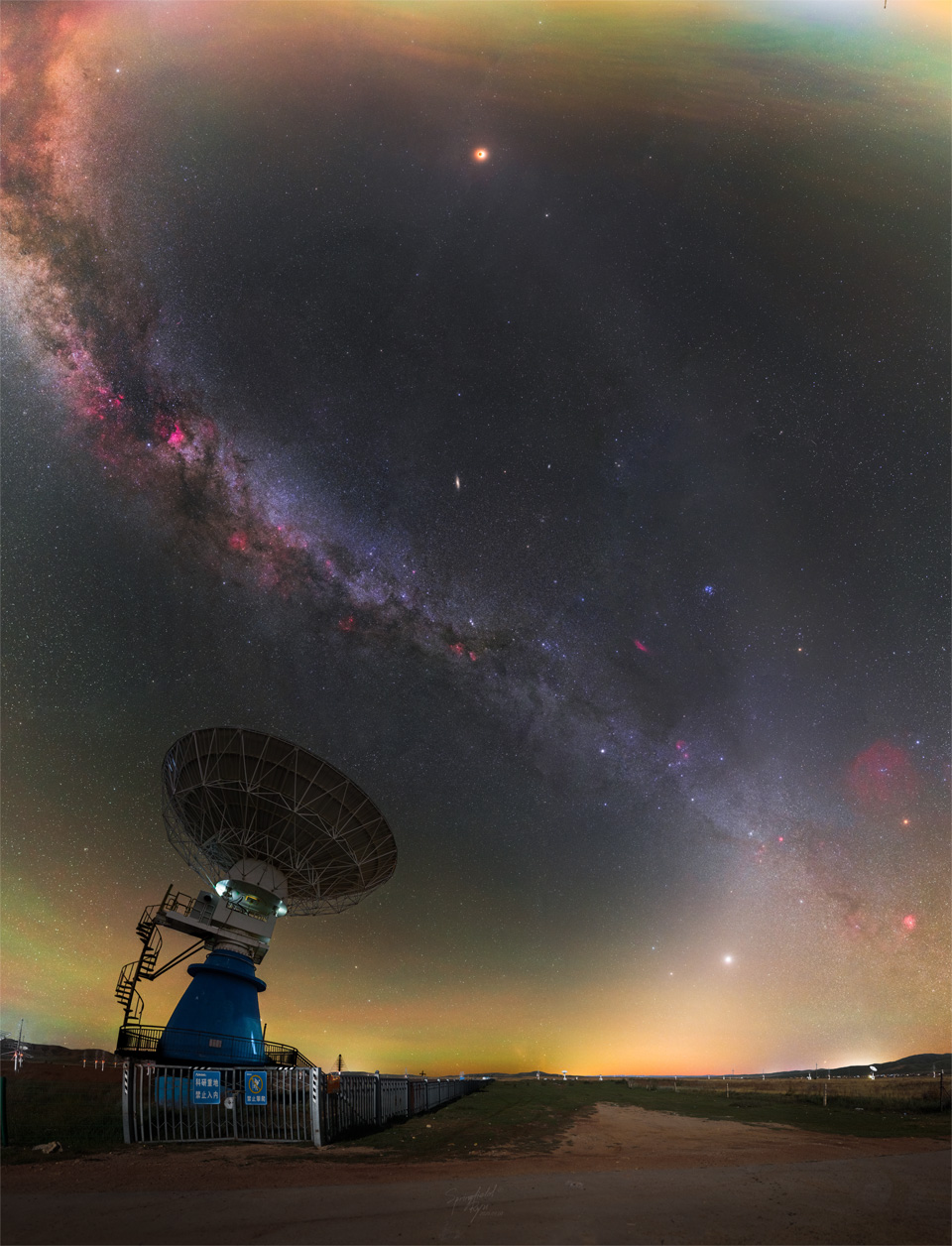
They may look like modern mechanical dinosaurs, but they are enormous swiveling eyes that watch the sky. The High Energy Stereoscopic System (H.E.S.S.) Observatory is composed of four 12-meter reflecting-mirror telescopes surrounding a larger telescope housing a 28-meter mirror. They are designed to detect strange flickers of blue light -- Cherenkov radiation --emitted when charged particles move slightly faster than the speed of light in air. This light is emitted when a gamma ray from a distant source strikes a molecule in Earth's atmosphere and starts a charged-particle shower. H.E.S.S. is sensitive to some of the highest energy photons (TeV) crossing the universe. Operating since 2003 in Namibia, H.E.S.S. has searched for dark matter and has discovered over 50 sources emitting high energy radiation including supernova remnants and the centers of galaxies that contain supermassive black holes. Pictured in June, H.E.S.S. telescopes swivel and stare in time-lapse sequences shot in front of our Milky Way Galaxy and the Magellanic Clouds -- as the occasional Earth-orbiting satellite zips by. Surf the Universe: Random APOD Generator
Pueden parecer dinosaurios mecánicos modernos, pero son enormes ojos que giran y observan el cielo. El Observatorio High Energy Stereoscopic System (H.E.S.S.) está compuesto por cuatro telescopios de espejo reflectante de 12 metros que rodean un telescopio más grande con un espejo de 28 metros. Están diseñados para detectar extraños destellos de luz azul —radiación Cherenkov— emitidos cuando partículas cargadas se mueven ligeramente más rápido que la velocidad de la luz en el aire. Esta luz se emite cuando un rayo gamma de una fuente distante choca contra una molécula en la atmósfera terrestre y genera una lluvia de partículas cargadas. H.E.S.S. es sensible a algunos de los fotones de mayor energía (TeV) que atraviesan el universo. Desde su operación en 2003 en Namibia, H.E.S.S. ha buscado materia oscura y ha descubierto más de 50 fuentes que emiten radiación de alta energía, incluyendo restos de supernovas y los centros de galaxias que contienen agujeros negros supermasivos. En junio se mostraron los telescopios H.E.S.S. girando y observando en secuencias de tiempo acelerado tomadas frente a nuestra Vía Láctea y las Nubes de Magallanes, mientras de vez en cuando un satélite en órbita terrestre pasa por delante.