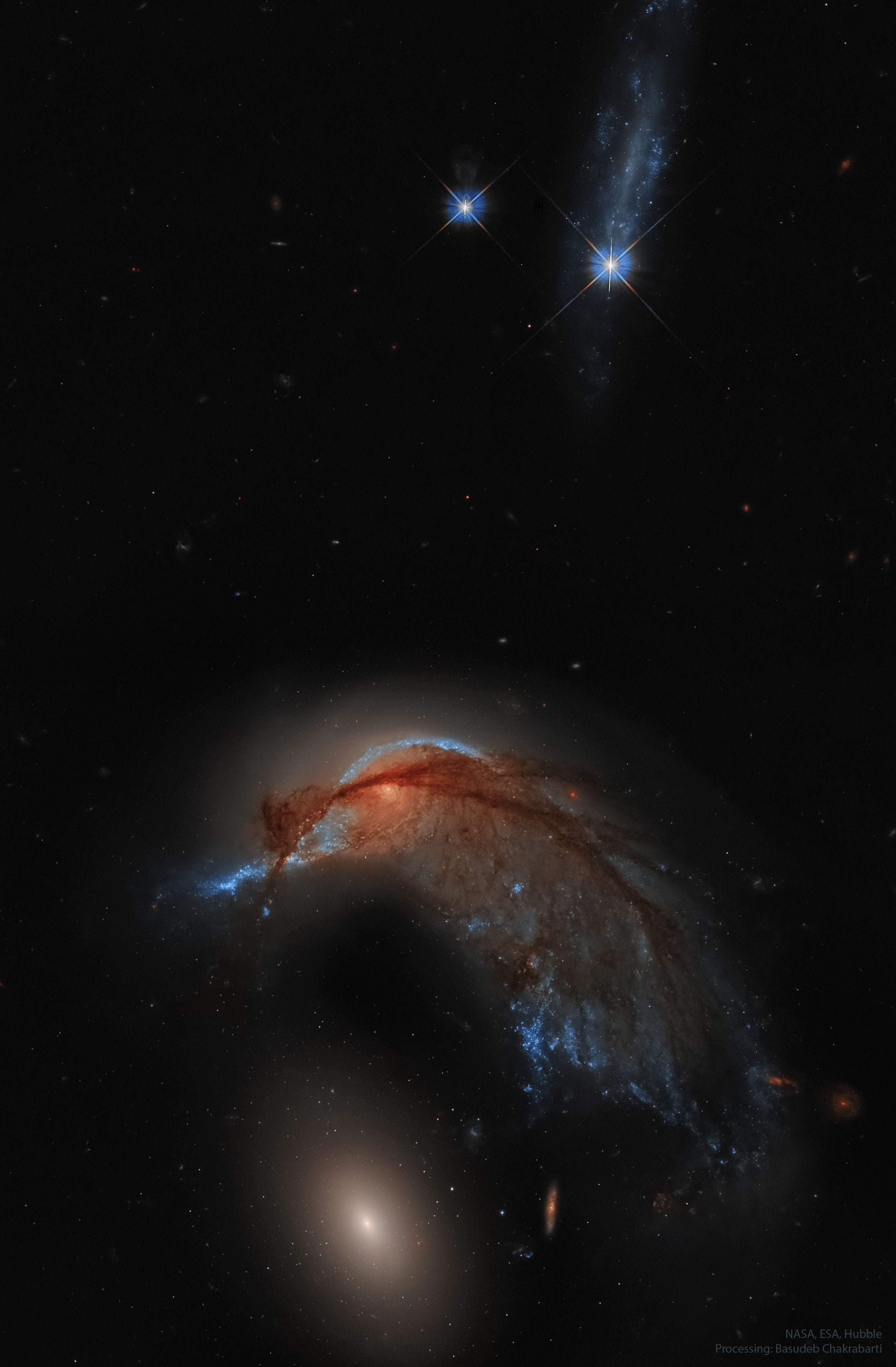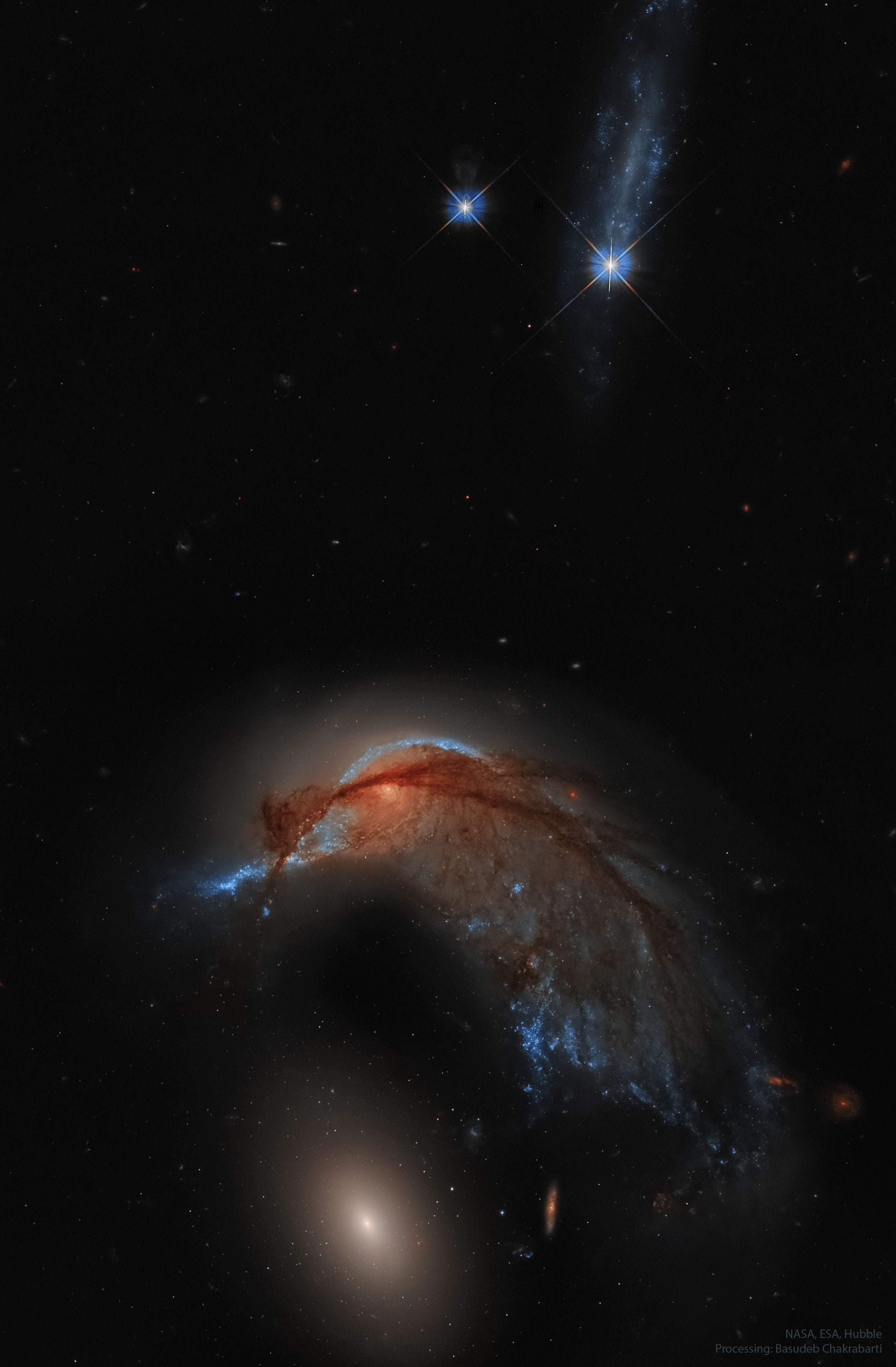
What's happening to this spiral galaxy? Just a few hundred million years ago, NGC 2936, the upper of the two large galaxies shown at the bottom, was likely a normal spiral galaxy -- spinning, creating stars -- and minding its own business. But then it got too close to the massive elliptical galaxy NGC 2937, just below, and took a turn. Sometimes dubbed the Hummingbird Galaxy for its iconic shape, NGC 2936 is not only being deflected but also being distorted by the close gravitational interaction. Behind filaments of dark interstellar dust, bright blue stars form the nose of the hummingbird, while the center of the spiral appears as an eye. Alternatively, the galaxy pair, together known as Arp 142, look to some like Porpoise or a penguin protecting an egg. The featured re-processed image showing Arp 142 in great detail was taken recently by the Hubble Space Telescope. Arp 142 lies about 300 million light years away toward the constellation of the Water Snake (Hydra). In a billion years or so the two galaxies will likely merge into one larger galaxy.
Crédito: Telescopio Espacial Hubble ¿Qué está sucediendo con esta galaxia espiral? Hace solo unos cientos de millones de años, NGC 2936, la galaxia superior de las dos grandes mostradas en la parte inferior, probablemente era una galaxia espiral normal — girando, formando estrellas — y sin interferencias. Pero luego se acercó demasiado a la galaxia elíptica masiva NGC 2937, justo debajo, y tomó un rumbo distinto. A menudo apodada como la Galaxia Colibrí por su forma icónica, NGC 2936 no solo está siendo desviada, sino también distorsionada por la cercana interacción gravitacional. Detrás de filamentos de polvo interestelar oscuro, estrellas brillantes de color azul forman el pico del colibrí, mientras que el centro de la espiral aparece como un ojo. Alternativamente, el par de galaxias, conocidas colectivamente como Arp 142, parecen a algunos como un marsopario o un pingüino protegiendo un huevo. La imagen procesada que muestra Arp 142 con gran detalle fue recientemente capturada por el Telescopio Espacial Hubble. Arp 142 se encuentra a unos 300 millones de años luz en dirección a la constelación de la Serpiente de Agua (Hydra). En aproximadamente mil millones de años, las dos galaxias probablemente se fusionarán en una galaxia más grande.