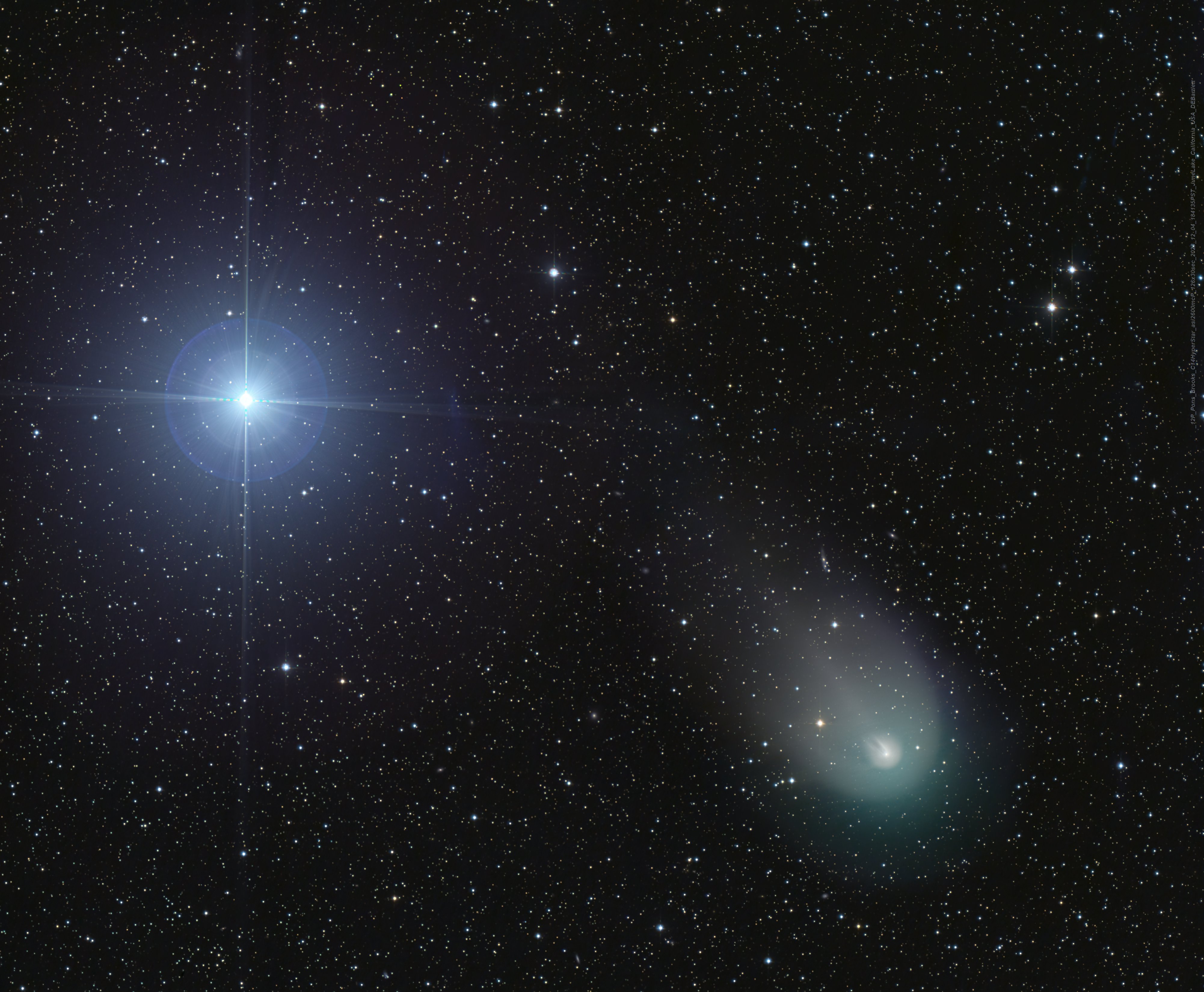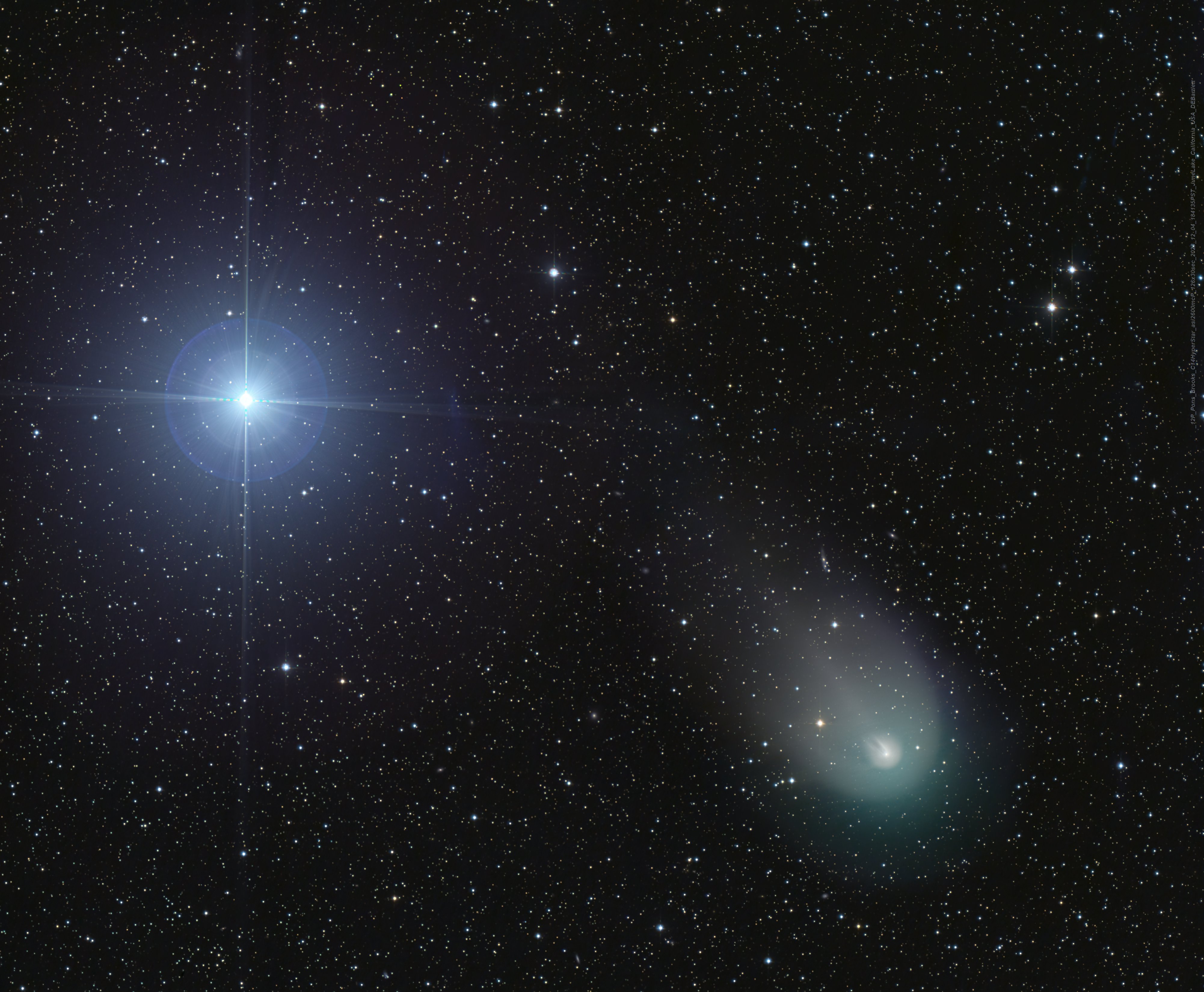
On December 4, periodic Comet 12P/Pons-Brooks shared this telescopic field of view with Vega, alpha star of the northern constellation Lyra. Fifth brightest star in planet Earth's night, Vega is some 25 light-years distant while the much fainter comet was about 21 light-minutes away. In recent months, outbursts have caused dramatic increases in brightness for Pons-Brooks though. Nicknamed the Devil Comet for its hornlike appearance, fans of interstellar spaceflight have also suggested the distorted shape of this large comet's central coma looks like the Millenium Falcon. A Halley-type comet, 12P/Pons-Brooks last visited the inner Solar System in 1954. Its next perihelion passage or closest approach to the Sun will be April 21, 2024. That's just two weeks after the April 8 total solar eclipse path crosses North America. But, highly inclined to the Solar System's ecliptic plane, the orbit of periodic Comet 12P/Pons-Brooks will never cross the orbit of planet Earth.
El 4 de diciembre, el cometa periódico 12P/Pons-Brooks compartió este campo de visión telescópico con Vega, la estrella alfa de la constelación norteña de Lyra. Vega es la quinta estrella más brillante del cielo nocturno terrestre y se encuentra a unos 25 años luz de distancia, mientras que el cometa, mucho más tenue, estaba a unos 21 minutos luz de distancia. Sin embargo, en los últimos meses, las erupciones han causado aumentos dramáticos en la brillantez de Pons-Brooks. Apodado el Cometa del Diablo por su apariencia similar a cuernos, los entusiastas del vuelo interestelar también han sugerido que la forma distorsionada de la coma central de este gran cometa parece la de la Nave Milenio. Un cometa del tipo Halley, 12P/Pons-Brooks visitó por última vez el sistema solar interior en 1954. Su próxima pasada al perihelio o acercamiento más cercano al Sol será el 21 de abril de 2024. Ese será solo dos semanas después de que la trayectoria de la eclipse solar total del 8 de abril cruce América del Norte. Sin embargo, su órbita, altamente inclinada respecto al plano de la eclíptica del sistema solar, nunca cruzará la órbita de la Tierra.