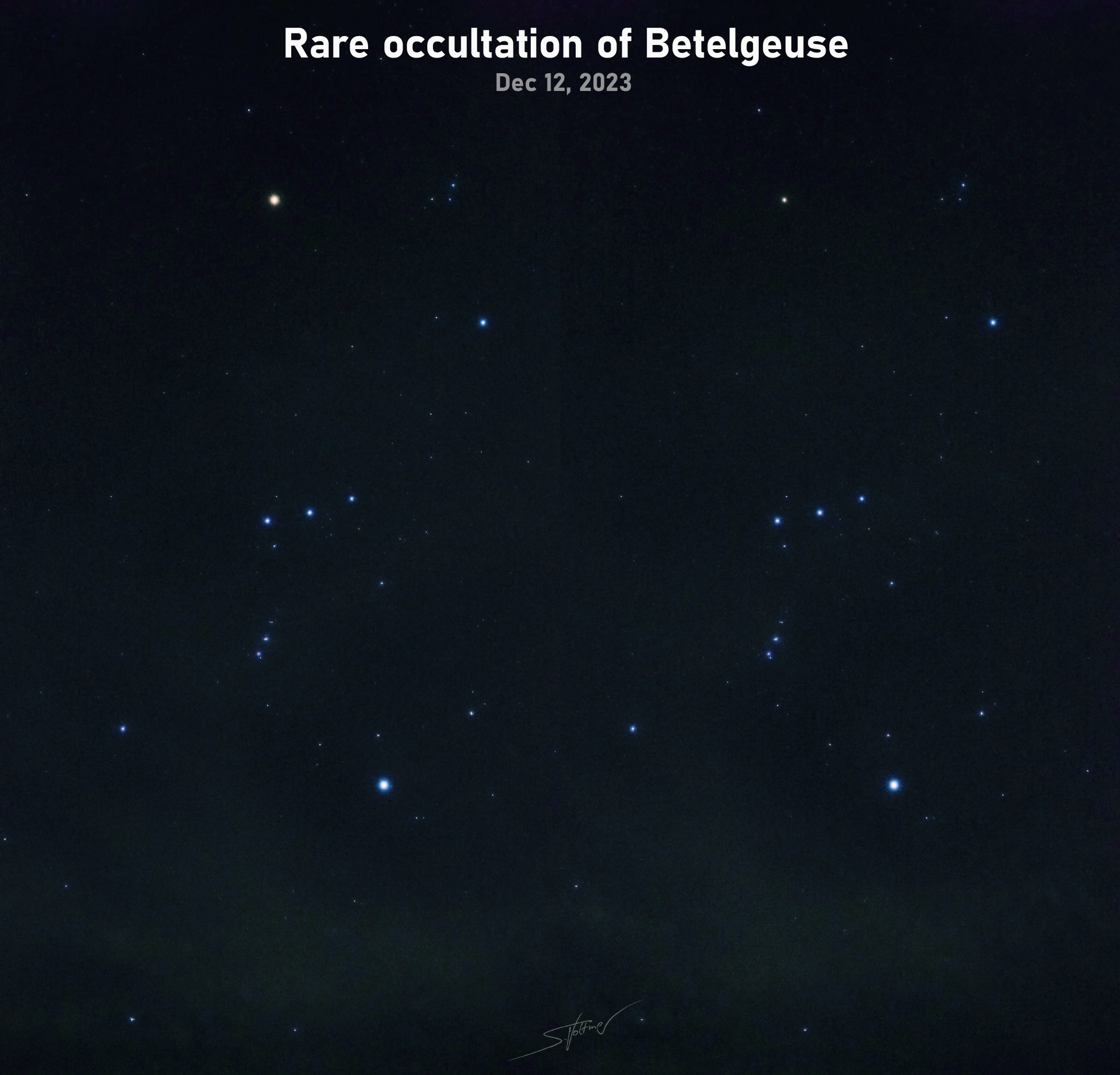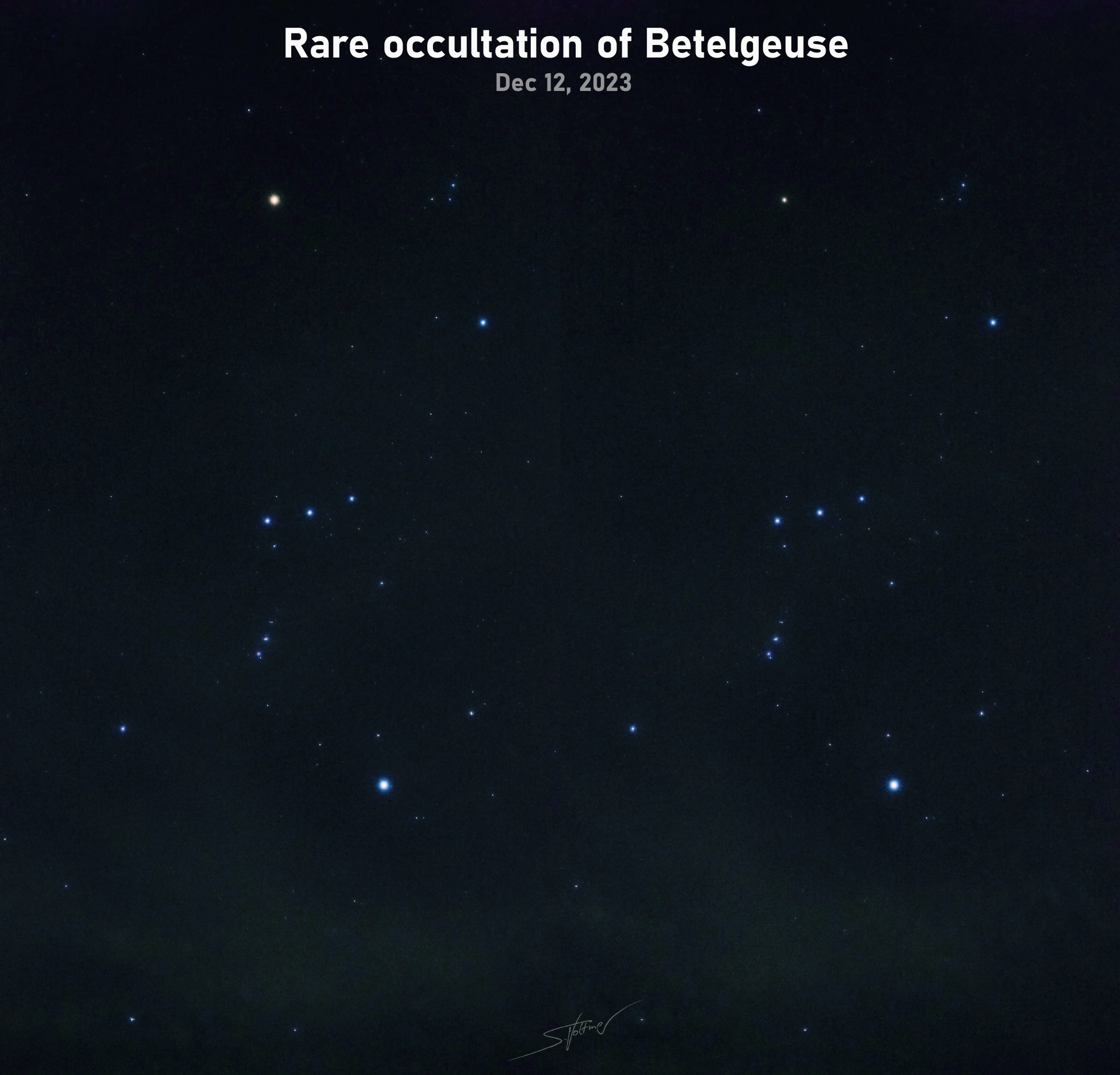
Asteroid 319 Leona cast a shadow across planet Earth on December 12, as it passed in front of bright star Betelgeuse. But to see everyone's favorite red giant star fade this time, you had to stand near the center line of the narrow shadow path starting in central Mexico and extending eastward across southern Florida, the Atlantic Ocean, southern Europe, and Eurasia. The geocentric celestial event was captured in these two panels taken at Almodovar del Rio, Spain from before (left) and during the asteroid-star occultation. In both panels Betelgeuse is seen above and left, at the shoulder of the familiar constellation Orion. Its brightness diminishes noticeably during the exceedingly rare occultation when, for several seconds, the giant star was briefly eclipsed by a roughly 60 kilometer diameter main-belt asteroid.
El 12 de diciembre, el asteroide 319 Leona proyectó una sombra sobre la Tierra al pasar frente a la brillante estrella Betelgeuse. Pero para ver que la estrella gigante roja favorita de todos se atenuara en esta ocasión, tenías que estar cerca de la línea central del estrecho camino de sombra que comenzaba en el centro de México y se extendía hacia el este a través de la Florida meridional, el océano Atlántico, Europa meridional y Eurasia. Este evento celeste geocéntrico fue capturado en estos dos paneles tomados en Almodóvar del Río, España, antes (izquierda) y durante la ocultación del asteroide-estrella. En ambos paneles se ve a Betelgeuse arriba y a la izquierda, en el hombro de la familiar constelación de Orión. Su brillo disminuye notablemente durante la rara ocultación, cuando, durante varios segundos, la gigante estrella fue brevemente eclipsada por un asteroide del cinturón principal de aproximadamente 60 kilómetros de diámetro.