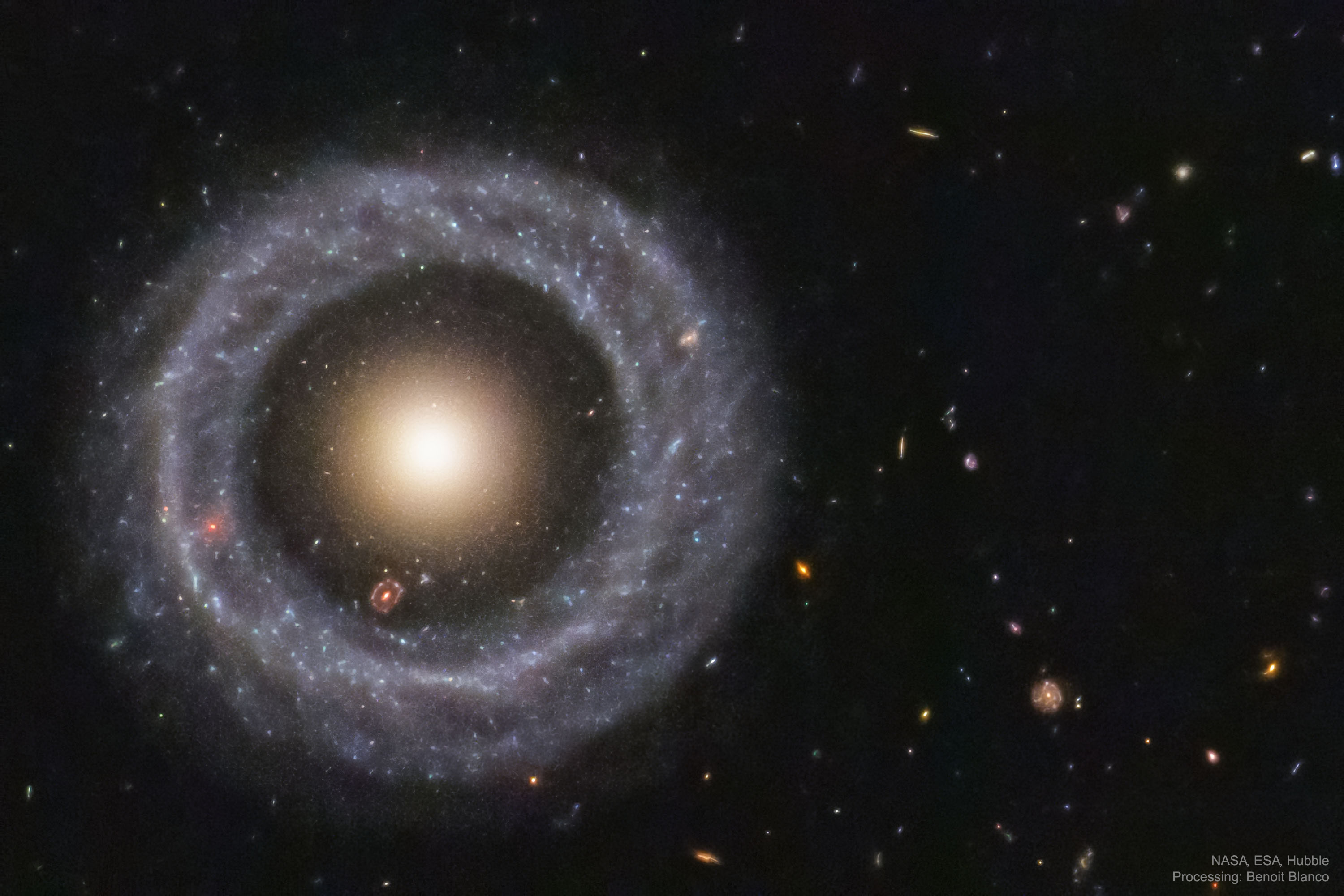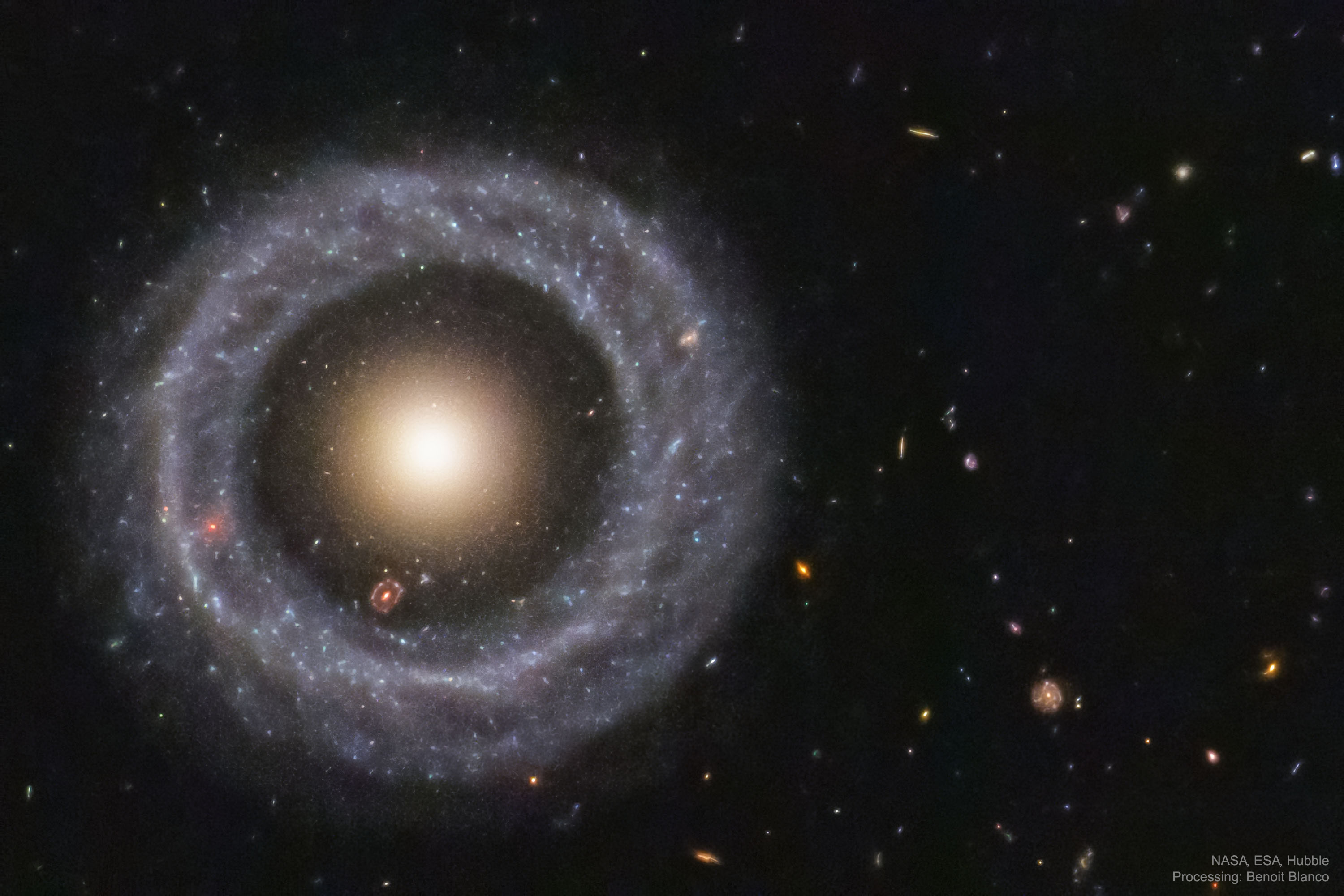
Is this one galaxy or two? This question came to light in 1950 when astronomer Arthur Hoag chanced upon this unusual extragalactic object. On the outside is a ring dominated by bright blue stars, while near the center lies a ball of much redder stars that are likely much older. Between the two is a gap that appears almost completely dark. How Hoag's Object formed, including its nearly perfectly round ring of stars and gas, remains unknown. Genesis hypotheses include a galaxy collision billions of years ago and the gravitational effect of a central bar that has since vanished. The featured photo was taken by the Hubble Space Telescope and reprocessed using an artificially intelligent de-noising algorithm. Observations in radio waves indicate that Hoag's Object has not accreted a smaller galaxy in the past billion years. Hoag's Object spans about 100,000 light years and lies about 600 million light years away toward the constellation of the Snake (Serpens). Many galaxies far in the distance are visible toward the right, while coincidentally, visible in the gap at about seven o'clock, is another but more distant ring galaxy.
¿Es esta una galaxia o dos? Esta pregunta surgió en 1950 cuando el astrónomo Arthur Hoag descubrió por casualidad este objeto extragaláctico inusual. En el exterior se encuentra un anillo dominado por estrellas brillantes de color azul, mientras que cerca del centro hay una bola de estrellas mucho más rojizas que probablemente sean mucho más antiguas. Entre ambos hay un espacio que parece casi completamente oscuro. Cómo se formó el objeto de Hoag, incluyendo su anillo casi perfectamente redondo de estrellas y gas, sigue siendo desconocido. Las hipótesis sobre su origen incluyen una colisión galáctica hace miles de millones de años y el efecto gravitacional de una barra central que ya no existe. La imagen destacada fue tomada por el Telescopio Espacial Hubble y reprocesada utilizando un algoritmo de inteligencia artificial para reducir el ruido. Observaciones en ondas de radio indican que el objeto de Hoag no ha absorbido una galaxia más pequeña en los últimos mil millones de años. El objeto de Hoag tiene un diámetro de aproximadamente 100,000 años luz y se encuentra a unos 600 millones de años luz de distancia en la constelación de la Serpiente (Serpens). Se pueden ver muchas galaxias distantes hacia la derecha, y curiosamente, hacia las siete en punto en el espacio vacío, se observa otra galaxia en anillo, pero más distante.