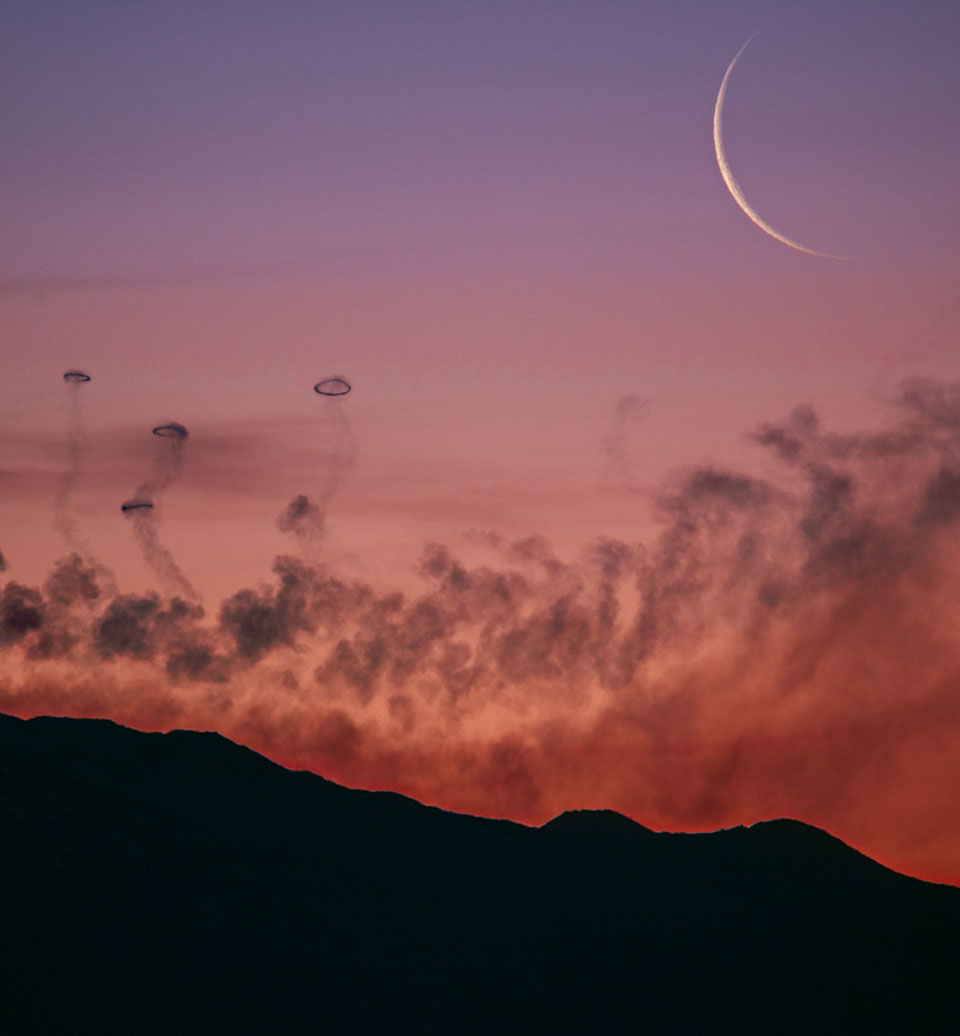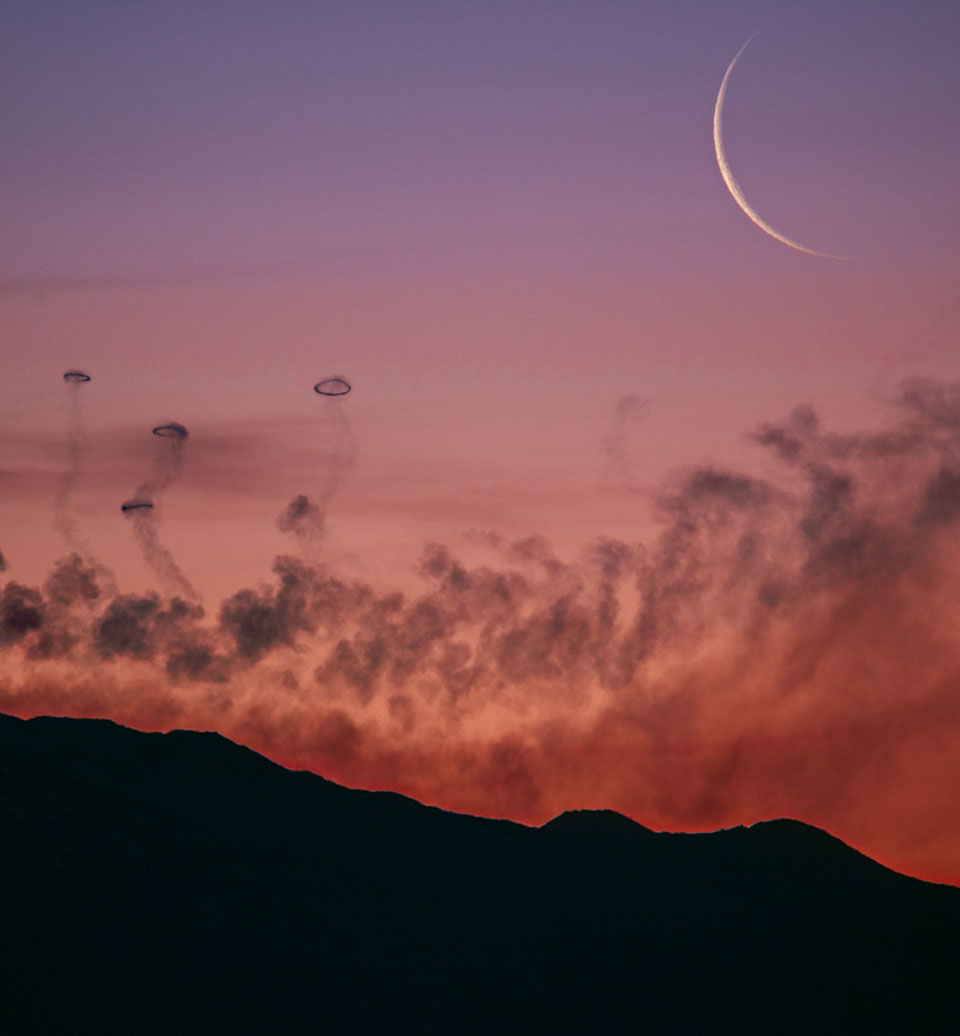
Yes, but can your volcano do this? To the surprise of some, Mt. Etna emits, on occasion, smoke rings. Technically known as vortex rings, the walls of the volcano slightly slow the outside of emitted smoke puffs, causing the inside gas to move faster. A circle of low pressure develops so that the emitted puff of volcanic gas and ash loops around in a ring, a familiar geometric structure that can be surprisingly stable as it rises. Smoke rings are quite rare and need a coincidence of the right geometry of the vent, the right speed of ejected smoke, and the relative calmness of the outside atmosphere. In the featured image taken about two weeks ago from Gangi, Sicily, Italy, multiple volcanic smoke rings are visible. The scene is shaded by the red light of a dawn Sun, while a crescent Moon is visible in the background.
Sí, pero ¿puede tu volcán hacer esto? Para sorpresa de algunos, el Monte Etna emite, ocasionalmente, anillos de humo. Técnicamente conocidos como anillos de vórtice, las paredes del volcán ralentizan ligeramente la parte exterior de las nubes de humo emitidas, lo que hace que el gas interior se mueva más rápido. Se desarrolla un círculo de baja presión de manera que la nube emitida de gas y ceniza volcánica se enrolla en un anillo, una estructura geométrica familiar que puede ser sorprendentemente estable mientras asciende. Los anillos de humo son bastante raros y requieren una coincidencia de la geometría adecuada del conducto, la velocidad adecuada del humo eyectado y la calma relativa de la atmósfera exterior. En la imagen destacada, tomada hace aproximadamente dos semanas desde Gangi, Sicilia, Italia, se pueden ver múltiples anillos de humo volcánico. La escena está teñida por la luz rojiza de un Sol en la aurora, mientras que un creciente de Luna es visible en el fondo.