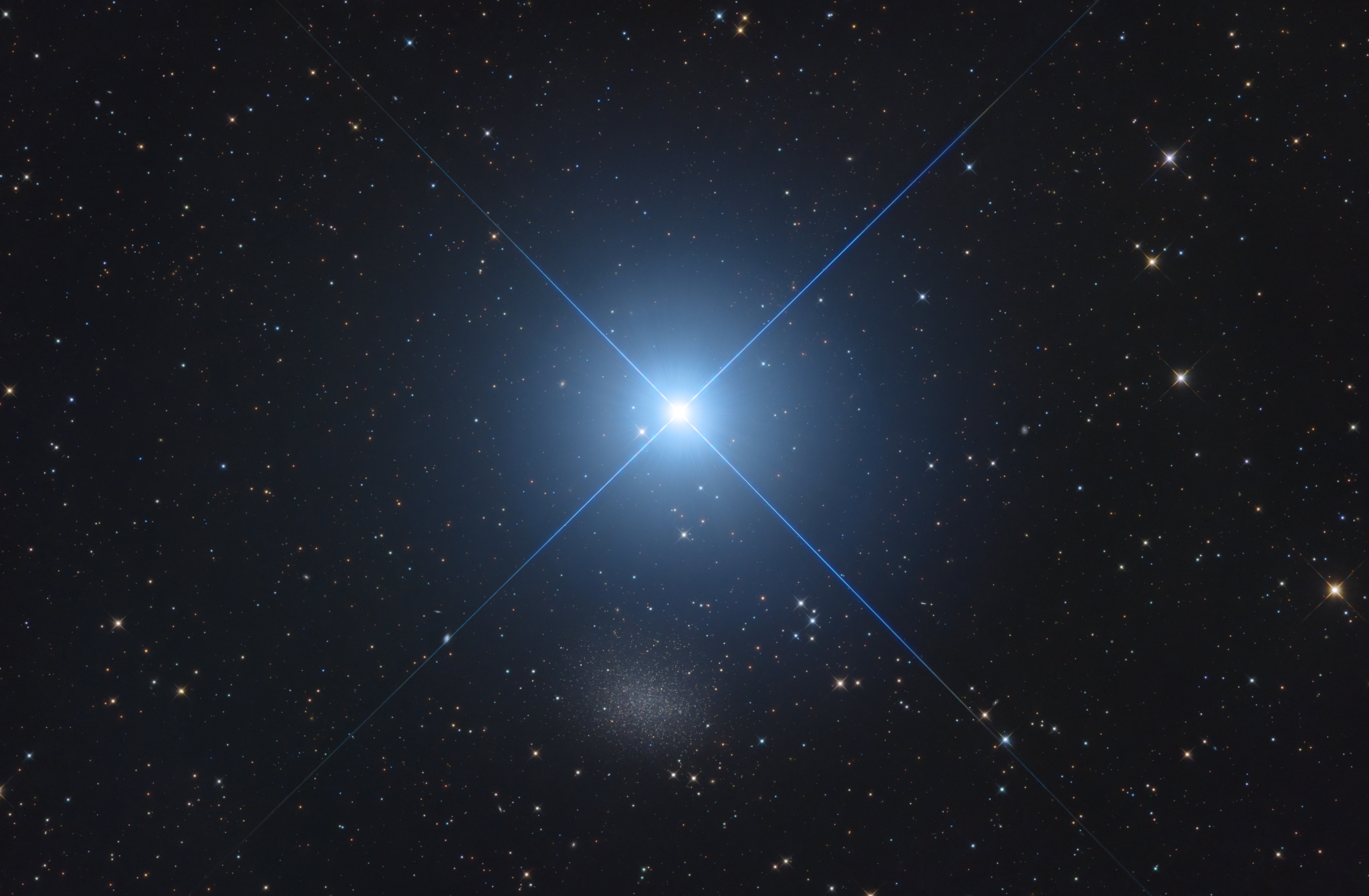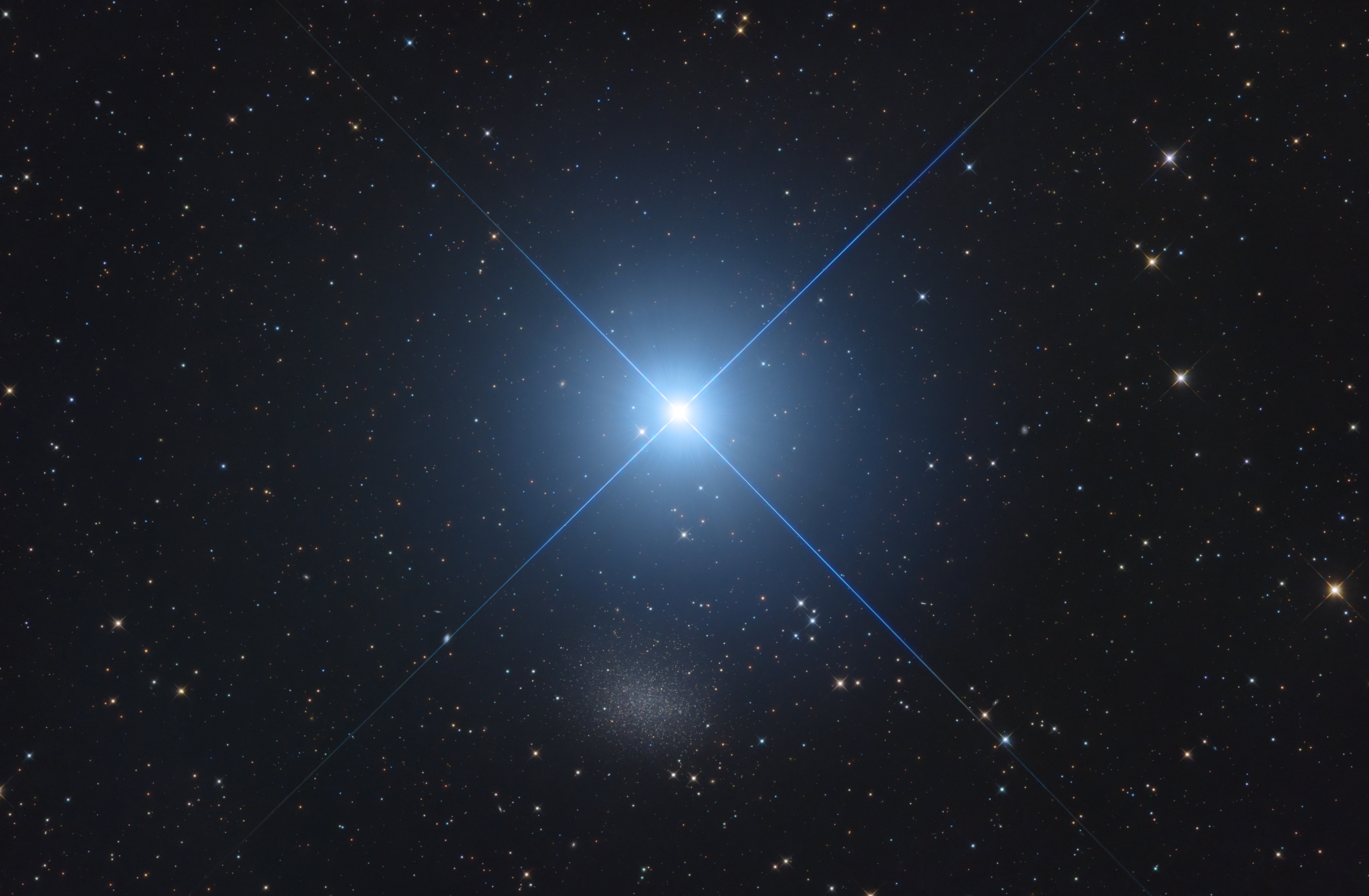
In northern hemisphere spring, bright star Regulus is easy to spot above the eastern horizon. The alpha star of the constellation Leo, Regulus is the spiky star centered in this telescopic field of view. A mere 79 light-years distant, Regulus is a hot, rapidly spinning star that is known to be part of a multiple star system. Not quite lost in the glare, the fuzzy patch just below Regulus is diffuse starlight from small galaxy Leo I. Leo I is a dwarf spheroidal galaxy, a member of the Local Group of galaxies dominated by our Milky Way Galaxy and the Andromeda Galaxy (M31). About 800 thousand light-years away, Leo I is thought to be the most distant of the known small satellite galaxies orbiting the Milky Way. But dwarf galaxy Leo I has shown evidence of a supermassive black hole at its center, comparable in mass to the black hole at the center of the Milky Way.
Crédito: NASA, CGRO SSC En la primavera del hemisferio norte, la brillante estrella Regulus es fácil de localizar sobre el horizonte oriental. Regulus es la estrella con forma de estrella en el centro de este campo de visión telescópico. A solo 79 años luz de distancia, Regulus es una estrella caliente y de rápida rotación que se sabe que forma parte de un sistema estelar múltiple. No del todo perdida en el resplandor, la mancha borrosa justo debajo de Regulus es la luz difusa de la pequeña galaxia Leo I. Leo I es una galaxia enana esférica, miembro del Grupo Local de galaxias dominado por nuestra galaxia Vía Láctea y la galaxia de Andrómeda (M31). A unos 800 mil años luz de distancia, Leo I se cree que es la más distante de las conocidas pequeñas galaxias satélite que orbitan la Vía Láctea. Pero la galaxia enana Leo I ha mostrado evidencia de un agujero negro supermasivo en su centro, comparable en masa al agujero negro en el centro de la Vía Láctea.