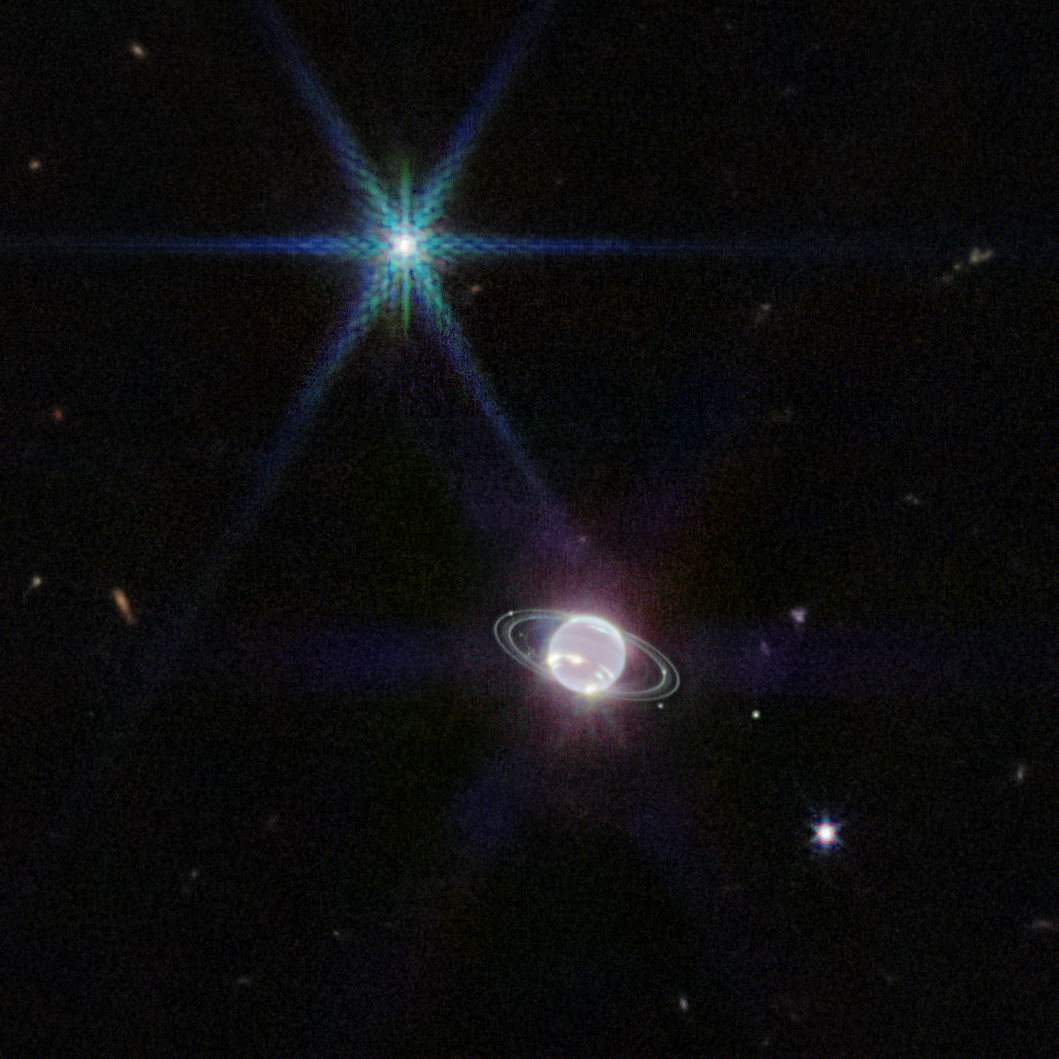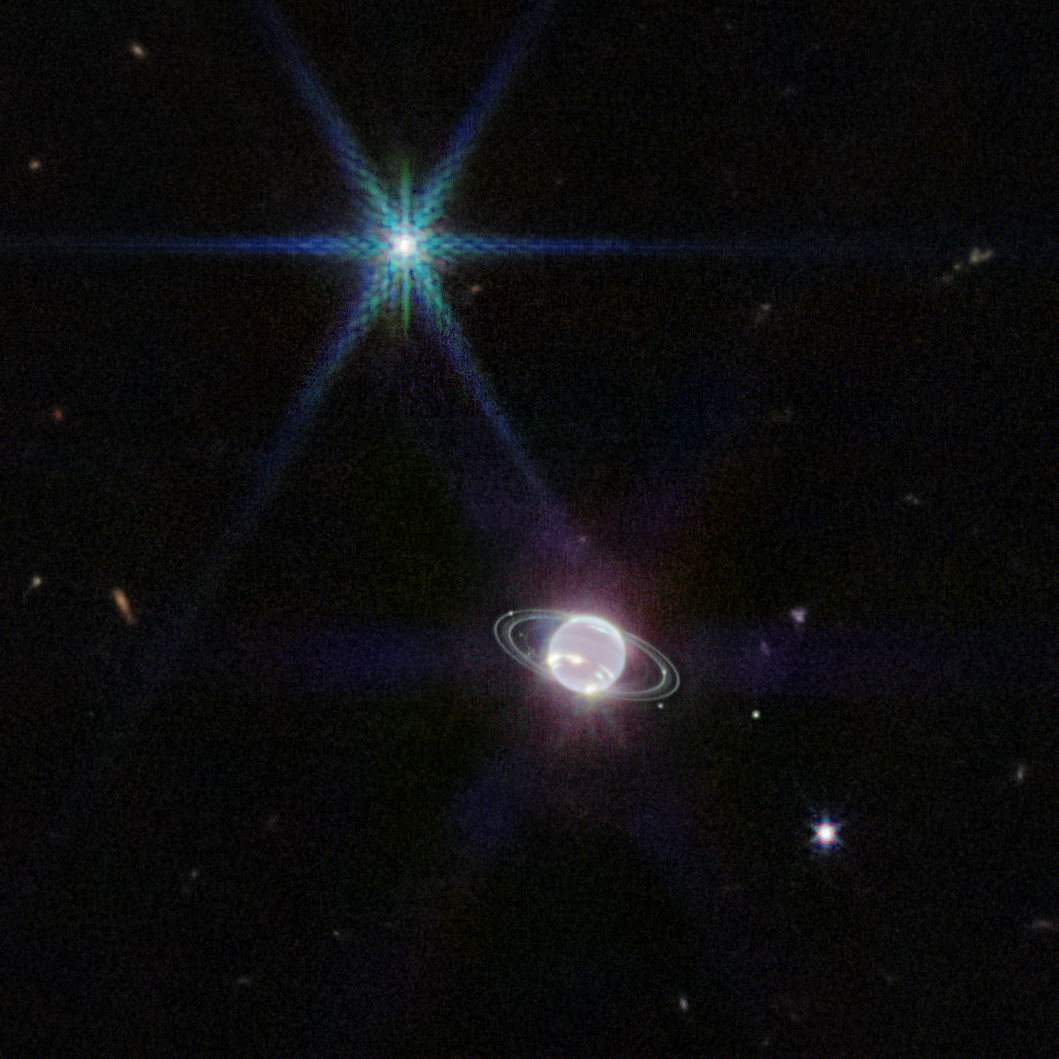
Ringed ice giant Neptune lies near the center of this sharp near-infrared image from the James Webb Space Telescope. The dim and distant world is the farthest planet from the Sun, about 30 times farther away than planet Earth. But in the stunning Webb view, the planet's dark and ghostly appearance is due to atmospheric methane that absorbs infrared light. High altitude clouds that reach above most of Neptune's absorbing methane easily stand out in the image though. Coated with frozen nitrogen, Neptune's largest moon Triton is brighter than Neptune in reflected sunlight, seen at the upper left sporting the Webb telescope's characteristic diffraction spikes. Including Triton, seven of Neptune's 14 known moons can be identified in the field of view. Neptune's faint rings are striking in this space-based planetary portrait. Details of the complex ring system are seen here for the first time since Neptune was visited by the Voyager 2 spacecraft in August 1989.
El gigante de hielo anillado Neptuno se encuentra cerca del centro de esta nítida imagen en infrarrojo cercano del Telescopio Espacial James Webb. El mundo tenue y distante es el planeta más alejado del Sol, aproximadamente 30 veces más lejos que la Tierra. Pero en esta impresionante imagen de Webb, la apariencia oscura y fantasmal del planeta se debe al metano atmosférico que absorbe la luz infrarroja. Las nubes de alta altitud que se elevan por encima de la mayor parte del metano absorbente de Neptuno se destacan claramente en la imagen. Recubierta de nitrógeno congelado, la luna más grande de Neptuno, Tritón, es más brillante que Neptuno en la luz solar reflejada, visible en la esquina superior izquierda, mostrando las características púas de difracción del telescopio Webb. Incluyendo a Tritón, siete de las 14 lunas conocidas de Neptuno pueden identificarse en el campo de visión. Los anillos tenues de Neptuno son llamativos en este retrato planetario desde el espacio. Detalles del complejo sistema de anillos se ven aquí por primera vez desde que Neptuno fue visitado por la nave espacial Voyager 2 en agosto de 1989.