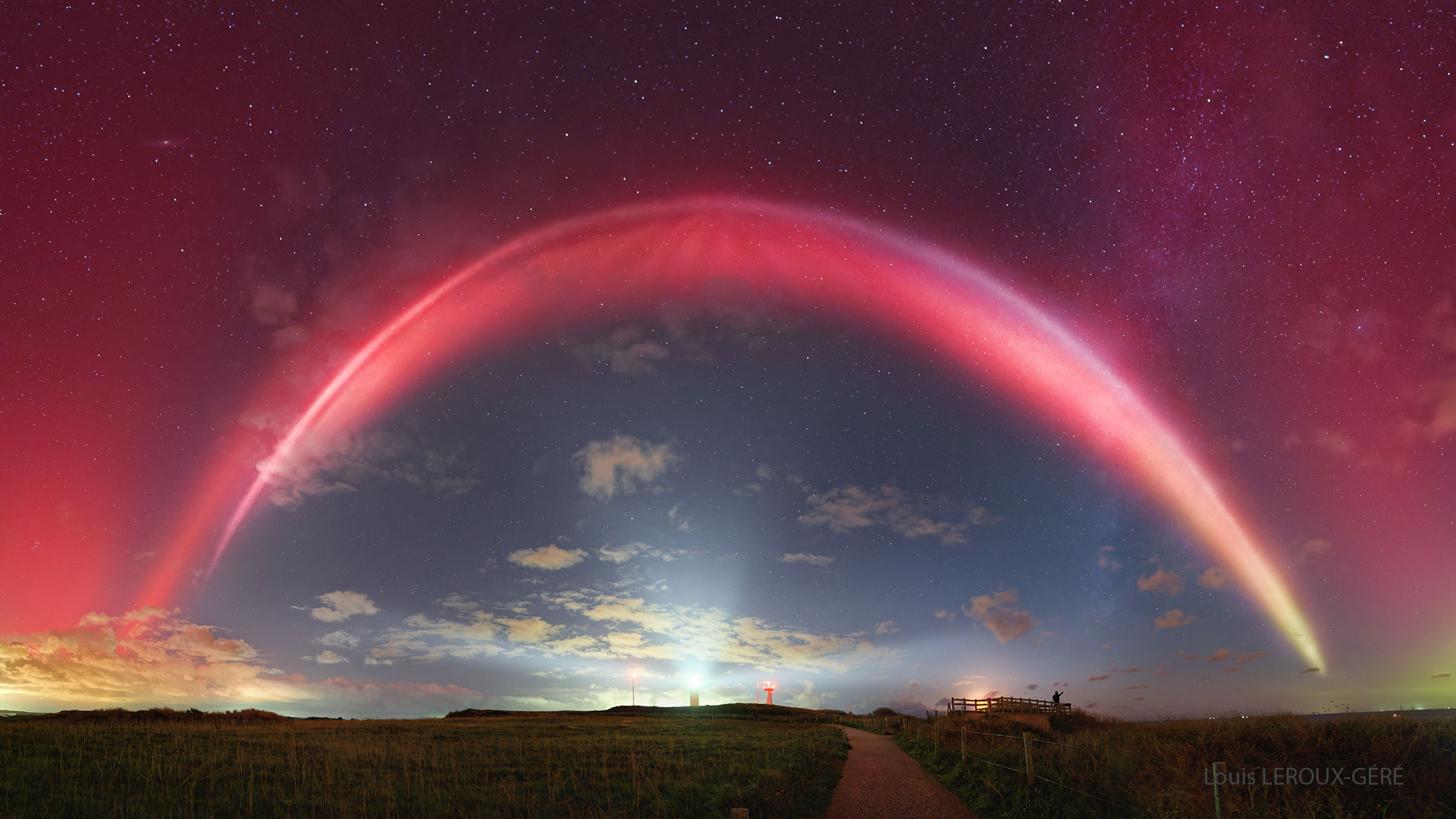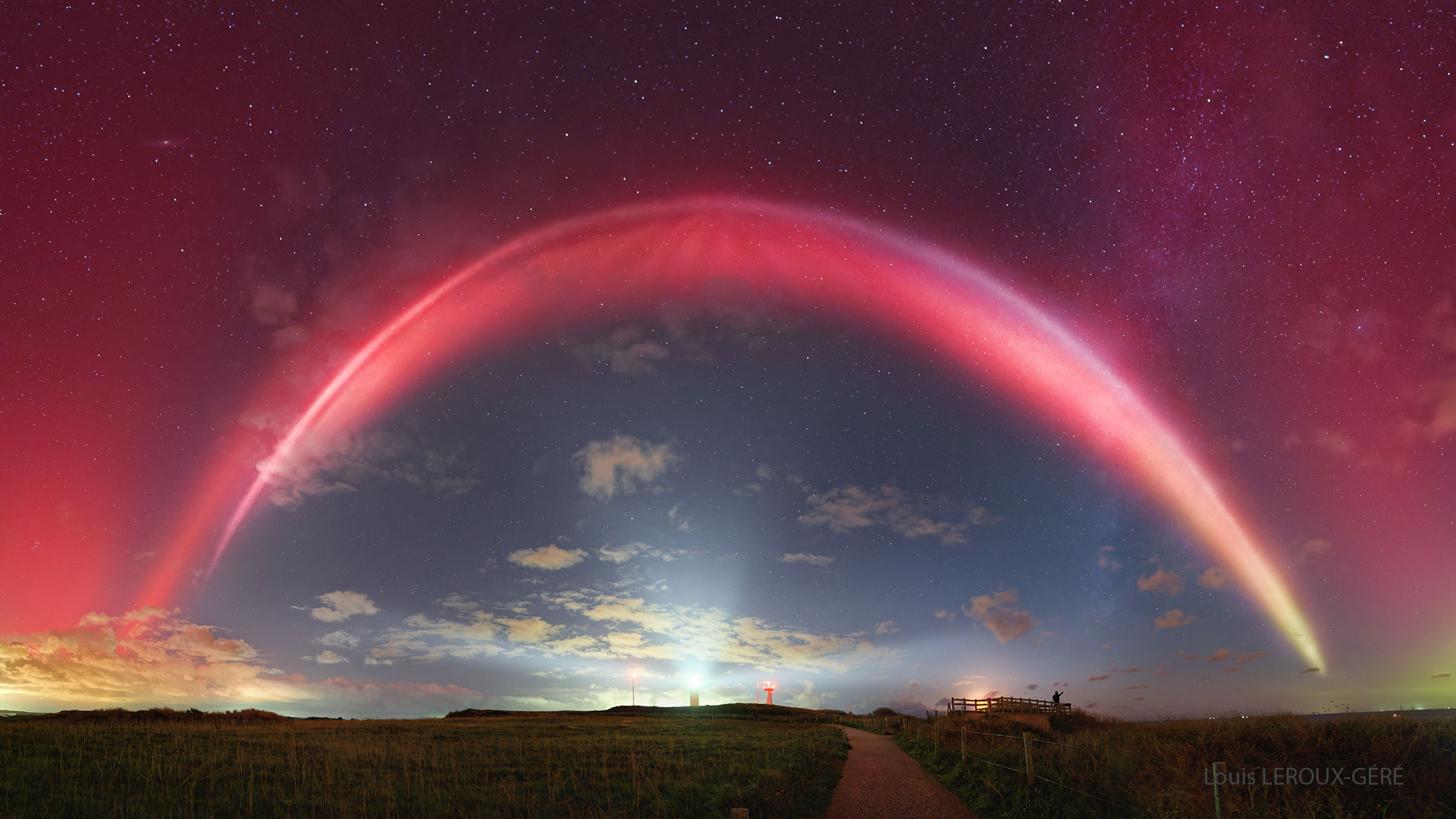
Sometimes a river of hot gas flows over your head. In this case the river created a Strong Thermal Emission Velocity Enhancement (STEVE) that glowed bright red, white, and pink. Details of how STEVEs work remain a topic of research, but recent evidence holds that their glow results from a fast-moving river of hot ions flowing over a hundred kilometers up in the Earth's atmosphere: the ionosphere. The more expansive dull red glow might be related to the flowing STEVE, but alternatively might be a Stable Auroral Red (SAR) arc, a more general heat-related glow. The featured picture, taken earlier this month in Côte d'Opale, France, is a wide-angle digital composite made as the STEVE arc formed nearly overhead. Although the apparition lasted only a few minutes, this was long enough for the quick-thinking astrophotographer to get in the picture -- can you find him?
A veces, un río de gas caliente fluye sobre tu cabeza. En este caso, el río creó un fenómeno de Elevación de Velocidad por Emisión Térmica Intensa (STEVE, por sus siglas en inglés), que brilló con colores rojo, blanco y rosa. Los detalles sobre cómo funcionan los STEVE siguen siendo un tema de investigación, pero evidencia reciente sugiere que su brillo se debe a un río rápido de iones calientes que fluyen a cientos de kilómetros de altura en la atmósfera terrestre: la ionosfera. El brillo rojizo más extenso podría estar relacionado con el STEVE en movimiento, pero también podría ser un arco de Luminiscencia Roja Auroral Estable (SAR, por sus siglas en inglés), un fenómeno más general relacionado con el calor. La imagen destacada, tomada hace unos días en la Costa de Alabaster (Côte d'Opale), Francia, es una composición digital de ángulo amplio realizada cuando el arco STEVE se formaba casi directamente sobre la cabeza del fotógrafo. Aunque la aparición duró solo unos minutos, esto fue suficiente para que el fotógrafo de astrofotografía, rápido de reflejos, lograra incluirse en la imagen. ¿Puedes encontrarlo?