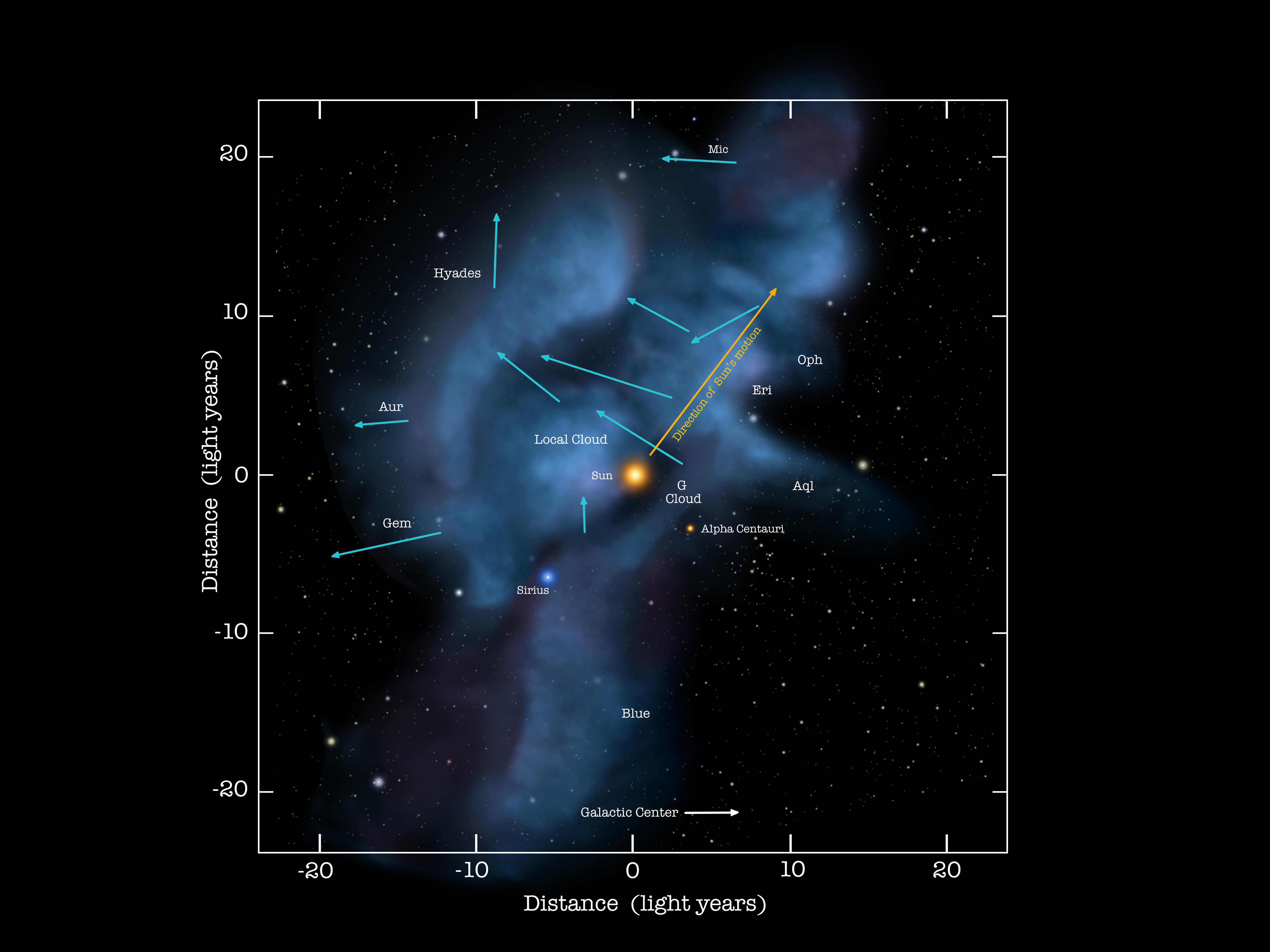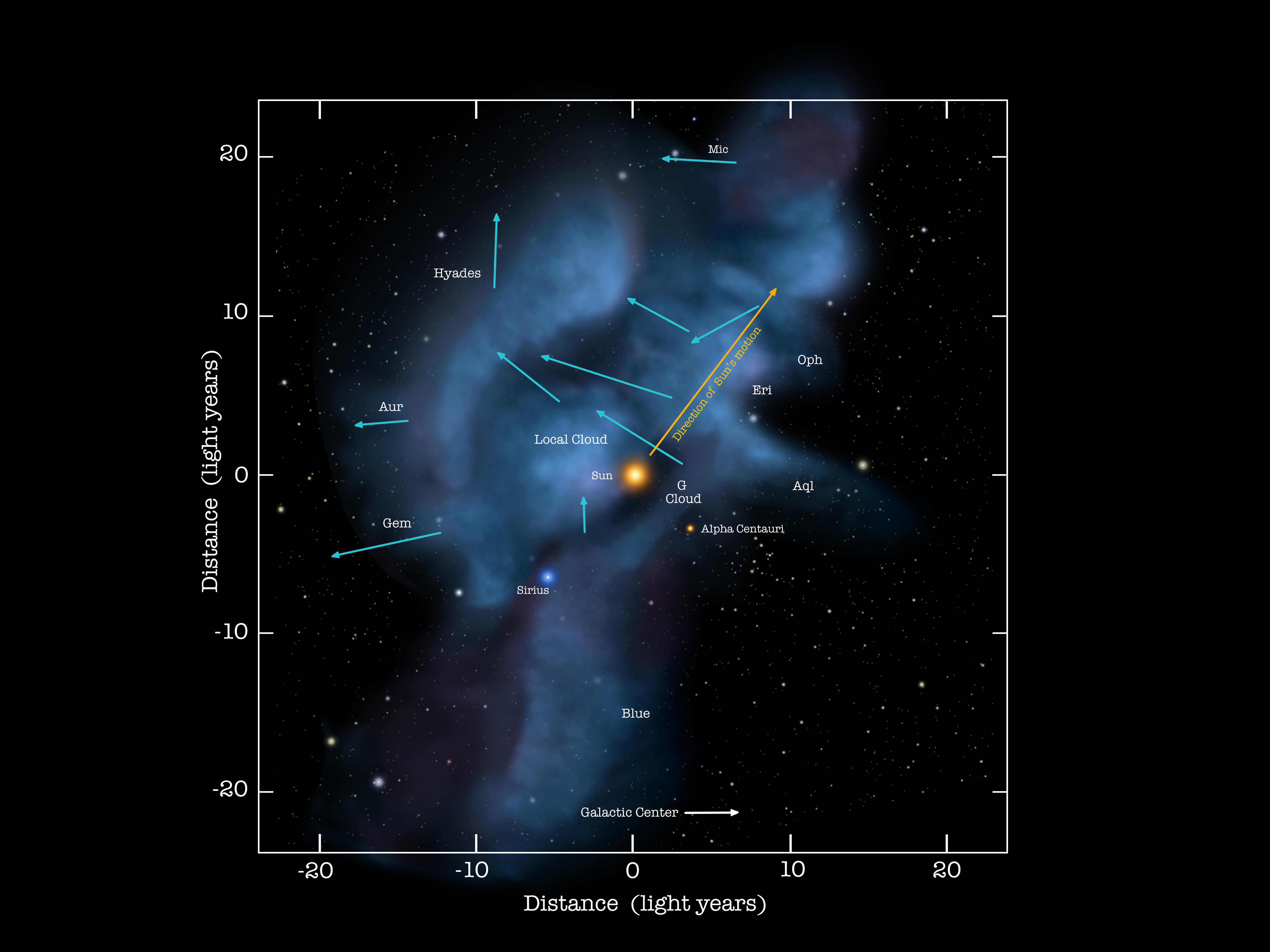
The stars are not alone. In the disk of our Milky Way Galaxy, about 10 percent of visible matter is in the form of gas called the interstellar medium (ISM). The ISM is not uniform and shows patchiness even near our Sun. It can be quite difficult to detect the local ISM because it is so tenuous and emits so little light. This mostly hydrogen gas, however, absorbs some very specific colors that can be detected in the light of the nearest stars. A working map of the local ISM within 20 light-years, based on ongoing observations and particle detections from the Earth-orbiting Interstellar Boundary Explorer satellite (IBEX), is shown here. These observations indicate that our Sun is moving through a Local Interstellar Cloud as this cloud flows outwards from the Scorpius-Centaurus Association star forming region. Our Sun may exit the Local Cloud, also called the Local Fluff, during the next 10,000 years. Much remains unknown about the local ISM, including details of its distribution, its origin, and how it affects the Sun and the Earth. Unexpectedly, IBEX spacecraft measurements indicate that the direction from which neutral interstellar particles flow through our Solar System is changing. APOD Year in Review: Night Sky Network Presentation for 2024
Las estrellas no están solas. En el disco de nuestra galaxia, la Vía Láctea, aproximadamente el 10 por ciento de la materia visible está en forma de gas llamado medio interestelar (MIS). El MIS no es uniforme y muestra irregularidades incluso cerca de nuestro Sol. Detectar el MIS local puede ser bastante difícil porque es tan tenue y emite tan poca luz. Sin embargo, este gas, principalmente hidrógeno, absorbe algunos colores muy específicos que pueden detectarse en la luz de las estrellas más cercanas. Se muestra aquí un mapa funcional del MIS local dentro de 20 años luz, basado en observaciones y detecciones de partículas en curso del satélite Interstellar Boundary Explorer (IBEX) en órbita terrestre. Estas observaciones indican que nuestro Sol se mueve a través de una Nube Interestelar Local, ya que esta nube fluye hacia afuera desde la región de formación estelar de la Asociación Scorpius-Centaurus. Nuestro Sol podría salir de la Nube Local, también llamada Nube Fluffy, durante los próximos 10,000 años. Queda mucho por descubrir sobre el MIS local, incluyendo detalles sobre su distribución, su origen y cómo afecta al Sol y a la Tierra. Inesperadamente, las mediciones del satélite IBEX indican que la dirección desde la cual fluyen las partículas interestelares neutras a través de nuestro sistema solar está cambiando.