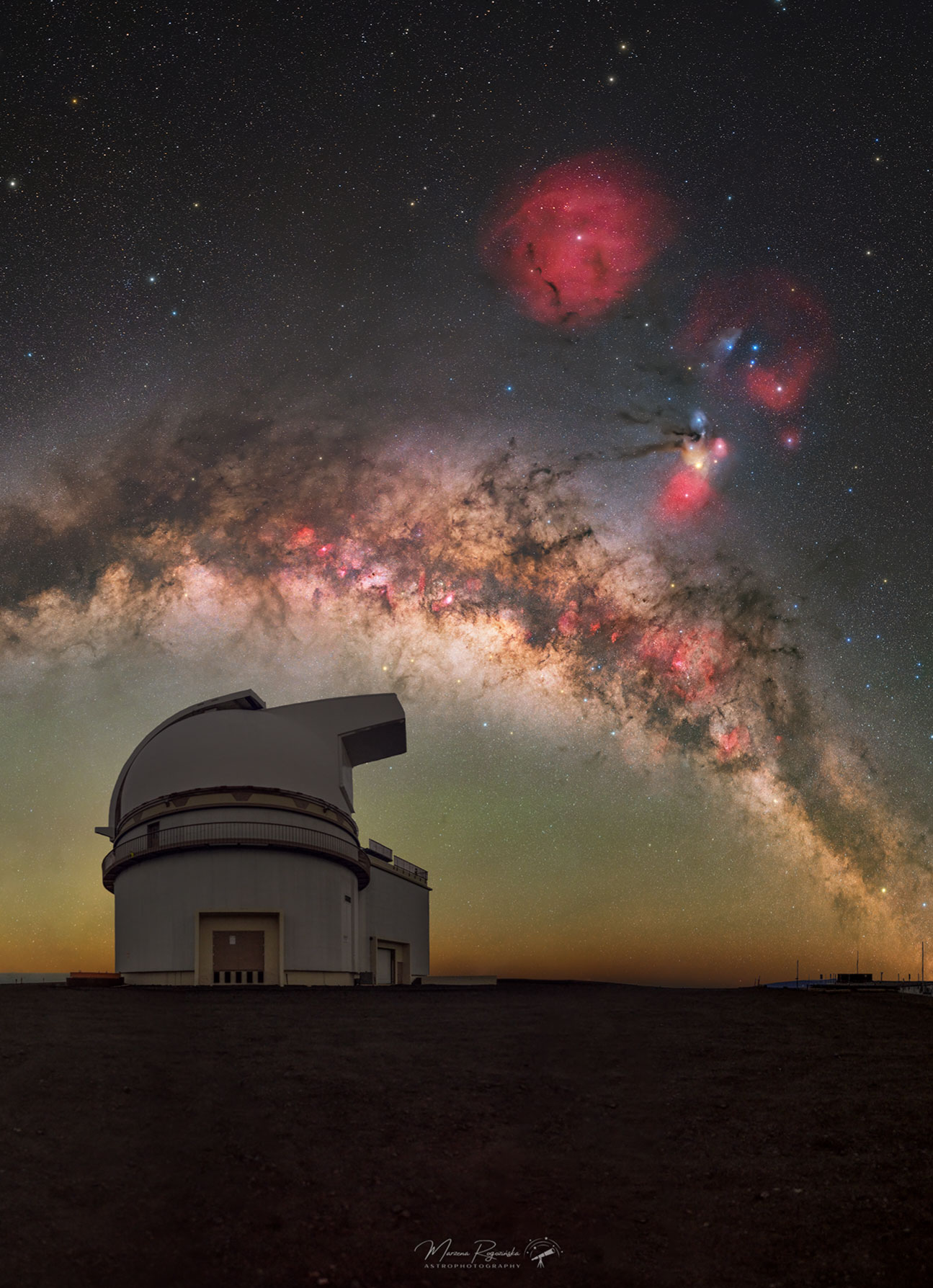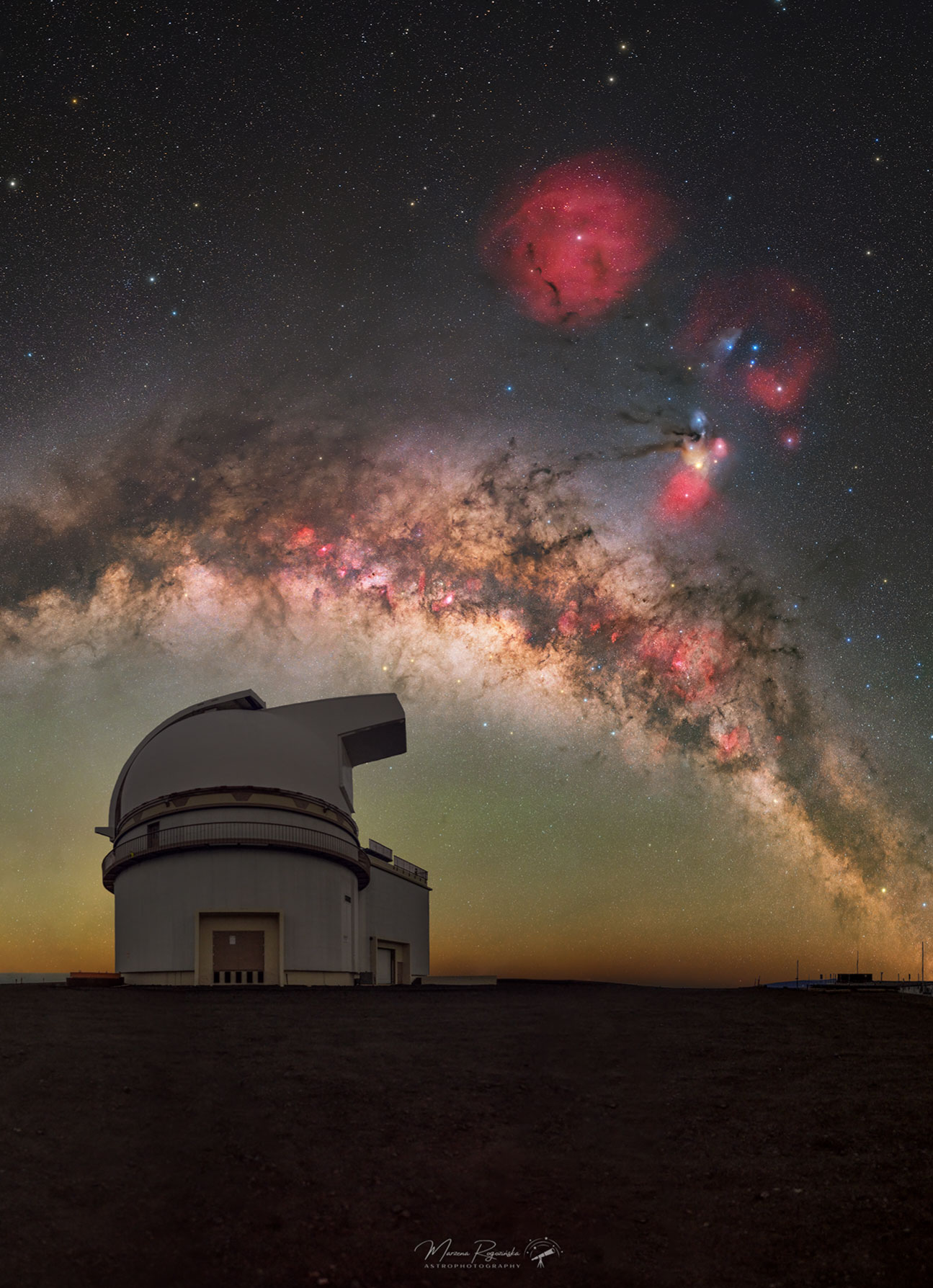
Have you ever seen the band of our Milky Way Galaxy? In a clear sky from a dark location at the right time, a faint band of light becomes visible across the sky. Soon after your eyes become dark adapted, you might spot the band for the first time. It may then become obvious. Then spectacular. One reason for your growing astonishment might be the realization that this fuzzy swath, the Milky Way, contains billions of stars. Visible in the featured image, high above in the night sky, the band of the Milky Way Galaxy arcs. Also visible are the colorful clouds of Rho Ophiuchi on the right, and the red and circular Zeta Ophiuchi nebula near the top center. Taken in late February from Maunakea, Hawaii, USA, the foreground telescope is the University of Hawaii's 2.2-Meter Telescope. Fortunately, you don’t need to be near the top of a Hawaiian volcano to see the Milky Way. Put it All Together: Astronomy Puzzle of the Day
¿Alguna vez has visto la banda de nuestra galaxia, la Vía Láctea? En un cielo despejado desde un lugar oscuro y en el momento adecuado, una banda tenue de luz se vuelve visible a través del cielo. Poco después de que tus ojos se adapten a la oscuridad, podrías ver por primera vez la banda. Luego podría volverse evidente. Luego espectacular. Una de las razones de tu creciente asombro podría ser la realización de que esta banda borrosa, la Vía Láctea, contiene miles de millones de estrellas. En la imagen destacada, muy alta en el cielo nocturno, la banda de la galaxia Vía Láctea se curva. También se ven las nubes coloridas de Rho Ophiuchi a la derecha, y la nebulosa rojiza y circular Zeta Ophiuchi cerca del centro superior. La imagen fue tomada a finales de febrero desde Maunakea, Hawái, Estados Unidos. El telescopio en primer plano es el Telescopio de 2,2 metros de la Universidad de Hawái. Afortunadamente, no necesitas estar cerca de la cima de un volcán hawaiano para ver la Vía Láctea.