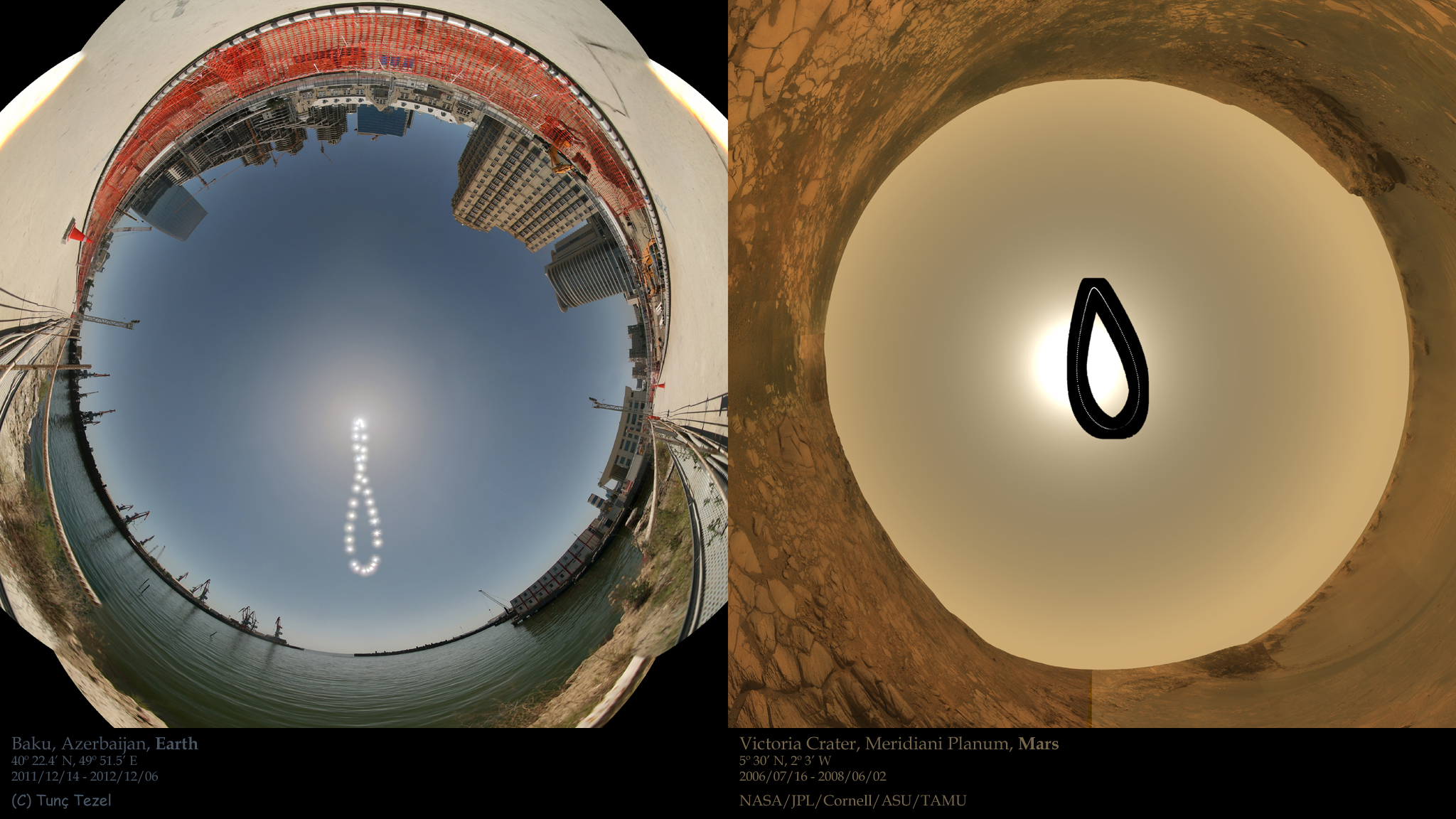
Sure, that figure-8 shaped curve you get when you mark the position of the Sun in Earth's sky at the same time each day over one year is called an analemma. On the left, Earth's figure-8 analemma was traced by combining wide-angle digital images recorded during the year from December 2011 through December 2012. But the shape of an analemma depends on the eccentricity of a planet's orbit and the tilt of its axis of rotation, so analemma curves can look different for different worlds. Take Mars for example. The Red Planet's axial tilt is similar to Earth's, but its orbit around the same sun is more eccentric (less circular) than Earth's orbit. As seen from the Martian surface, the analemma traced in the right hand panel is shaped more like a tear drop. The Mars rover Opportunity captured the images used over the Martian year corresponding to Earth dates July 2006 to June 2008. Of course, each world's solstice dates still lie at the top and bottom of their different analemma curves. The last Mars northern summer solstice was May 29, 2025. Our fair planet's 2025 northern summer solstice is at June 21, 2:42 UTC.
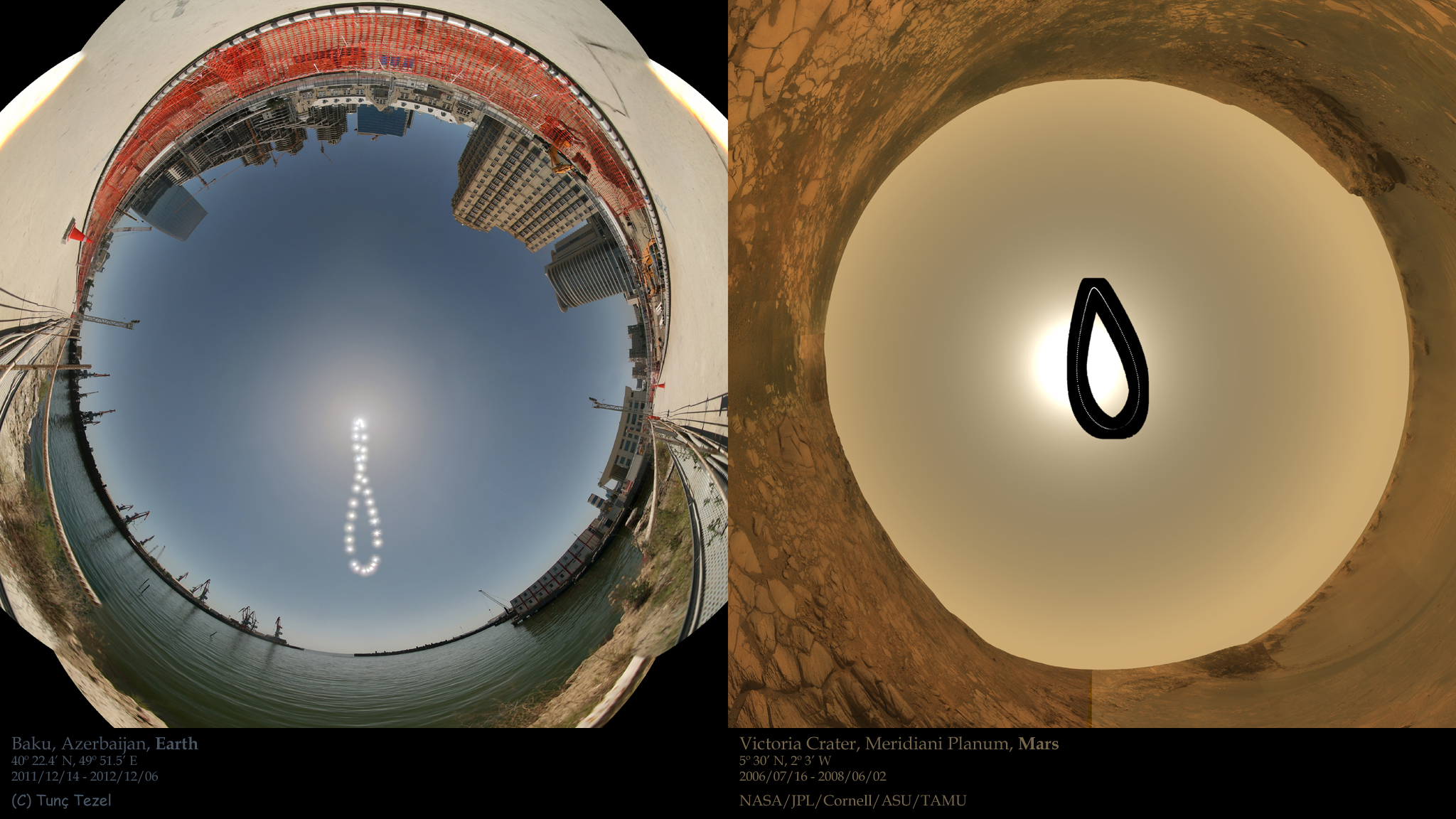
Crédito: NASA, Mars Exploration Rover Team El análogo de la figura en forma de 8 que obtienes cuando marcas la posición del Sol en el cielo terrestre a la misma hora cada día durante un año se llama anáлема. A la izquierda, el anáлема en forma de 8 de la Tierra fue trazado combinando imágenes digitales de ángulo amplio registradas durante el año, desde diciembre de 2011 hasta diciembre de 2012. Pero la forma de un anáлема depende de la excentricidad de la órbita de un planeta y de la inclinación de su eje de rotación, por lo que las curvas de anáлемa pueden tener aspectos diferentes en distintos mundos. Tome Marte como ejemplo. La inclinación axial del Planeta Rojo es similar a la de la Tierra, pero su órbita alrededor del mismo Sol es más excéntrica (menos circular) que la órbita terrestre. Visto desde la superficie marciana, el anáлема trazado en el panel de la derecha tiene una forma más similar a una lágrima. El rover Opportunity capturó las imágenes utilizadas durante el año marciano correspondiente a las fechas terrestres de julio de 2006 a junio de 2008. Por supuesto, las fechas de solsticio de cada mundo aún se encuentran en la parte superior e inferior de sus distintas curvas de anáлемa. El último solsticio de verano en el hemisferio norte de Marte fue el 29 de mayo de 2025. Nuestro planeta tiene su solsticio de verano en el hemisferio norte el 21 de junio a las 2:42 UTC.