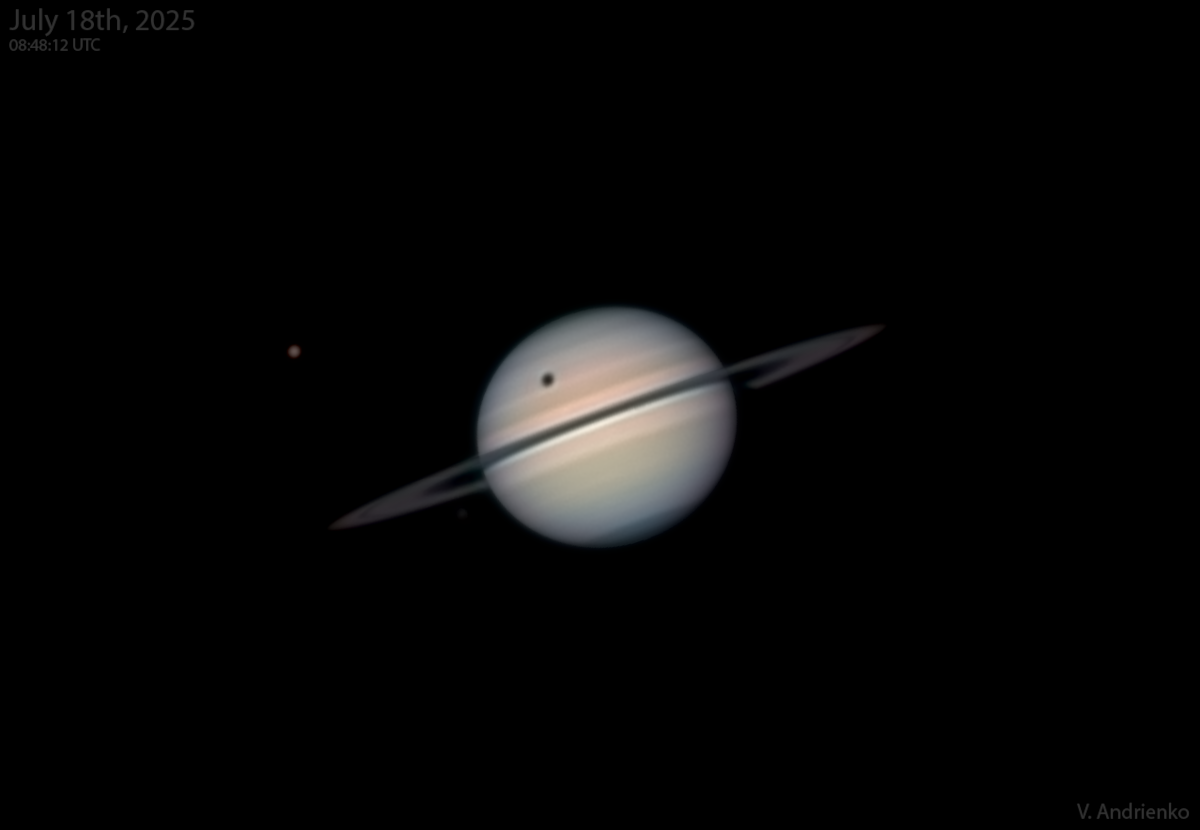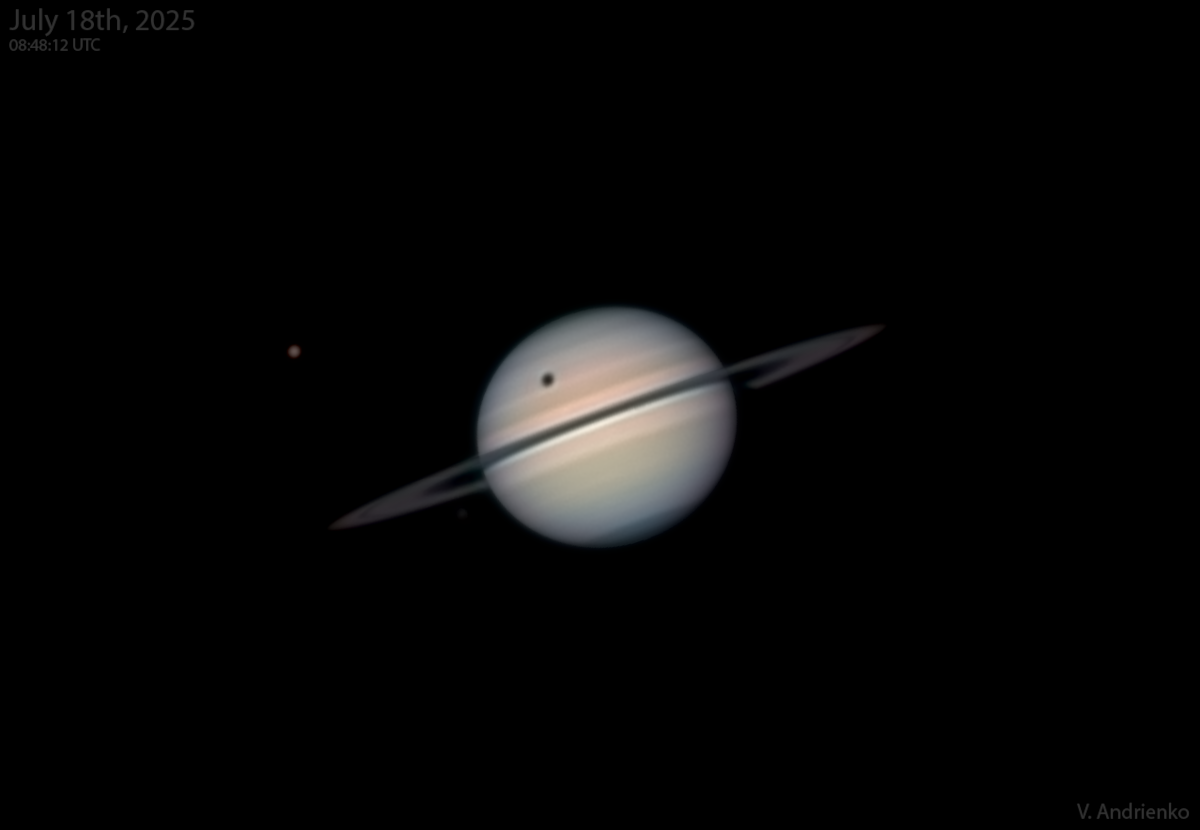
very 15 years or so, Saturn's rings are tilted edge-on to our line of sight. As the bright, beautiful ring system grows narrower and fainter it becomes increasingly difficult to see for denizens of planet Earth. But it does provide the opportunity to watch transits of Saturn's moons and their dark shadows across the ringed gas giant's still bright disk. Of course Saturn's largest moon Titan is the easiest to spot in transit. In this telescopic snapshot from July 18, Titan itself is at the upper left, casting a round dark shadow on Saturn's banded cloudtops above the narrow rings. In fact Titan's transit season is in full swing now with shadow transits every 16 days corresponding to the moon's orbital period. Its final shadow transit will be on October 6, though Titan's pale disk will continue to cross in front of Saturn as seen from telescopes on planet Earth every 16 days through January 25, 2026.
Cada 15 años aproximadamente, los anillos de Saturno se inclinan de manera que su borde se alinea con nuestra línea de visión. A medida que el sistema de anillos brillantes y hermosos se vuelve más estrecho y tenue, se vuelve cada vez más difícil de ver para los habitantes del planeta Tierra. Sin embargo, esto proporciona la oportunidad de observar los tránsitos de las lunas de Saturno y sus sombras oscuras sobre el disco aún brillante del gigante gaseoso anillado. Por supuesto, Titán, la luna más grande de Saturno, es la más fácil de observar durante un tránsito. En esta imagen capturada con telescopio el 18 de julio, Titán mismo se encuentra en la esquina superior izquierda, proyectando una sombra redonda oscura sobre las nubes a rayas de Saturno, por encima de los anillos estrechos. De hecho, la temporada de tránsitos de Titán está en pleno apogeo, con tránsitos de sombra cada 16 días, correspondientes al período orbital de la luna. Su último tránsito de sombra será el 6 de octubre, aunque el disco pálido de Titán continuará pasando frente a Saturno, visto desde telescopios en la Tierra, cada 16 días hasta el 25 de enero de 2026.