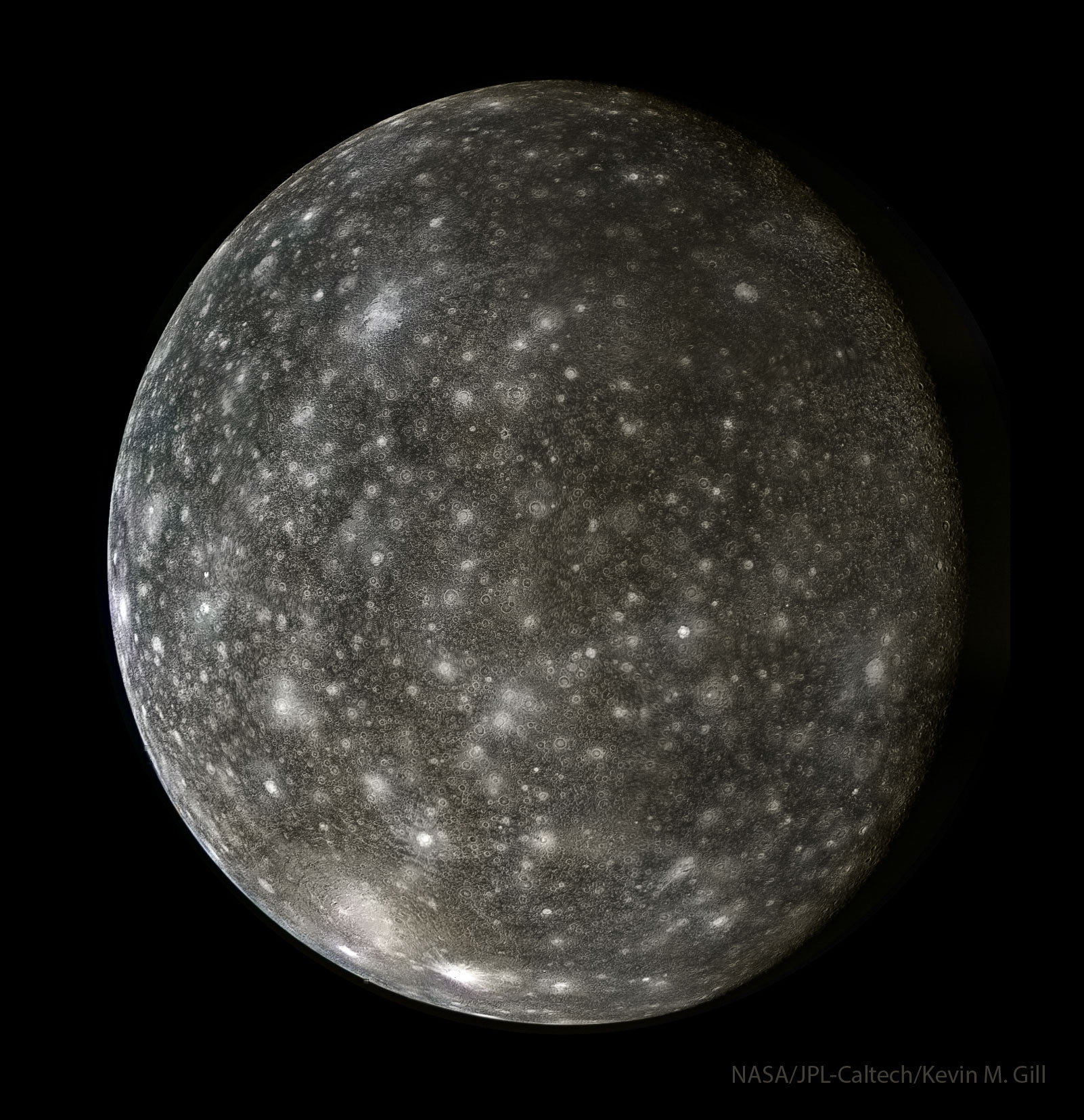
Its surface is the most densely cratered in the Solar System -- but what's inside? Jupiter's moon Callisto is a battered ball of dirty ice that is slightly smaller than the planet Mercury. It was visited by NASA's Galileo spacecraft in the 1990s and 2000s, but the recently reprocessed featured image is from a flyby of NASA's Voyager 2 in 1979. The moon would appear darker if it weren't for the tapestry of light-colored fractured surface ice created by eons of impacts. The interior of Callisto is potentially even more interesting because therein might lie an internal layer of liquid water. This potential underground sea is a candidate to harbor life -- similar with sister moons Europa and Ganymede. Callisto is larger than Luna, Earth's Moon, and even with its high ice content is still more massive. ESA's JUICE and NASA's Europa Clipper missions are now headed out to Jupiter to better investigate its largest moons.
Su superficie es la más densamente craterizada del Sistema Solar, pero ¿qué hay dentro? La luna de Júpiter, Calisto, es una bola de hielo sucio golpeada que es ligeramente más pequeña que el planeta Mercurio. Fue visitada por la nave espacial Galileo de la NASA en las décadas de 1990 y 2000, pero la imagen destacada recientemente reprocesada proviene de un sobrevuelo de la nave espacial Voyager 2 de la NASA en 1979. La luna aparecería más oscura si no fuera por el mosaico de hielo superficial fracturado de color claro creado por impactos a lo largo de eones. El interior de Calisto podría ser aún más interesante, ya que podría albergar una capa interna de agua líquida. Este océano subterráneo potencial es un candidato para albergar vida, al igual que sus lunas hermanas Europa y Ganímedes. Calisto es más grande que la Luna, satélite natural de la Tierra, y, a pesar de su alto contenido de hielo, sigue siendo más masiva. Las misiones JUICE de la ESA y Europa Clipper de la NASA ahora se dirigen a Júpiter para investigar mejor sus lunas más grandes.