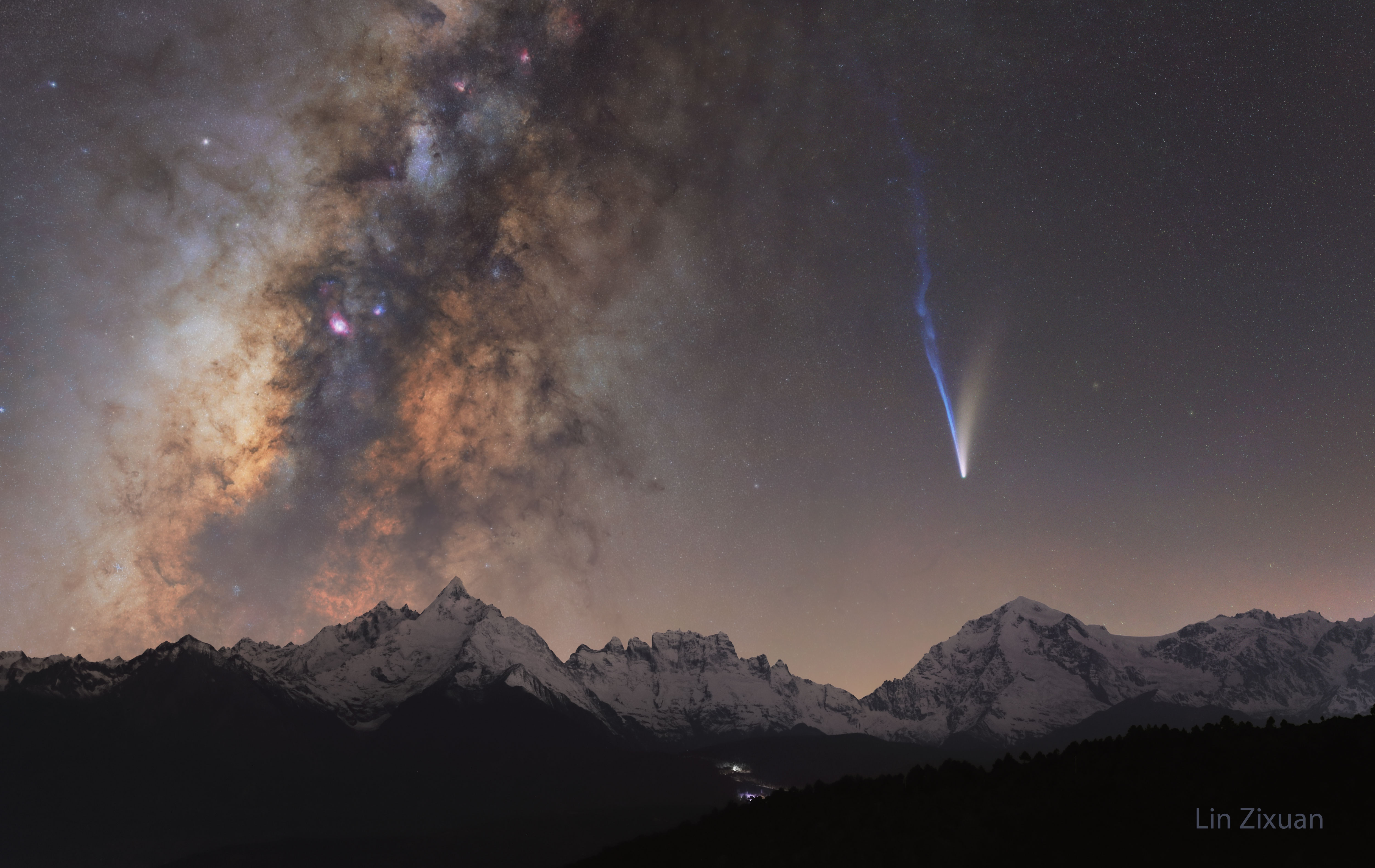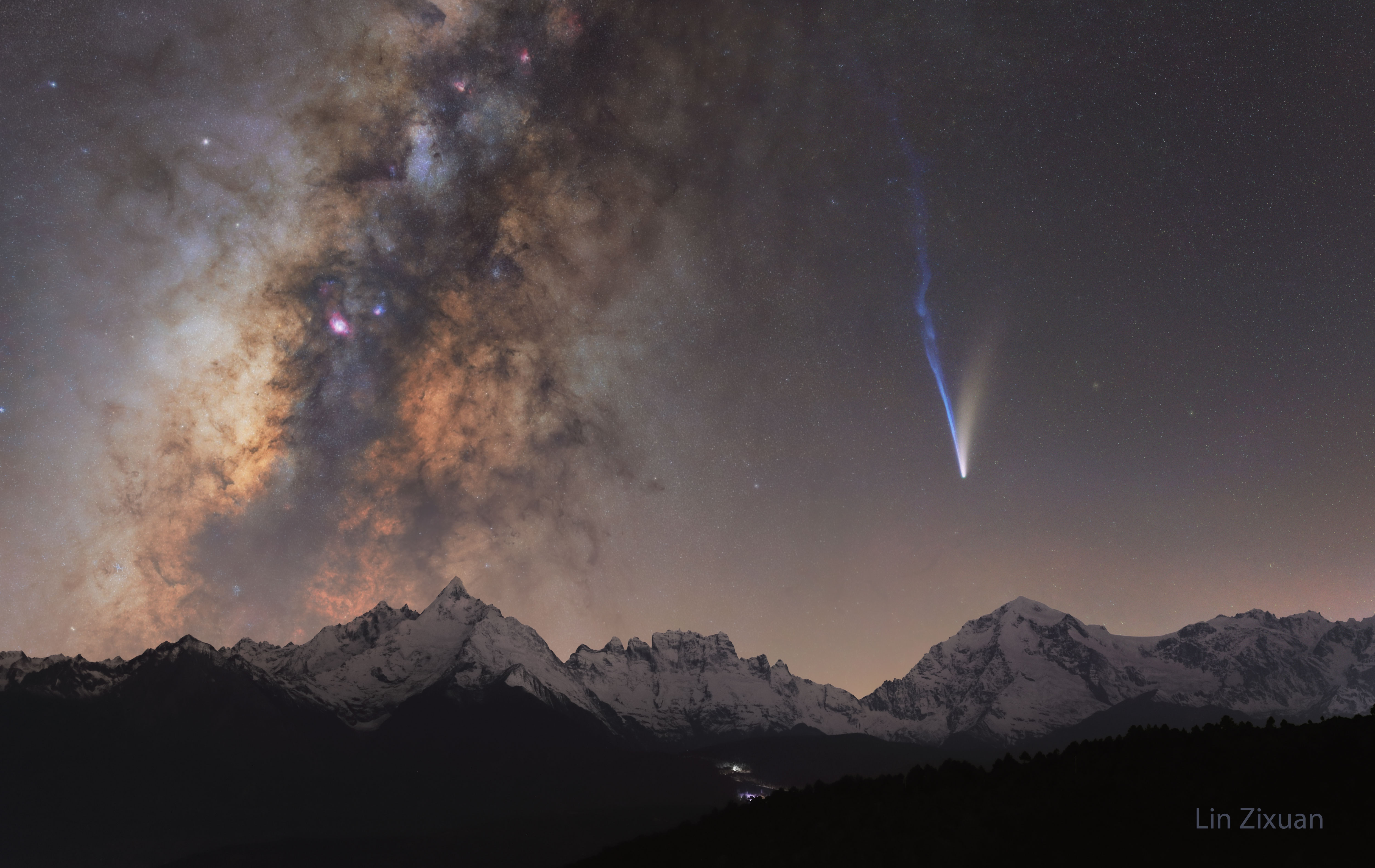
What did Comet Lemmon look like when it was at its best? One example is pictured here, featuring three celestial spectacles all at different distances. The closest spectacle is the snowcapped Meili Mountains, part of the Himalayas in China. The middle marvel is Comet Lemmon near its picturesque best early this month, showing not only a white dust tail trailing off to the right but its blue solar wind-distorted ion tail trailing off to the left. Far in the distance on the left is the magnificent central plane of our Milky Way Galaxy, featuring dark dust, red nebula, and including billions of Sun-like stars. Comet C/2025 A6 (Lemmon) is already fading as it heads back into the outer Solar System, while the Himalayan mountains will gradually erode over the next billion years. The Milky Way Galaxy, though, will live on -- forming new mountains and comets -- for many billions of years into the future.
¿Cómo lucía el cometa Lemmon en su mejor momento? Un ejemplo se muestra aquí, destacando tres espectáculos celestes a diferentes distancias. El espectáculo más cercano es la cumbre nevada de las Montañas Meili, parte de los Himalayas en China. El maravilloso fenómeno intermedio es el cometa Lemmon, cerca de su mejor aspecto pictórico principios de este mes, mostrando no solo una cola de polvo blanca que se extiende hacia la derecha, sino también su cola de iones azulada, distorsionada por el viento solar, que se extiende hacia la izquierda. En la distancia, a la izquierda, se encuentra la magnífica banda central de nuestra galaxia, la Vía Láctea, que incluye polvo oscuro, nebulosas rojas y miles de millones de estrellas similares al Sol. El cometa C/2025 A6 (Lemmon) ya está desvaneciéndose a medida que regresa al sistema solar exterior, mientras que las montañas himalayas se erosionarán gradualmente a lo largo de los próximos mil millones de años. La galaxia Vía Láctea, sin embargo, continuará existiendo —formando nuevas montañas y cometas— durante muchos miles de millones de años en el futuro.