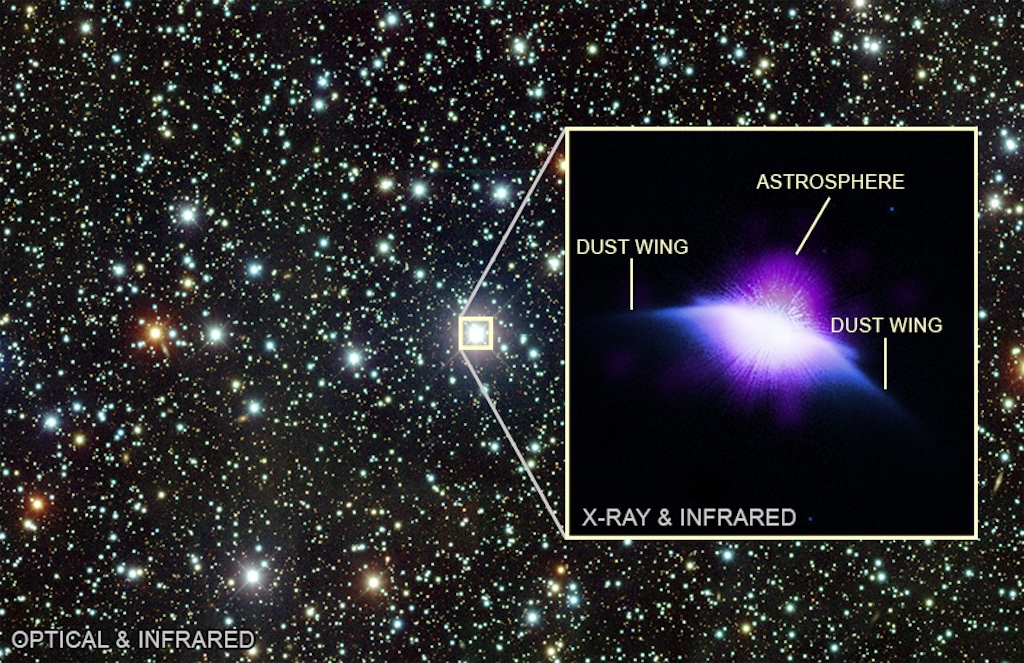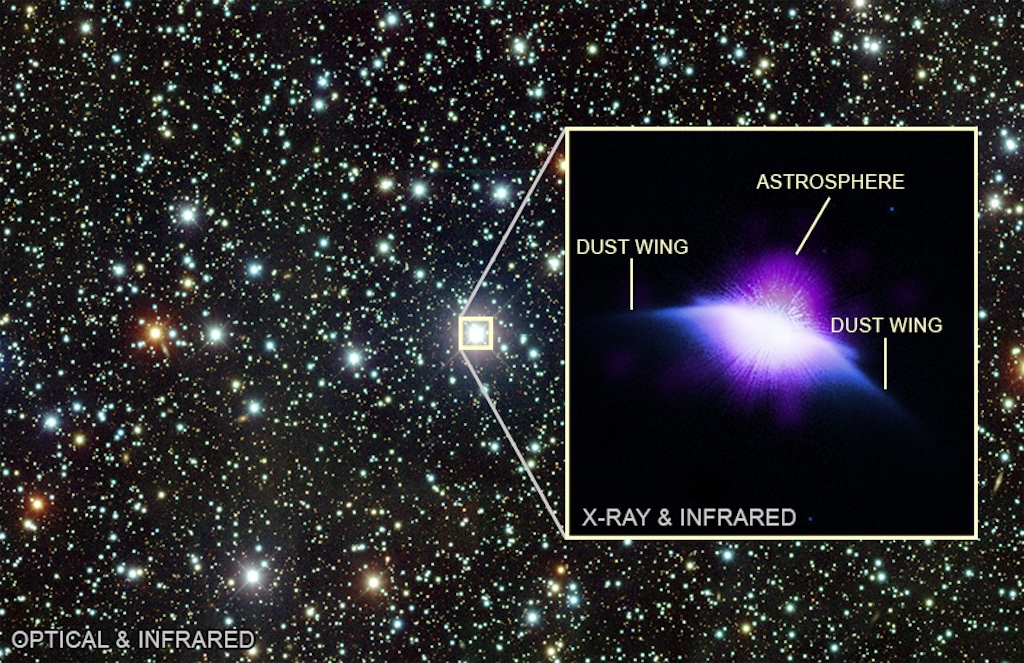
Do young stars blow bubbles? The larger view shows a stellar field observed with the Cerro Tololo Inter-American Observatory in Chile, and the inset highlights HD 61005, a star like our Sun, only 120 light-years away. Much younger than the Sun, at just about 100 million years old, it blows a fast and dense stellar wind that pushes out the cooler dust and gas that surrounds it, forming a bubble called an astrosphere. The star-blown bubble was detected with the Chandra X-ray Observatory, and it has a diameter roughly 200 times the Earth-Sun distance. Our Sun has a bubble too, called the heliosphere, which protects the planets from cosmic radiation. Also shown in the inset is debris left behind from star formation, observed by Hubble. The debris appears as wings, giving the star its nickname: the Moth.
¿Las estrellas jóvenes inflan burbujas? La vista más amplia muestra un campo estelar observado con el Observatorio Interamericano Cerro Tololo en Chile, y el recuadro resalta HD 61005, una estrella similar a nuestro Sol, ubicada a solo 120 años luz de distancia. Mucho más joven que el Sol, con apenas unos 100 millones de años, emite un viento estelar rápido y denso que empuja hacia afuera el polvo y el gas más fríos que lo rodean, formando una burbuja llamada astrosfera. La burbuja inflada por la estrella fue detectada por la Observatorio de Rayos X Chandra, y tiene un diámetro aproximadamente 200 veces la distancia Tierra-Sol. Nuestro Sol también tiene una burbuja, llamada heliosfera, que protege a los planetas de la radiación cósmica. También se muestra en el recuadro el material residual dejado tras la formación estelar, observado por Hubble. El material aparece como alas, dándole al estrella su apodo: la Mariposa.