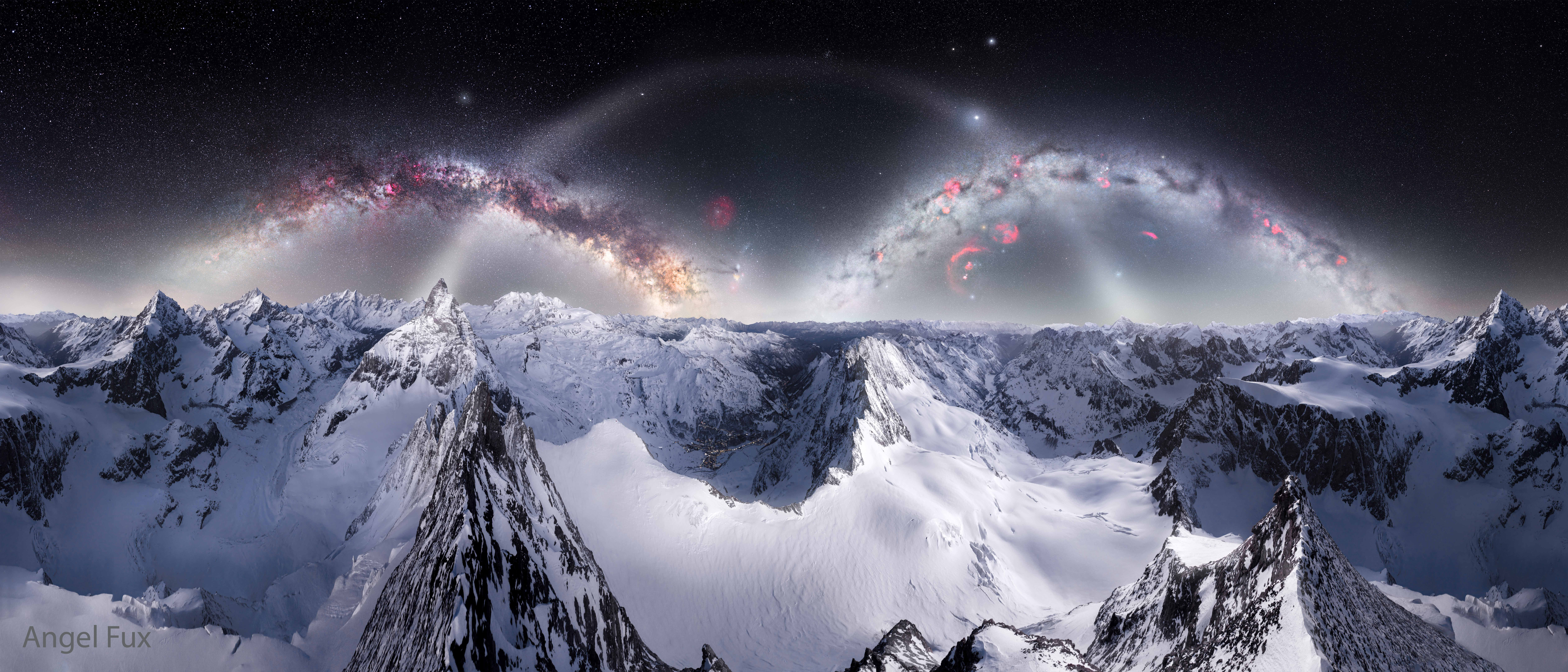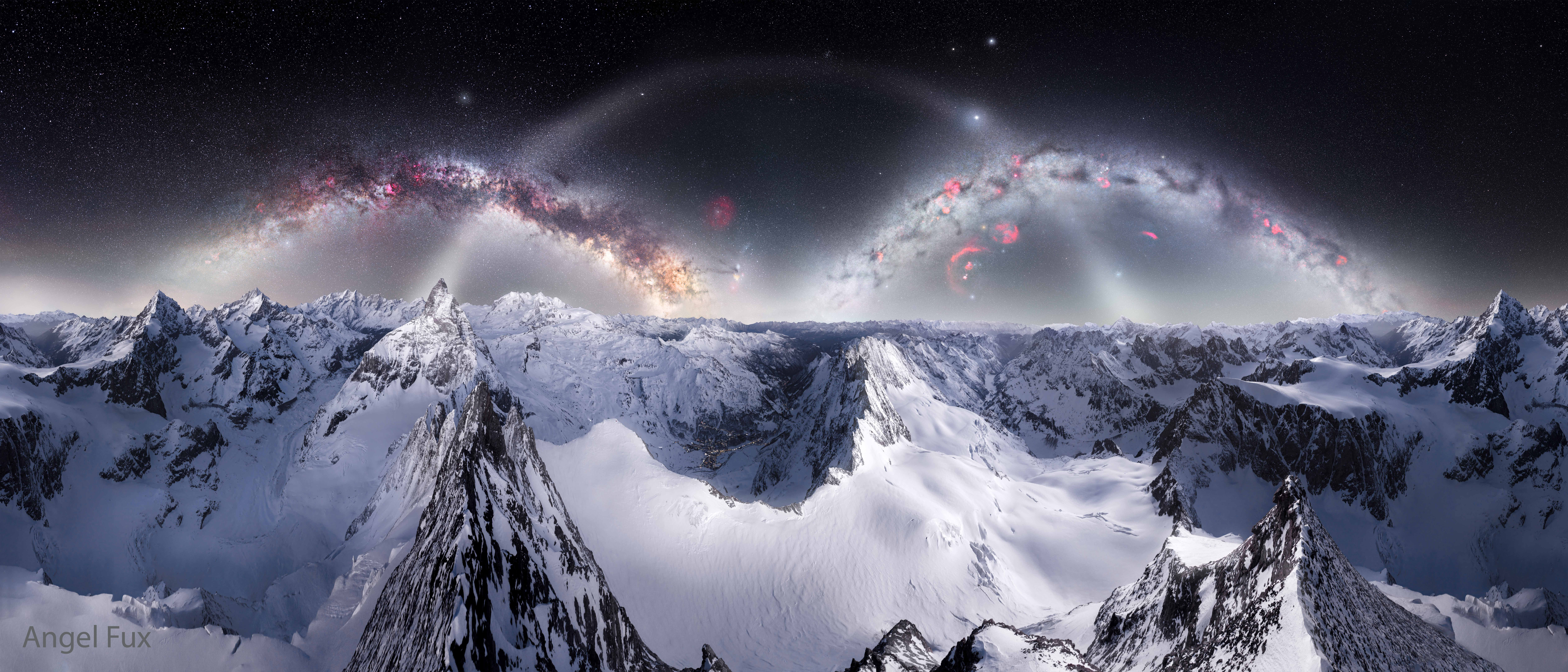
Why are there three arches across the sky instead of two? Last month, after being dropped off by a helicopter at a high mountain peak in the Alps near the Swiss Italian border, an adventurous astrophotographer expected two arches of our Milky Way galaxy to be visible during the night. These were the inner arch looking in toward the center of our galaxy on the left, visible just before sunrise, and the outer arch on the right visible just after sunset. But there were three arches. The surprised astrophotographer soon realized that the sky was so dark that an entire arc of faint zodiacal light was also noticeable -- sunlight scattered by inner Solar System dust. And it artfully connected the two Milky Way arches! The next morning a helicopter picked the astrophotographer back up, and after 40 hours of processing and combining that night's images, the featured triple-arch 360-degree panorama resulted. Jigsaw Vistas: Astronomy Puzzle of the Day
¿Por qué hay tres arcos cruzando el cielo en lugar de dos? El mes pasado, tras ser dejado por un helicóptero en una alta cima montañosa de los Alpes, cerca de la frontera entre Suiza e Italia, un aventurero astrofotógrafo esperaba poder ver dos arcos de nuestra galaxia Vía Láctea durante la noche. Estos eran el arco interior, orientado hacia el centro de nuestra galaxia, visible a la izquierda justo antes del amanecer, y el arco exterior, visible a la derecha justo después del atardecer. Sin embargo, había tres arcos. El sorprendido astrofotógrafo pronto se dio cuenta de que el cielo era tan oscuro que también podía distinguirse un arco completo de tenue luz zodiacal —luz solar dispersada por el polvo del Sistema Solar interior—. ¡Y este conectaba artísticamente los dos arcos de la Vía Láctea! A la mañana siguiente, un helicóptero recogió al astrofotógrafo, y tras 40 horas de procesado y combinación de las imágenes capturadas esa noche, se obtuvo el panorama de 360 grados con el triple arco que aquí se presenta.