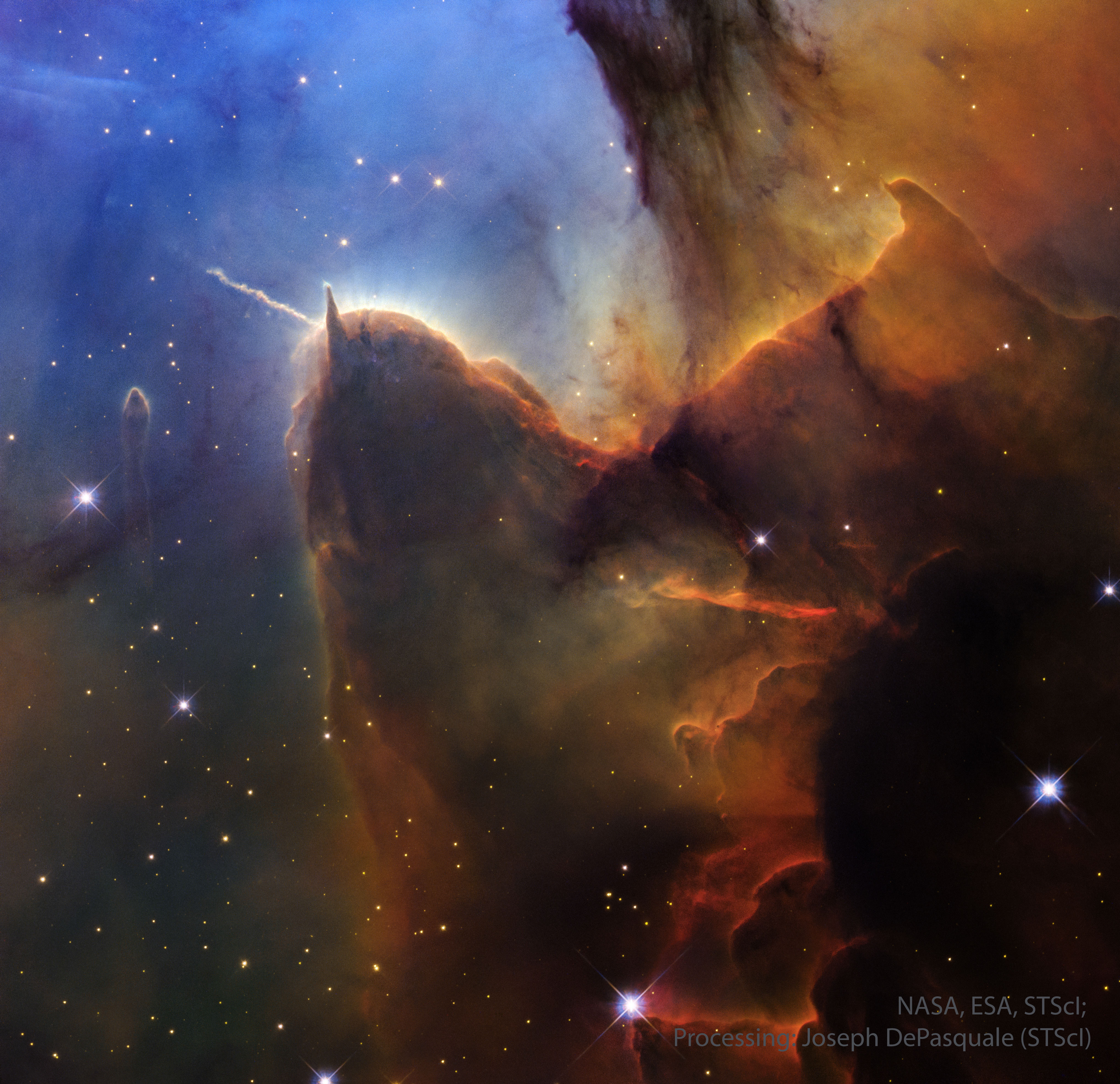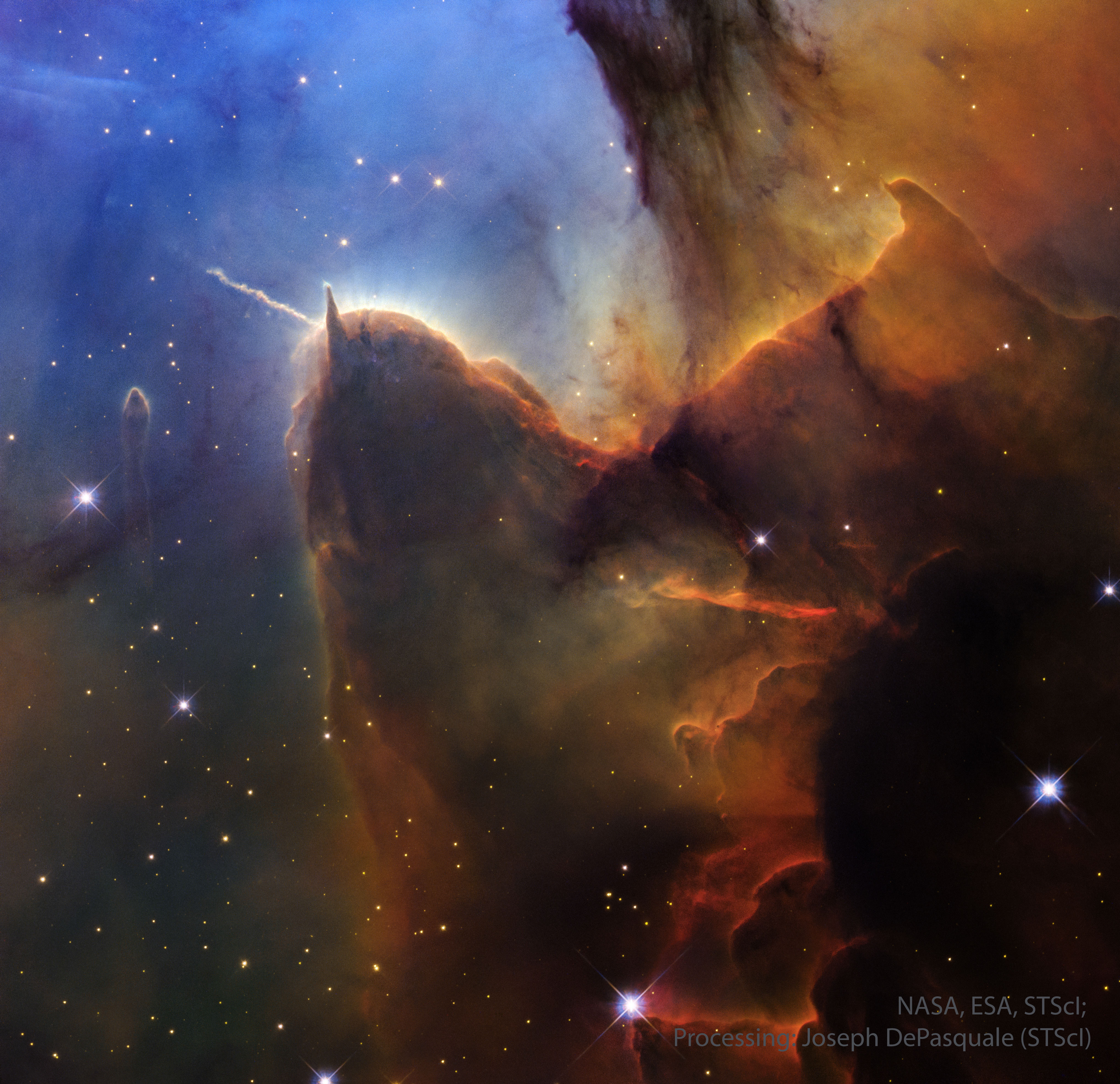
Dust pillars are like interstellar mountains. They survive because they are more dense than their surroundings, but they are slowly being eroded away by a hostile environment. Visible in the featured picture by the Hubble Space Telescope is the end of a huge gas and dust pillar in the Trifid Nebula (M20), punctuated by a smaller pillar pointing up and an unusual jet pointing to the upper left. Many of the bright dots are newly formed stars. A star near the small pillar's end is slowly being stripped of its accreting gas by radiation from a tremendously brighter star situated off the top of the image. The jet extends nearly a light-year and would not be visible without external illumination. As gas and dust evaporate from the pillars, the hidden stellar source of this jet will likely be uncovered, possibly over the next 20,000 years. Explore the Universe: Random APOD Generator
Los pilares de polvo son como montañas interestelares. Sobreviven porque son más densos que su entorno, pero están siendo erosionados lentamente por un ambiente hostil. En la imagen destacada, captada por el Telescopio Espacial Hubble, se observa el extremo de un enorme pilar de gas y polvo en la Nebulosa Trífida (M20), coronado por un pilar más pequeño que apunta hacia arriba y un inusual chorro que se dirige hacia la parte superior izquierda. Muchos de los puntos brillantes son estrellas recién formadas. Una estrella situada cerca del extremo del pilar más pequeño está siendo despojada lentamente de su gas en acreción por la radiación de una estrella considerablemente más brillante ubicada fuera del borde superior de la imagen. El chorro se extiende casi un año luz y no sería visible sin iluminación externa. A medida que el gas y el polvo se evaporan de los pilares, la fuente estelar oculta de este chorro quedará probablemente al descubierto, posiblemente en los próximos 20.000 años.