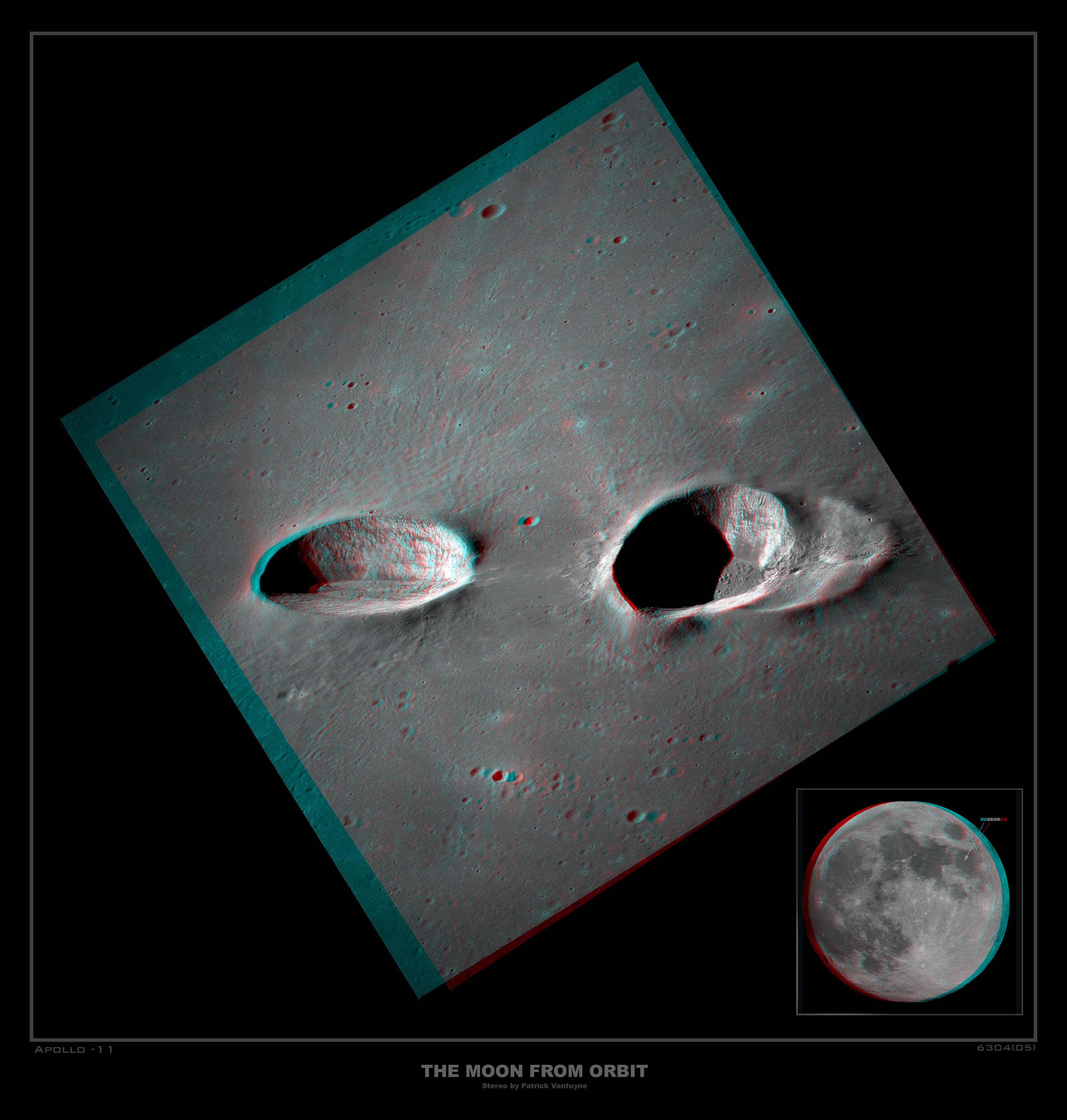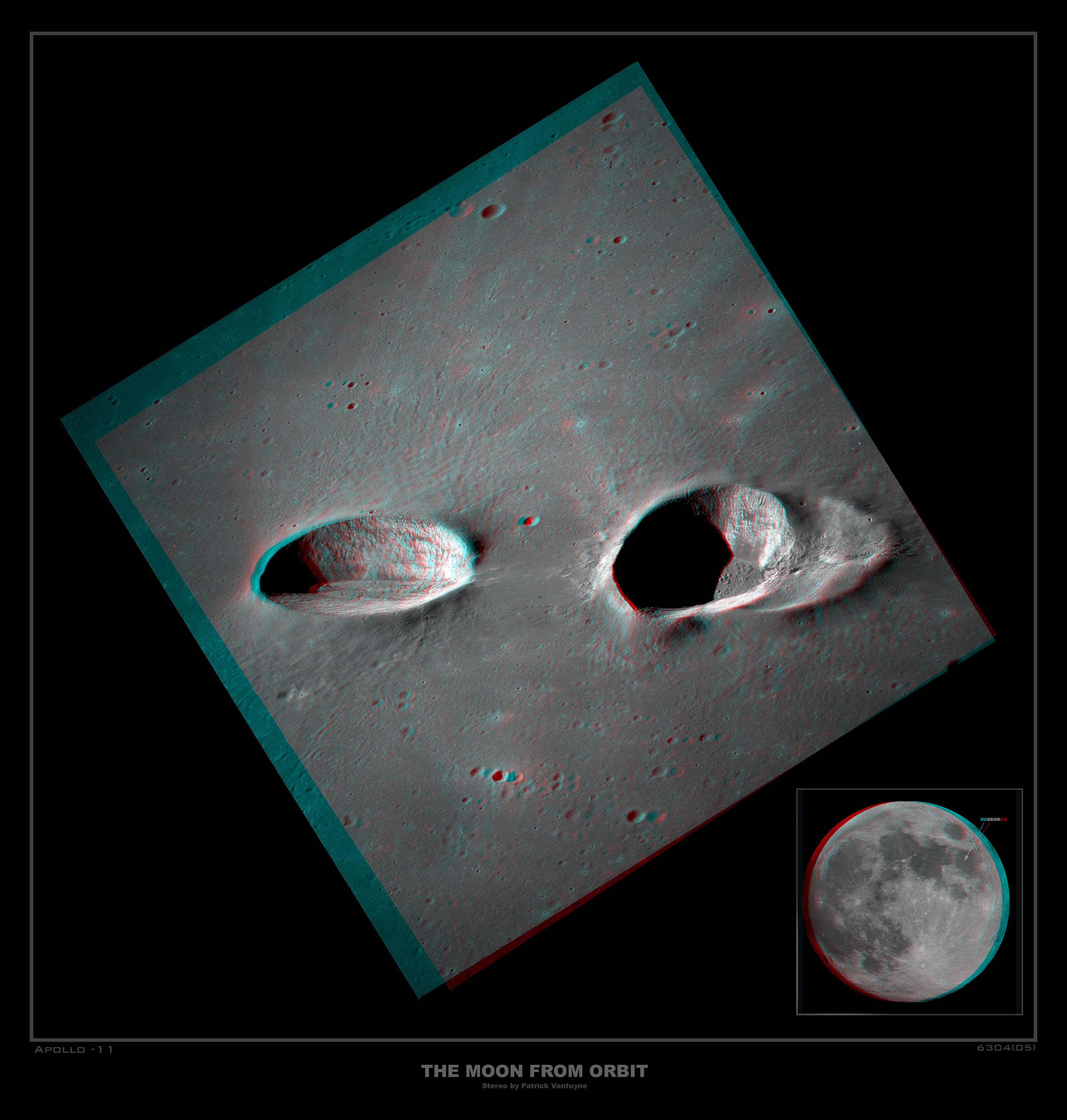
Many bright nebulae and star clusters in planet Earth's sky are associated with the name of astronomer Charles Messier from his famous 18th century catalog. His name is also given to these two large and remarkable craters on the Moon. Standouts in the dark, smooth lunar Sea of Fertility or Mare Fecunditatis, Messier (left) and Messier A have dimensions of 15 by 8 and 16 by 11 kilometers respectively. Their elongated shapes are explained by the extremely shallow-angle trajectory followed by an impactor, moving left to right, that gouged out the craters. The shallow impact also resulted in two bright rays of material extending along the surface to the right, beyond the picture. Intended to be viewed with red/blue glasses (red for the left eye), this striking stereo picture of the crater pair was recently created from high resolution scans of two images (AS11-42-6304, AS11-42-6305) taken during the Apollo 11 mission to the Moon.
Muchas nebulosas brillantes y cúmulos estelares en el cielo del planeta Tierra están asociados con el nombre del astrónomo Charles Messier, proveniente de su famoso catálogo del siglo XVIII. Su nombre también fue dado a estos dos grandes y notables cráteres en la Luna. Destacados en el oscuro y liso Mar de la Fecundidad lunar o Mare Fecunditatis, Messier (izquierda) y Messier A tienen dimensiones de 15 por 8 y 16 por 11 kilómetros respectivamente. Sus formas alargadas se explican por la trayectoria de ángulo extremadamente rasante seguida por un impactor que se desplazó de izquierda a derecha y excavó los cráteres. El impacto rasante también produjo dos rayos brillantes de material que se extienden a lo largo de la superficie hacia la derecha, más allá de los límites de la imagen. Concebida para ser vista con lentes rojo/azul (rojo para el ojo izquierdo), esta llamativa imagen estéreo del par de cráteres fue creada recientemente a partir de escaneos de alta resolución de dos imágenes (AS11-42-6304, AS11-42-6305) tomadas durante la misión Apolo 11 a la Luna.