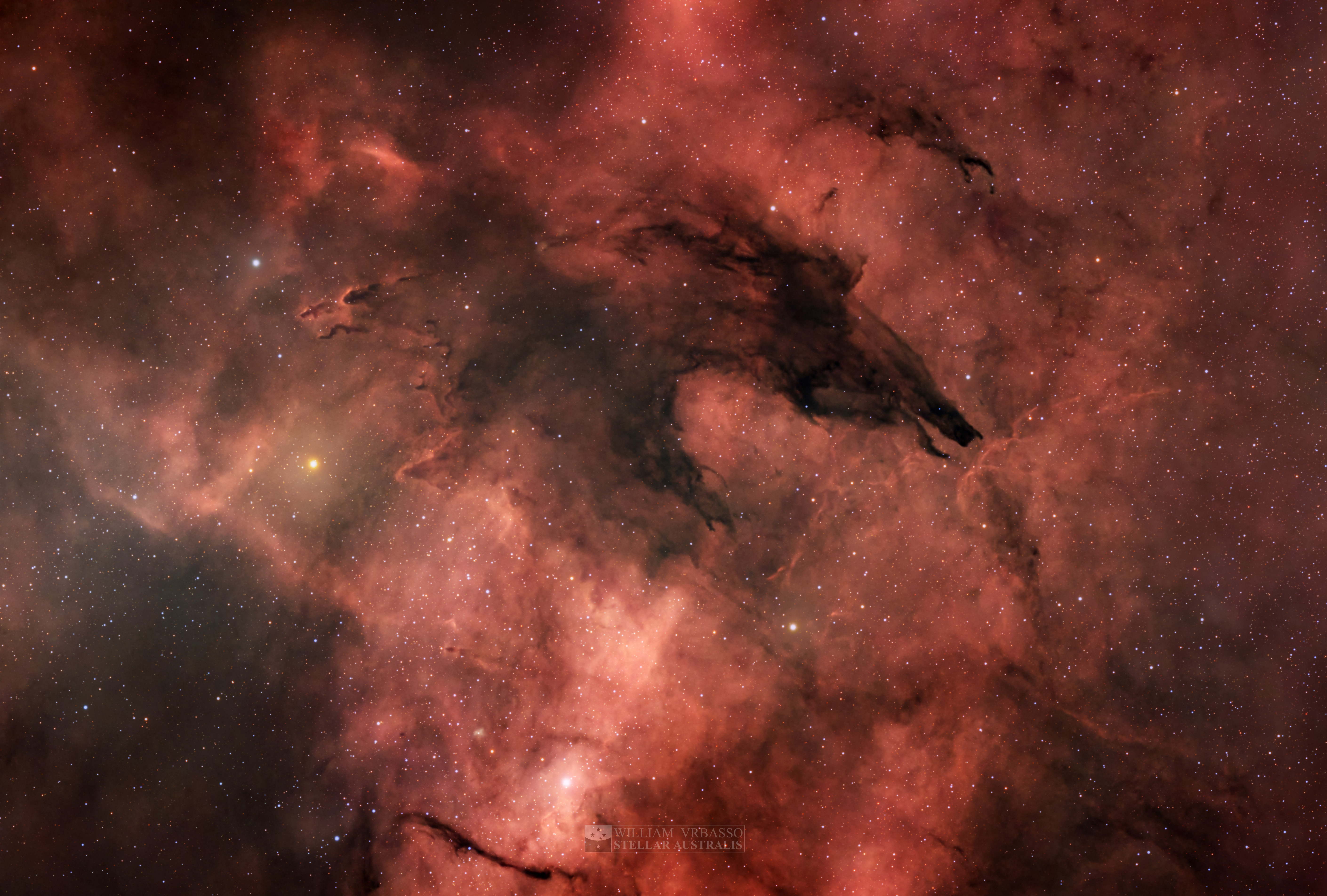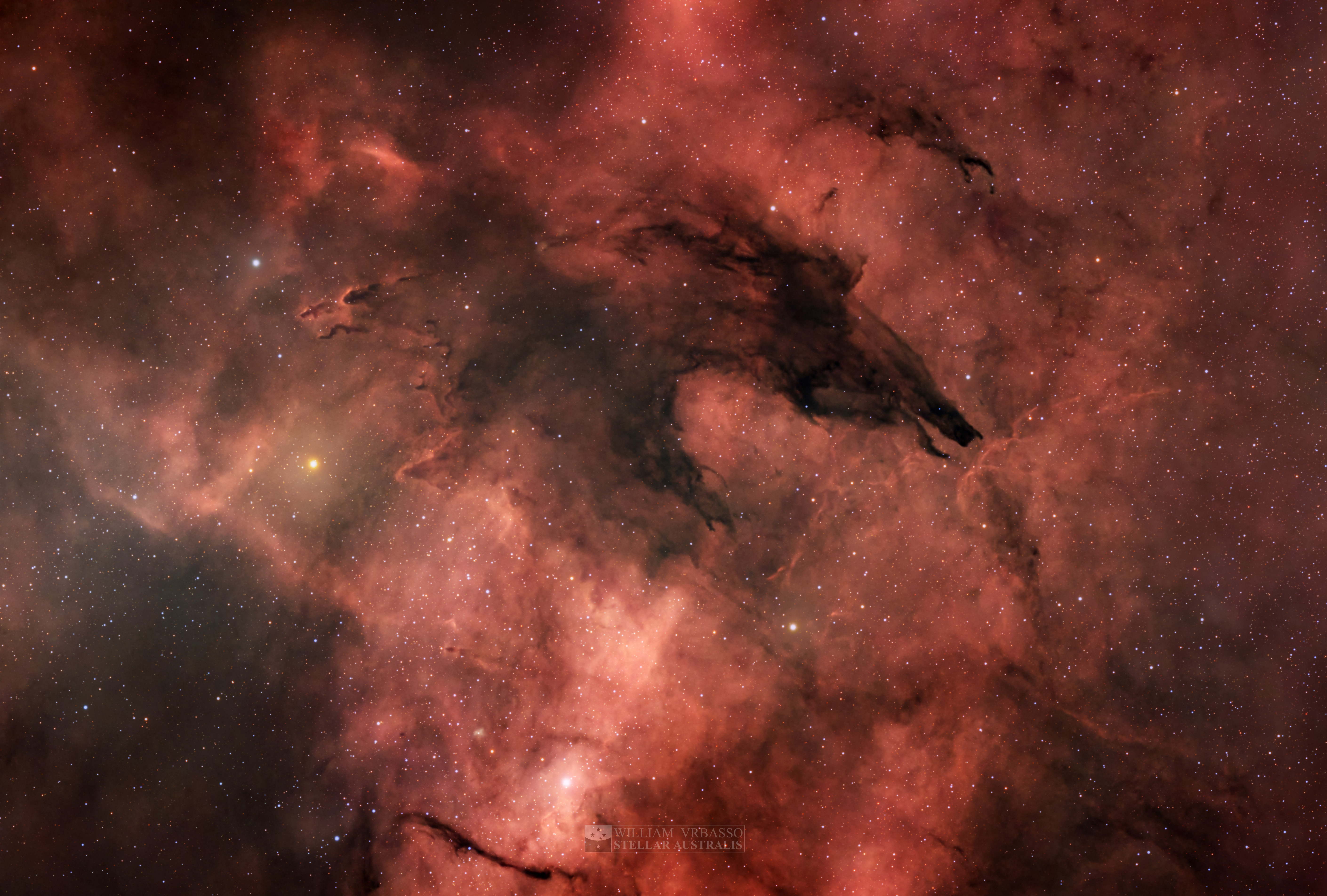
A dark wolf lies in gum. No, this isn’t a riddle! Today's image features the Dark Wolf Nebula (Sandqvist–Lindroos 17), a spooky dust cloud embedded within the Gum 55 (RCW 113) Nebula in the Scorpius constellation. While dust is a pest to us, it serves a vital role in creating the necessary conditions for stars to be born. The Dark Wolf absorbs the intense ultraviolet and visible light emitted by young stars in Gum 55 and re-emits it at longer, mainly infrared, wavelengths. This prevents the higher energy light from heating up the gas in the region. When a region of gas is cool enough, gravity takes over and causes the gas to collapse into a star. Not only does dust act as an interstellar thermostat, but it is also the meet-cute for single hydrogen atoms forming molecular hydrogen, the building block for stars. The seemingly sinister Dark Wolf is actually a harbinger of cosmic life.
Un lobo oscuro yace en el Gum. ¡No es un acertijo! La imagen de hoy presenta la Nebulosa del Lobo Oscuro (Sandqvist–Lindroos 17), una fantasmal nube de polvo inmersa en la Nebulosa Gum 55 (RCW 113), en la constelación de Escorpio. Aunque el polvo interestelar puede parecer un obstáculo, desempeña un papel fundamental al crear las condiciones necesarias para el nacimiento de las estrellas. El Lobo Oscuro absorbe la intensa luz ultravioleta y visible emitida por las jóvenes estrellas de Gum 55 y la reemite a longitudes de onda mayores, principalmente en el infrarrojo. Esto impide que la luz de mayor energía caliente el gas de la región. Cuando una región gaseosa se enfría lo suficiente, la gravedad toma el control y provoca que el gas colapse para formar una estrella. El polvo no solo actúa como un termostato interestelar, sino que también propicia el encuentro entre átomos de hidrógeno individuales para formar hidrógeno molecular, el componente fundamental de las estrellas. El aparentemente siniestro Lobo Oscuro es, en realidad, un heraldo de vida cósmica.