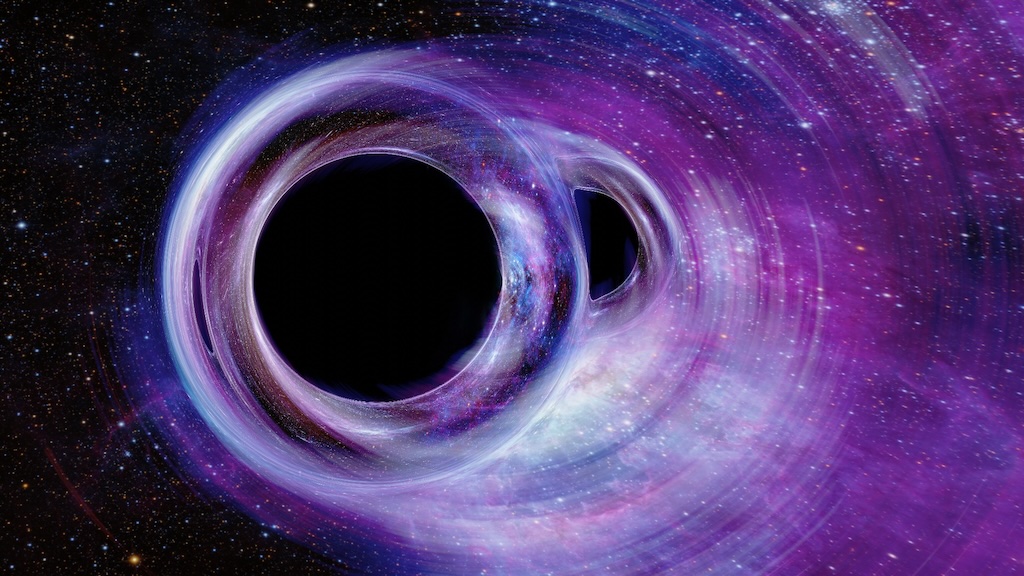
What does it feel like to zoom around a spinning supermassive black hole? The featured video is an animation showing a time-lapse of 4 years of observations of the star S301 orbiting Sagittarius A*, the 4-million-solar-mass black hole in the center of our Galaxy. S301 was discovered in 2023 with the Very Large Telescope Interferometer of the European Southern Observatory, located in the Atacama Desert in Chile. Astronomers recently found that S301 takes approximately 8.7 years to go around the black hole and reaches speeds of 25,000 km/s. It comes closer to the black hole than any other stars detected before, at a distance similar to that from Saturn to the Sun. Because it comes so close to Sagittarius A*, S301 could be used to directly measure how fast the black hole spins and test Einstein's theory of general relativity. According to the theory, a spinning black hole drags the fabric of spacetime around itself, affecting the orbits of close-by objects.
¿Cómo se siente aproximarse en órbita a un agujero negro supermasivo en rotación? El vídeo presentado es una animación que muestra un lapso de tiempo de 4 años de observaciones de la estrella S301 orbitando Sagitario A*, el agujero negro de 4 millones de masas solares ubicado en el centro de nuestra Galaxia. S301 fue descubierta en 2023 mediante el Interferómetro del Very Large Telescope del Observatorio Europeo Austral, situado en el desierto de Atacama, en Chile. Los astrónomos determinaron recientemente que S301 tarda aproximadamente 8,7 años en completar una vuelta alrededor del agujero negro y alcanza velocidades de 25 000 km/s. Se aproxima al agujero negro más que cualquier otra estrella detectada anteriormente, a una distancia similar a la que separa a Saturno del Sol. Dado que se acerca tanto a Sagitario A*, S301 podría utilizarse para medir directamente la velocidad de rotación del agujero negro y poner a prueba la teoría de la relatividad general de Einstein. Según dicha teoría, un agujero negro en rotación arrastra el tejido del espaciotiempo a su alrededor, afectando las órbitas de los objetos cercanos.