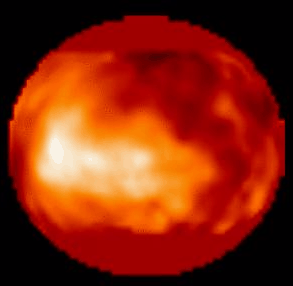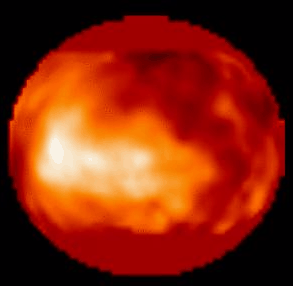
The surface of Titan, Saturn's largest moon, is normally hidden from view by its thick, hazy atmosphere. However, for the first time astronomers have been able to see surface features in images like the one above, made at near-infrared wavelengths with the Hubble Space Telescope. At these wavelengths (longer than visible light) Titan's smog like atmosphere begins to be transparent enough to allow glimpses of it's surface. The bright feature seen above is about 2,500 miles across, similar in size to Australia. Astronomers are still trying to work out what the bright and dark areas represent - oceans, continents, craters, or other features. The images represent important information for planning the Cassini mission, scheduled for launch in 1997. The Cassini spacecraft will explore the Saturn system and parachute a probe to Titan's surface.
La superficie de Titán, la luna más grande de Saturno, normalmente permanece oculta a la vista por su atmósfera espesa y brumosa. Sin embargo, por primera vez los astrónomos han podido observar características superficiales en imágenes como la mostrada arriba, obtenida en longitudes de onda del infrarrojo cercano con el Telescopio Espacial Hubble. En estas longitudes de onda (más largas que la luz visible), la atmósfera similar al smog de Titán comienza a ser lo suficientemente transparente como para permitir vislumbres de su superficie. La característica brillante observada arriba tiene aproximadamente 2,500 millas de ancho, similar en tamaño a Australia. Los astrónomos aún están tratando de determinar qué representan las áreas brillantes y oscuras: océanos, continentes, cráteres u otras características. Las imágenes representan información importante para planificar la misión Cassini, programada para su lanzamiento en 1997. La nave espacial Cassini explorará el sistema de Saturno y descenderá una sonda mediante paracaídas a la superficie de Titán.