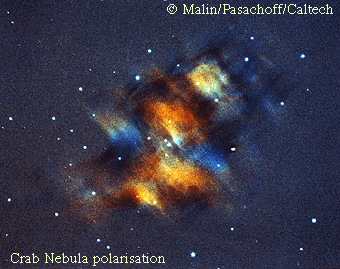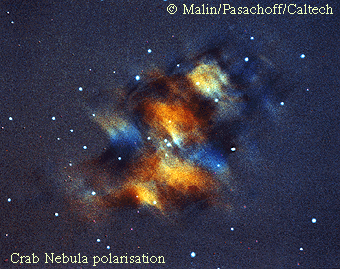
The Crab Nebula resulted from a star that exploded - a supernova. Although the stellar explosion that caused the Crab Nebula was seen over 900 years ago, the nebula itself still expands and shines. Much of the emitted light has been found to be polarized. Light waves with the same polarization vibrate in the same plane. Light waves can be polarized by reflection from a surface, an effect familiar to sunglass wearing fishermen and skiers. Polarized light can also be emitted by regions that contain strong magnetic fields. Areas of different polarization above are highlighted by different colors. Mapping the polarization helps astronomers decipher which physical processes create the observed light.
La Nebulosa del Cangrejo resultó de una estrella que explotó: una supernova. Aunque la explosión estelar que causó la Nebulosa del Cangrejo fue observada hace más de 900 años, la nebulosa misma aún se expande y brilla. Se ha descubierto que gran parte de la luz emitida está polarizada. Las ondas de luz con la misma polarización vibran en el mismo plano. Las ondas de luz pueden polarizarse por reflexión en una superficie, un efecto familiar para los pescadores y esquiadores que usan gafas de sol. La luz polarizada también puede ser emitida por regiones que contienen campos magnéticos intensos. Las áreas de diferente polarización se destacan arriba mediante diferentes colores. Mapear la polarización ayuda a los astrónomos a descifrar qué procesos físicos crean la luz observada.