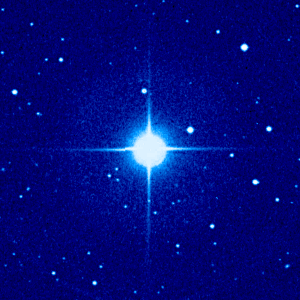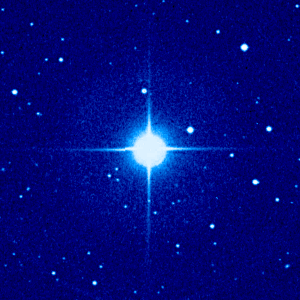
Are we alone in the universe? Do other stars have planets too? Humanity took one step closer to answering these questions in October 1995 when it was announced that the star 51 Pegasi harbors at least one planet. In the above picture of 51 Peg the planet is not visible - it can only be detected by noticing small changes in the star's motion. Claims of planets orbiting other stars are rare, with perhaps the most credible pertaining to a neutron star - a star much different than the Sun. But new ground was broken when the planetary detection claimed around the normal Sun-like star 51 Peg was confirmed. The planet, discovered by Michel Mayor and Didier Queloz, is thought to be like Jupiter - except orbiting so close to the parent star that it's year lasts only about 4 days! In the above picture the lines centered on 51 Peg are caused by the telescope itself and are not related to the star or planet.
¿Estamos solos en el universo? ¿Tienen otras estrellas planetas también? La humanidad dio un paso más cerca de responder estas preguntas en octubre de 1995 cuando se anunció que la estrella 51 Pegasi alberga al menos un planeta. En la imagen superior de 51 Peg el planeta no es visible - solo puede detectarse al notar pequeños cambios en el movimiento de la estrella. Las afirmaciones de planetas orbitando otras estrellas son raras, siendo quizás la más creíble la que pertenece a una estrella de neutrones - una estrella muy diferente al Sol. Pero se abrió un nuevo camino cuando se confirmó la detección planetaria reclamada alrededor de la estrella normal similar al Sol 51 Peg. El planeta, descubierto por Michel Mayor y Didier Queloz, se cree que es como Júpiter - excepto que orbita tan cerca de la estrella madre que su año dura solo unos 4 días. En la imagen superior las líneas centradas en 51 Peg son causadas por el telescopio mismo y no están relacionadas con la estrella o el planeta.