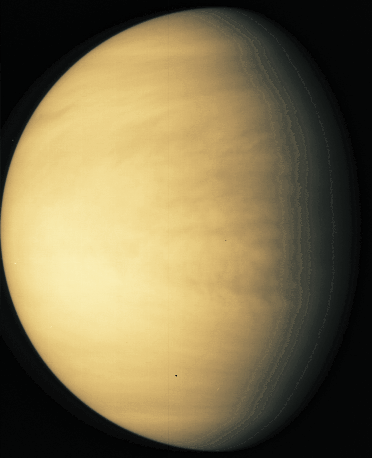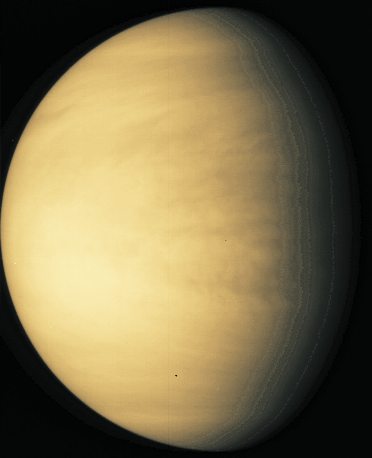
If Venus weren't so cloudy it would be more similar to Earth. This picture by the Galileo spacecraft shows just how cloudy Venus is. Venus is very similar to Earth in size and mass - and so is sometimes referred to as Earth's sister planet - but Venus has a quite different climate. Venus' thick clouds and closeness to the Sun (only Mercury is closer) make it the hottest planet - much hotter than the Earth. Humans could not survive there, and no life of any sort has ever been found. When Venus is visible it is usually the brightest object in the sky after the Sun and the Moon. More than 20 spacecraft have visited Venus including Venera 9, which landed on the surface, and Magellan, which used radar to peer through the clouds and make a map of the surface. This visible light picture of Venus was taken by the Galileo spacecraft now in orbit around Jupiter. Many things about Venus remain unknown, including the cause of mysterious bursts of radio waves.
Si Venus no estuviera tan nublado, sería más similar a la Tierra. Esta imagen de la nave espacial Galileo muestra cuán nublado es Venus. Venus es muy similar a la Tierra en tamaño y masa, por lo que a veces se le denomina el planeta hermano de la Tierra, aunque Venus tiene un clima muy diferente. Las densas nubes de Venus y su cercanía al Sol (solo Mercurio está más cerca) lo convierten en el planeta más caliente, mucho más caliente que la Tierra. Los seres humanos no podrían sobrevivir allí, y nunca se ha encontrado ningún tipo de vida. Cuando Venus es visible, suele ser el objeto más brillante del cielo después del Sol y la Luna. Más de 20 naves espaciales han visitado Venus, entre ellas la Venera 9, que aterrizó en la superficie, y la Magellan, que utilizó radar para penetrar a través de las nubes y elaborar un mapa de la superficie. Esta imagen de Venus en luz visible fue tomada por la nave espacial Galileo, actualmente en órbita alrededor de Júpiter. Muchos aspectos de Venus permanecen desconocidos, incluida la causa de misteriosas ráfagas de ondas de radio.