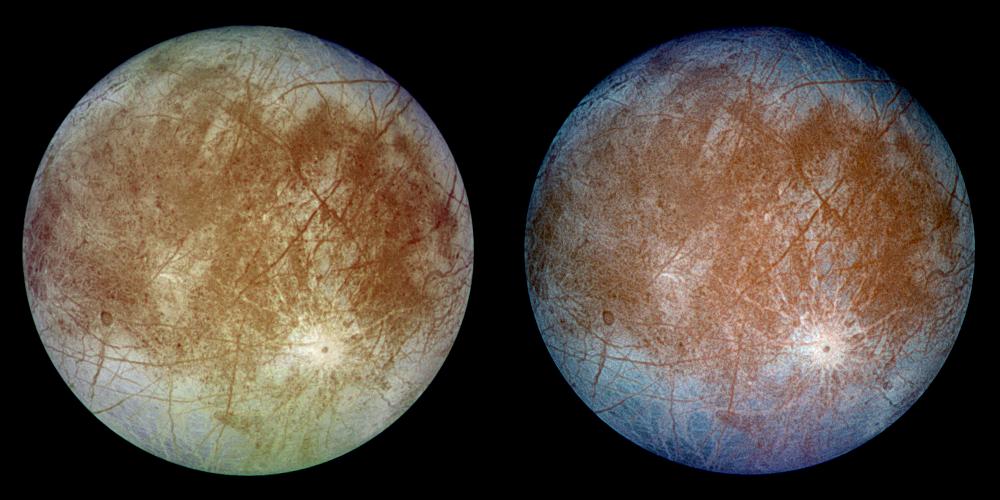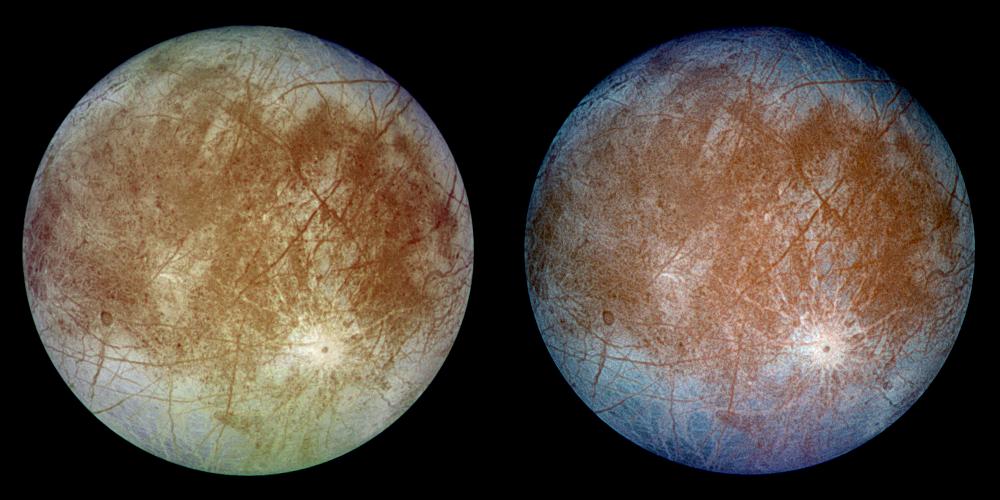
What mysteries might be solved by peering into this crystal ball? This crystal ball is quite unusual because it is actually a moon of Jupiter, the crystals are ice-crystals, and the ball is not only dirty and opaque but cracked beyond repair. Nevertheless, speculation is rampant that oceans exist under these tortured ice-plains that could support life. Europa, the smallest of Jupiter's Galilean moons, was photographed last month in natural color by the robot spacecraft Galileo, now in orbit around Jupiter. The brown patches are what one might think: dirt -- tainting an otherwise white ice-crust. Europa, nearly the same size as Earth's Moon, similarly keeps one face toward its home planet. The hemisphere of Europa shown above is the one that always trails. Why is Europa's surface the smoothest in the Solar System? Where are Europa's craters?
¿Qué misterios podrían resolverse al escudriñar esta bola de cristal? Esta bola de cristal es bastante inusual porque en realidad es una luna de Júpiter, los cristales son cristales de hielo, y la bola no solo está sucia y opaca, sino agrietada más allá de toda reparación. Sin embargo, abundan las especulaciones sobre la existencia de océanos bajo estas torturadas llanuras de hielo que podrían albergar vida. Europa, la menor de las lunas galileanas de Júpiter, fue fotografiada el mes pasado en color natural por la nave espacial robótica Galileo, actualmente en órbita alrededor de Júpiter. Las manchas marrones son lo que uno podría imaginar: suciedad, que tiñe una corteza de hielo que de otro modo sería blanca. Europa, de tamaño casi idéntico al de la Luna de la Tierra, mantiene igualmente una de sus caras orientada hacia su planeta anfitrión. El hemisferio de Europa que se muestra arriba es el que siempre queda en la dirección de retaguardia. ¿Por qué la superficie de Europa es la más suave del Sistema Solar? ¿Dónde están los cráteres de Europa?