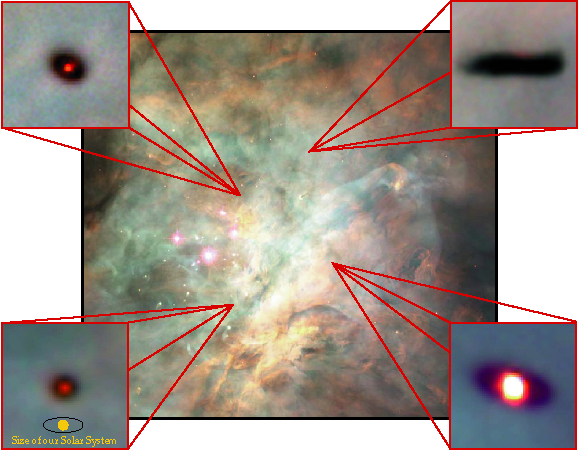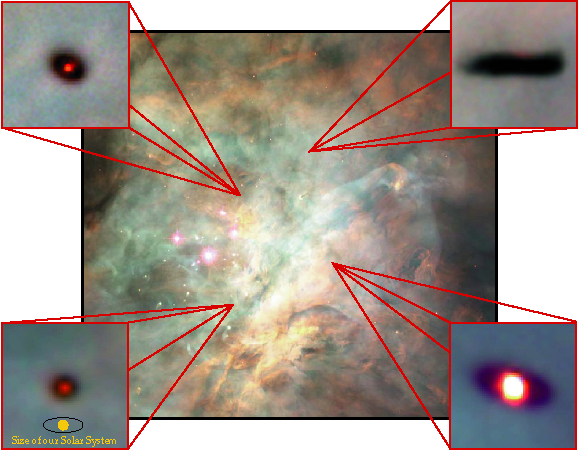
How do planets form? Astronomers are finding out by studying one of the most interesting of all astronomical nebulae known, the Great Nebula in Orion. Insets to above mosaic show several planetary systems in formation. The bottom left insert shows the relative size of our own Solar System. The Orion Nebula contains many stellar nurseries. These nurseries contain hydrogen gas, hot young stars, proplyds, and stellar jets spewing material at high speeds. Much of the filamentary structure visible in this image are actually shock waves - fronts where fast moving material encounters slow moving gas. Some shock waves are visible near one of the bright stars in the lower left of the picture. The Orion Nebula is located in the same spiral arm of our Galaxy as is our Sun.
¿Cómo se forman los planetas? Los astrónomos están descubriendo la respuesta estudiando una de las nebulosas astronómicas más interesantes que se conocen: la Gran Nebulosa de Orión. Los recuadros del mosaico superior muestran varios sistemas planetarios en proceso de formación. El recuadro inferior izquierdo muestra el tamaño relativo de nuestro propio Sistema Solar. La Nebulosa de Orión contiene numerosas guarderías estelares. Estas guarderías contienen gas hidrógeno, jóvenes estrellas calientes, proplyds y chorros estelares que expulsan material a grandes velocidades. Gran parte de la estructura filamentaria visible en esta imagen corresponde en realidad a ondas de choque: frentes donde el material en rápido movimiento se encuentra con gas de movimiento lento. Algunas ondas de choque son visibles cerca de una de las estrellas brillantes en la parte inferior izquierda de la imagen. La Nebulosa de Orión se encuentra en el mismo brazo espiral de nuestra Galaxia que nuestro Sol.