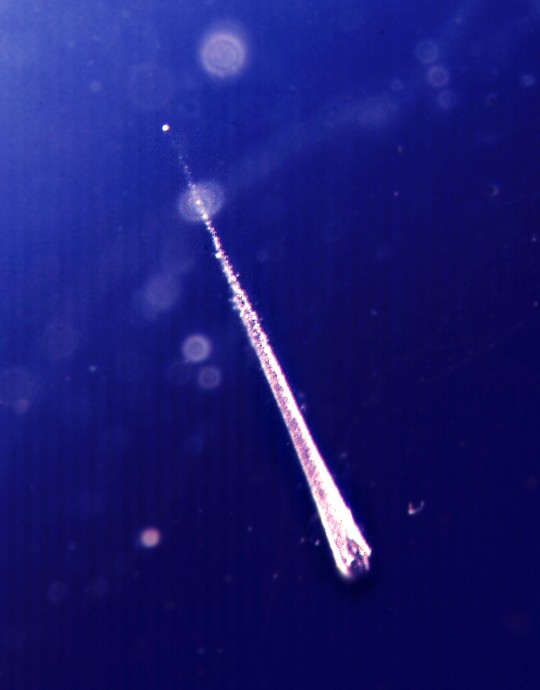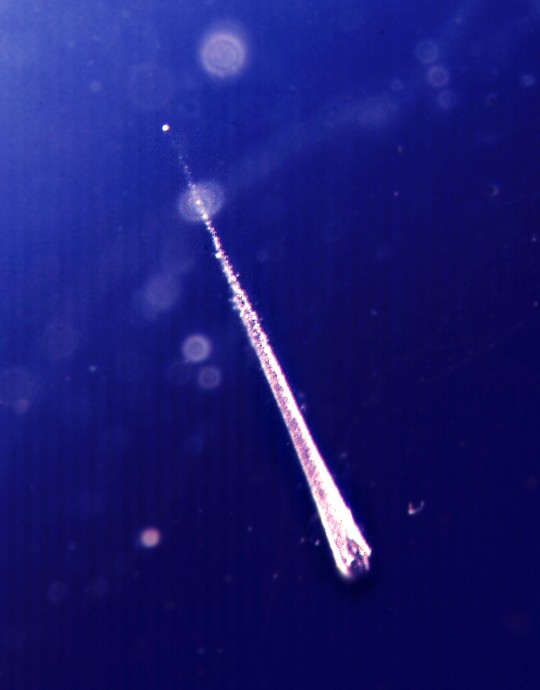
This carrot shaped track is actually little more than 5 hundredths of an inch long. It is the trail of a meteroid through aerogel exposed to space by the shuttle launched EURECA (European Recoverable Carrier) spacecraft. The meteoroid itself, about a thousandth of an inch in diameter, is visible where it came to rest, just beyond the tip of the carrot (far right). Chemical analyses of interplanetary dust particles similar to this one suggest that some of them may be bits of comets and represent samples of material from the early stages of the formation of the Solar System. NASA's Stardust mission, planned for launch in 1999, will attempt to directly collect dust from the tail of a comet and return it to Earth -- the first non-lunar sample return mission ever! In addition to peering into the chemistry and history of the solar system, the composition of cometary dust has important implications for the possibility of past life on Mars.
Esta huella con forma de zanahoria tiene en realidad poco más de cinco centésimas de pulgada de longitud. Es el rastro de un meteoroide a través de aerogel expuesto al espacio por la nave espacial EURECA (European Recoverable Carrier), lanzada desde el transbordador espacial. El meteoroide en sí, de aproximadamente una milésima de pulgada de diámetro, es visible en el punto donde se detuvo, justo más allá del extremo de la zanahoria (extremo derecho). Los análisis químicos de partículas de polvo interplanetario similares a esta sugieren que algunas de ellas podrían ser fragmentos de cometas y representar muestras de material de las primeras etapas de la formación del Sistema Solar. La misión Stardust de la NASA, cuyo lanzamiento estaba previsto para 1999, intentará recolectar directamente polvo de la cola de un cometa y devolverlo a la Tierra, ¡la primera misión de retorno de muestras no lunares de la historia! Además de explorar la química y la historia del sistema solar, la composición del polvo cometario tiene importantes implicaciones para la posibilidad de que haya existido vida en el pasado en Marte.