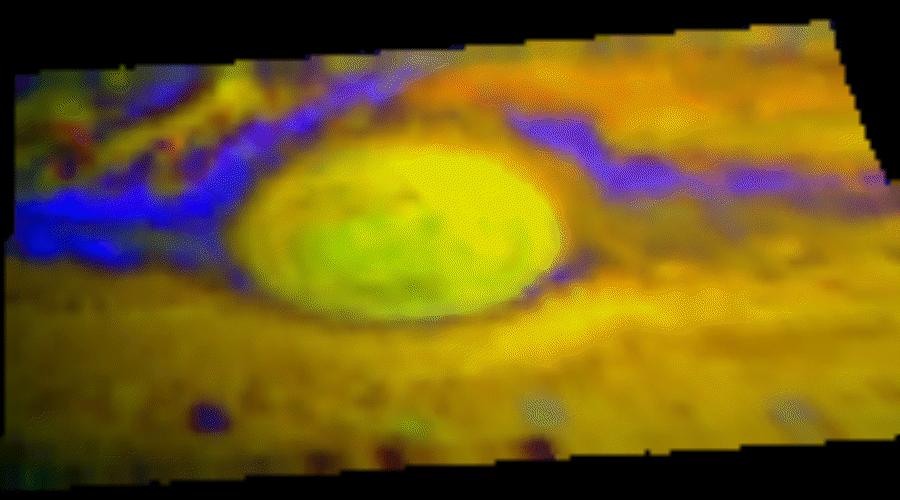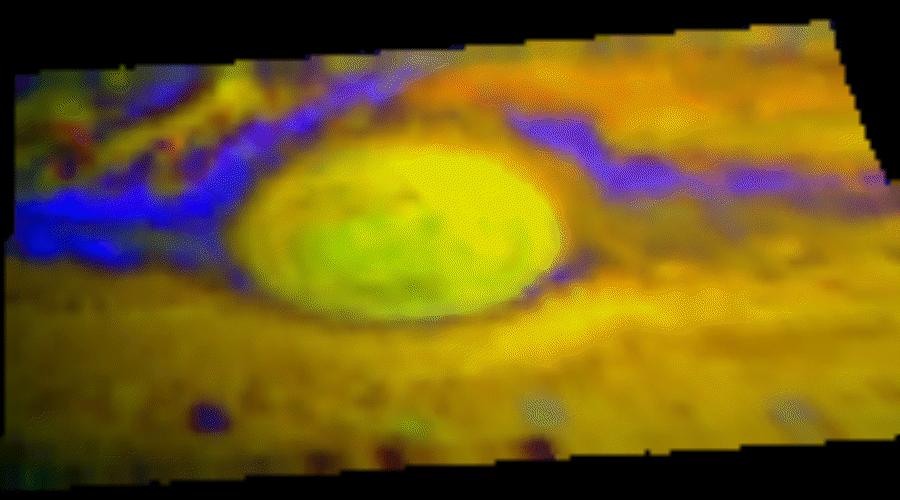
What happened to Jupiter's Great Red Spot? Operating at a chilly 55 degrees Kelvin, the Galileo Spacecraft's Near Infrared Mapping Spectrometer (NIMS) recorded this composite image of Jupiter's Great Red Spot in late June 1996. Red, green, and blue colors were chosen to represent three different infrared wavelengths detected by the NIMS instrument. The resulting yellowish green appearance of the massive Jovian storm system - a cold, high pressure area 2 to 3 Earth diameters wide - indicates that it lies high above the surrounding cloud features. Blue corresponds to regions where the clouds are relatively thin and the features lie at greater depths.
¿Qué le ocurrió a la Gran Mancha Roja de Júpiter? Operando a la fría temperatura de 55 grados Kelvin, el Espectrómetro de Mapeo en Infrarrojo Cercano (NIMS, por sus siglas en inglés) de la sonda espacial Galileo registró esta imagen compuesta de la Gran Mancha Roja de Júpiter a finales de junio de 1996. Los colores rojo, verde y azul fueron seleccionados para representar tres longitudes de onda infrarrojas distintas detectadas por el instrumento NIMS. La apariencia amarillo-verdosa resultante del masivo sistema de tormenta joviano —una zona fría de alta presión con un diámetro de entre 2 y 3 veces el de la Tierra— indica que se encuentra a gran altitud por encima de las formaciones de nubes circundantes. El color azul corresponde a las regiones donde las nubes son relativamente delgadas y las estructuras se sitúan a mayores profundidades.